Securing MAVLink in Connected Robotic & UAV Environments.
Zero-trust architecture for a protocol designed for serial links & now operating over WiFi, cellular, and satellite.
Zuletzt aktualisiert:
A Protocol That Outlived Its Link Model
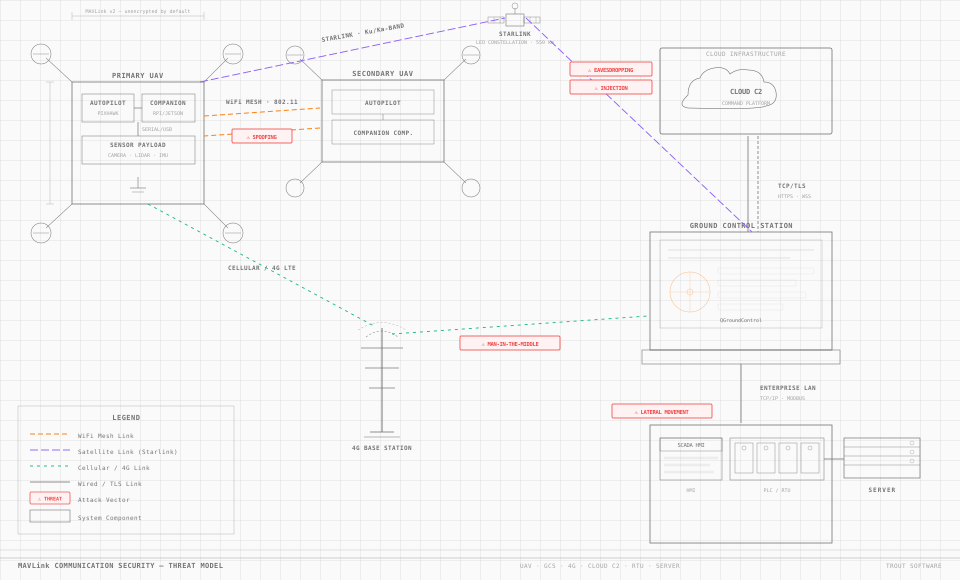
MAVLink was designed in 2009 for point-to-point serial connections between a single autopilot and a ground station. It assumed a trusted, physically isolated link. That assumption collapses when UAVs communicate over WiFi, 4G, and satellite: links that traverse public infrastructure.
Cleartext Telemetry. Cleartext Commands.
MAVLink v1 and v2 transmit GPS coordinates, altitude, heading, battery state, and control commands in plaintext. Any device on the radio link or network path can read every packet. Message signing in v2 authenticates the payload, but does not encrypt it.
Shared Secrets Without Rotation
MAVLink v2 signing uses a single shared passphrase across all participants. There is no key rotation mechanism, no forward secrecy, no per-session keys. Compromise of one node exposes the signing capability for the entire fleet.
Command Injection with Commodity Hardware
Die Einstiegshürde ist niedrig und asymmetrisch. Ein reines Empfangs-SDR für etwa 30 $ (ein RTL-SDR) genügt, um Klartext-Telemetrie abzuhören und GPS-, Kurs- und Missionsdaten aus der Luft mitzulesen. Das Einschleusen von Befehlen erfordert mehr: ein sendefähiges SDR wie ein HackRF oder bladeRF, ungefähr ab 150 $. Doch sobald ein Angreifer senden kann, sind SET_MODE, DO_SET_HOME und MISSION_ITEM legitime Protokollbefehle, die keinen Exploit benötigen, und der Autopilot hat keine Möglichkeit, einen autorisierten Sender von einem unautorisierten zu unterscheiden.
Four Categories of MAVLink Attack.
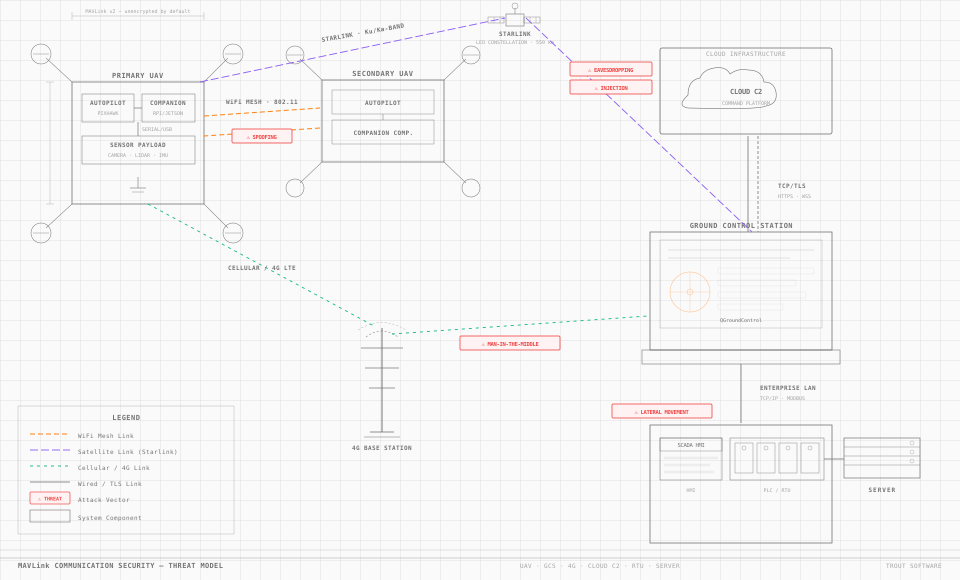
MAVLink threats span confidentiality, integrity, availability, and safety. Each category exploits the protocol's native trust model, and each has direct physical consequences when the target is an airborne vehicle.
Confidentiality
Telemetry broadcasts GPS position, altitude, heading, and sensor data in cleartext. An attacker can track vehicle location, infer mission objectives, and intercept sensor feeds without transmitting a single packet.
Integrity
Forged MAVLink packets can alter waypoints, change flight modes, or override geofence boundaries. GPS spoofing via replayed GLOBAL_POSITION_INT messages can divert vehicles to unauthorized locations.
Availability
Flooding the MAVLink serial bus or radio channel with high-rate messages causes message drops and communication timeouts. The vehicle enters failsafe mode, potentially triggering an uncontrolled landing in hostile terrain.
Safety
PARAM_SET commands can modify altitude limits, maximum velocity, or battery failsafe thresholds. These changes persist across reboots. A compromised parameter set can cause a vehicle to operate outside its safe flight envelope.
Zero-Trust Overlay for MAVLink.
Encrypt. Authenticate. Authorize.
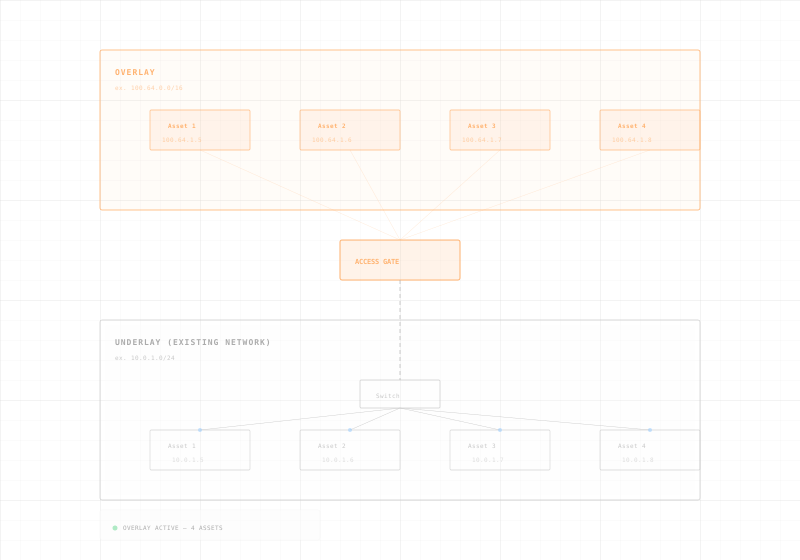
A WireGuard agent on each vehicle's companion computer establishes an encrypted tunnel to the Access Gate. MAVLink traffic is encapsulated before it reaches the radio link. The autopilot continues to speak standard MAVLink over its local serial connection. No firmware changes, no protocol modifications.
The Access Gate terminates the tunnel, verifies the vehicle's cryptographic identity, applies command authorization policies, and logs every message. Only authorized commands reach the ground control station or cloud C2 platform.
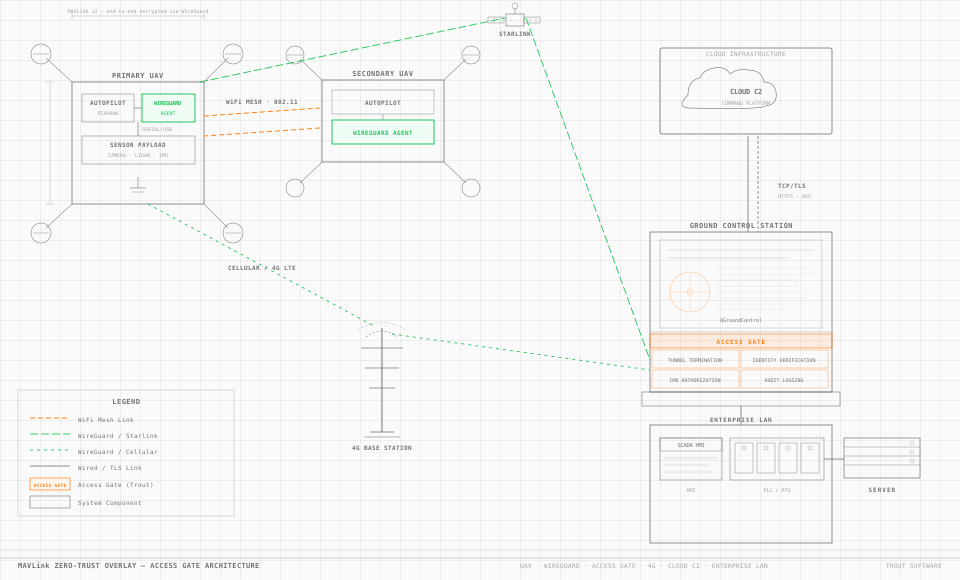
Vehicle Identity
Each UAV holds a unique cryptographic identity (WireGuard keypair). No shared secrets, no passphrase-based signing. Compromise of one vehicle does not affect the fleet.
Continuous Verification
Every MAVLink message traverses the encrypted tunnel. The Access Gate verifies the source identity on every packet, not just at session establishment.
Micro-Segmentation
Each vehicle communicates only with its authorized ground station or C2 endpoint. Lateral movement between vehicles is blocked by default. Fleet-wide compromise requires compromising every tunnel independently.
End-to-End Encryption
WireGuard provides authenticated encryption (ChaCha20-Poly1305) with perfect forward secrecy. Telemetry, commands, and sensor data are encrypted from companion computer to Access Gate.
Full Audit Trail
Every MAVLink command, telemetry message, and parameter change is logged with vehicle identity and timestamp. Complete forensic reconstruction after any incident.
Download the Full MAVLink Security Guide.
Get the complete 31-page guide: MAVLink protocol architecture, threat taxonomy, cryptographic remediation approaches, zero-trust overlay design, implementation roadmap, and regulatory compliance mapping.
What You'll Learn
Why MAVLink has no native encryption and why message signing is insufficient. How the four attack categories, eavesdropping, injection, denial of service, and parameter manipulation, translate to physical consequences. How a WireGuard overlay provides end-to-end encryption without modifying autopilot firmware.
Deploy With Access Gate
Access Gate implements the zero-trust overlay as a single on-premise appliance. WireGuard tunnel termination, vehicle identity verification, command authorization, and full audit logging. No changes to autopilots, no cloud dependency, works over any link type.
Common Questions About Securing MAVLink.
Zero-trust pillars: vehicle identity, continuous verification, micro-segmentation, end-to-end encryption, and full audit. Applied without modifying a single autopilot.
MAVLink was designed for direct serial connections between an autopilot and a ground station. It transmits system IDs, component IDs, and command payloads in cleartext with no authentication. MAVLink v2 added optional message signing, but it uses a shared secret with no key rotation, no forward secrecy, and no encryption of the payload itself. Any device that knows the passphrase can sign messages.
The four primary categories are: confidentiality attacks (passive eavesdropping on telemetry, GPS coordinates, and sensor feeds), integrity attacks (command injection and GPS spoofing using forged MAVLink packets), availability attacks (flooding the serial bus or radio link to cause denial of service), and safety attacks (manipulating flight parameters like altitude limits or geofence boundaries to cause physical harm).
Yes. A WireGuard agent running on the companion computer (Raspberry Pi, Jetson) establishes an encrypted tunnel to the Access Gate. MAVLink traffic is encapsulated inside this tunnel before it leaves the vehicle. The autopilot continues to speak standard MAVLink over its serial connection to the companion computer. No firmware changes required.
WireGuard fügt pro Paket einen geringen Overhead hinzu, in der Größenordnung von 1 bis 3 ms auf einem typischen Companion-Computer (Raspberry-Pi- oder Jetson-Klasse), niedrig genug, dass er bei üblichen MAVLink-Telemetrieraten von 1 bis 10 Hz bequem im Rahmen bleibt. Messen Sie die genau hinzukommende Latenz und den Jitter auf Ihrer eigenen Flugzelle, statt sie anzunehmen. In jedem Fall bleibt die Echtzeitsteuerung, die ein Timing im Submillisekundenbereich benötigt, auf dem lokalen seriellen Bus zwischen Autopilot und Companion-Computer; nur die Langstreckenverbindung ist verschlüsselt, sodass die Flugschleife nie auf den Tunnel wartet.
Yes. FAA BVLOS waivers increasingly require demonstration of command-and-control link security. CMMC Level 2 requires encryption of CUI in transit, telemetry from defense-related UAV operations qualifies. NIS2 mandates network security and incident detection for essential services. The zero-trust overlay provides encryption, identity verification, command authorization, and full audit logging across all three frameworks.