
Understanding Failover in Mission-Critical OT Networks
OT network downtime can cost thousands to millions of dollars per hour, depending on the industry. In safety-critical environments like energy, water treatment, or chemical processing, a network failure can also endanger personnel and equipment. Failover strategies ensure that when a primary system, link, or path goes down, a standby takes over fast enough to prevent process interruption. This article covers active-active, active-passive, and geo-redundant failover configurations for mission-critical OT networks, with guidance on design, testing, and compliance alignment.
The Importance of High Availability in OT Networks
Why Mission-Critical OT Networks Require High Availability
Mission-critical OT networks support essential industrial processes, from manufacturing and energy production to transportation and water management. These networks control physical systems where failures can lead to catastrophic outcomes, including safety hazards and substantial financial losses. Hence, achieving high availability is not merely a technical goal but a business necessity.
The Cost of Downtime
The consequences of downtime in OT environments are severe. According to industry studies, the cost can range from thousands to millions of dollars per hour, depending on the industry and scale of operations. This underscores the need for effective failover strategies to maintain operational continuity.
Key Concepts in Failover Strategies
Understanding Failover Mechanisms
Failover refers to the process of switching to a standby network component, system, or process when the primary one fails. In the context of OT networks, this often involves seamless transition mechanisms to prevent service disruption.
Types of Failover Configurations
- Active-Active Failover: All nodes or systems are active and share the load. If one fails, the others continue to handle the workload.
- Active-Passive Failover: A secondary system remains on standby and takes over if the primary system fails.
- Geo-Redundant Failover: Systems are duplicated across geographically dispersed locations to protect against regional failures.
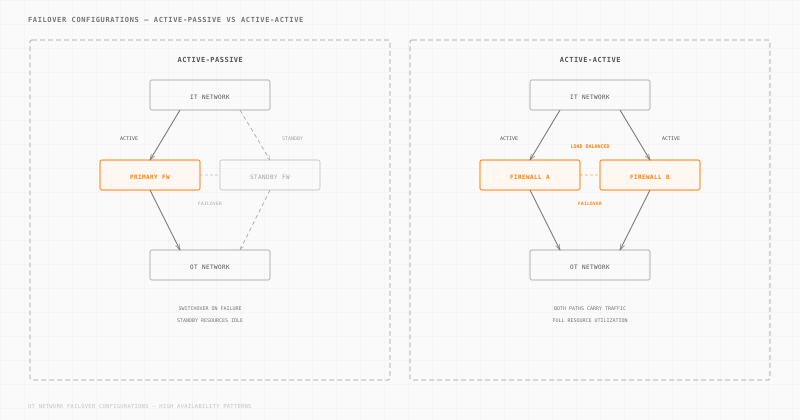
| Active-Passive | Active-Active | |
|---|---|---|
| Failover time | Seconds to minutes | Sub-second (seamless) |
| Resource utilization | Low, standby idles | High, both paths carry traffic |
| Complexity | Lower, simpler configuration | Higher, requires load balancing |
| Cost | Moderate, standby hardware underused | Higher, full duplication active |
| Best for | Budget-constrained OT environments | Mission-critical, zero-downtime systems |
Failover vs. Redundancy
While often used interchangeably, failover and redundancy have distinct purposes. Redundancy involves duplicating critical components to ensure availability, while failover is the mechanism that activates these redundant systems when needed.
Implementing Failover Strategies
Assessing Network Requirements
Before implementing a failover strategy, assess the specific needs of your network:
- Critical Systems Identification: Determine which systems are mission-critical and prioritize them in your failover planning.
- Recovery Time Objectives (RTO): Define the acceptable downtime for each system to guide your failover strategy.
- Network Architecture: Evaluate the current network layout to identify potential failover points.
Designing a Failover Plan
- Architecture Planning: Develop a network architecture that supports failover, considering both hardware and software components.
- Failover Testing: Regularly test failover systems to ensure they operate as expected during an actual failure.
- Monitoring and Alerts: Implement monitoring tools with real-time alerts and status updates on network health.
Practical Failover Solutions
- Load Balancers: Distribute network traffic across multiple servers to prevent overload and provide failover support.
- Virtualization: Use virtual machines to quickly spin up replacements for failed systems.
- Cloud Integration: Leverage cloud services for additional redundancy and failover capabilities, ensuring compliance with industry standards like CMMC and NIS2.
Challenges and Considerations
Balancing Security and Availability
Implementing failover systems must not compromise network security. Ensuring that failover mechanisms adhere to security standards, such as NIST 800-171, is required to maintain both availability and compliance.
Managing Complexity
As failover systems increase network complexity, managing and maintaining these systems can be challenging. Automation tools can help streamline failover processes and reduce the risk of human error.
Cost Implications
While failover solutions provide significant benefits, they also come with costs. Balancing investment in failover systems with budget constraints is a key consideration for IT and compliance officers.
Conclusion: Building Resilient OT Networks
Effective failover strategies are essential for maintaining high availability in mission-critical OT networks. By understanding and implementing robust failover mechanisms, organizations can safeguard their operations against unforeseen disruptions, ensuring continuous and reliable service delivery. Review and update your failover configurations regularly as your network grows and new tools become available. Test failover paths under realistic conditions to confirm they perform as designed.