Manufacturing cybersecurity: secure every machine in your plants.
Manufacturing cybersecurity for OT
Manufacturing cybersecurity controls who reaches each PLC, CNC machine and HMI, and logs every connection. One Trout Access Gate per plant, up in a day, with nothing installed on machines.
Last updated:
What is manufacturing cybersecurity?
Manufacturing cybersecurity protects the machines that run production, such as PLCs, CNC machines, robots and HMIs, and the network that connects them. It keeps production running by controlling who reaches each machine, vendors included, and by recording every connection for audits.
In 2025, Dragos counted 3,300 industrial organizations hit by ransomware. More than two-thirds were manufacturers (Dragos, 2026).
For the full method, read the OT cybersecurity guide. Defense suppliers should also read CMMC compliance for manufacturers.

Protect your oldest machines.
Dragos found no vendor patch or mitigation in 26% of 2025 ICS advisories. Those CNC machines and PLCs stay protected, with nothing installed on them.
Learn more
Give vendors safe remote access.
OEM vendors connect through the gate. Their VPN or 4G link ends there, with no route into production.
Learn more
Audit-ready for your customers.
Every connection is logged. Export the evidence for IEC 62443, NIST SP 800-82 or CMMC audits.
Learn moreOne gate per plant. Four jobs.
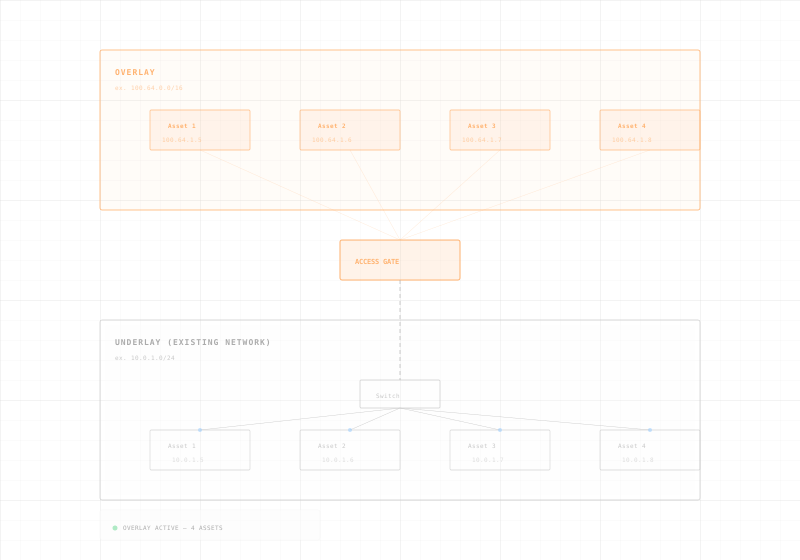
Access Gate connects to your existing network. Production keeps running.
See every machine.
Find every machine on the plant network, old or new, IT and OT.
Control who reaches what.
Each person reaches only the machines they need. No VLAN changes, no re-cabling.
Reach any machine, securely.
Vendors log in with MFA. Each session reaches only the machines it needs and is logged.
Prove every audit.
Every connection is logged. Export the evidence your customers ask for.

Up in a day per plant.
Access Gate connects to your existing network. No architecture change.
Nothing to install on machines.
CNC machines and PLCs stay as they are. Access Gate works from the network.
Run by your IT team.
Ready-made policies your IT generalists can run. No dedicated security team needed.
Which cyber risks matter most in a plant?
Four risks with public figures behind them, and what Access Gate does about each.
| Risk | The figure | What Access Gate does |
|---|---|---|
| Ransomware reaches the plant | Manufacturing was more than two-thirds of the 3,300 industrial organizations hit by ransomware in 2025 (Dragos, 2026). | Machines sit in zones that only the gate can reach. An infected office PC has no path to a machine it has no rule for. |
| Attackers stay unseen | Ransomware stayed in OT for 42 days on average in 2025, against 5 days at sites with full OT visibility (Dragos, 2026). | Lists every machine and logs every connection, so an unexpected session shows up the day it starts. |
| Machines that cannot be patched | 26% of 2025 ICS advisories had no patch or mitigation from the vendor (Dragos, 2026). | Puts a gate in front of the machine. Nothing is installed on it, and its configuration does not change. |
| The cost of a breach | The global average cost of a data breach is USD 4.99 million (IBM Cost of a Data Breach Report 2026). | Limits what one stolen password can reach, and records each session for the investigation. |
Start with the gate, then add services on the same appliance.
Secure your plants now, then digitalize them under your control.
Access Gate puts compute on the wire, next to your assets. Once the gate is in, the same box hosts the services that pull OT in securely: remote access, protocol gateways, DNS and time, historian, update server. You speed up digitalization and keep control of it.
Trusted by manufacturers across the supply chain.

to move a running production line behind Access Gate at a large manufacturer in North Carolina, with one route on its existing switch. Production never stopped.
Trusted by leading companies


“The Trout Access Gate gave us a clear path to CMMC compliance without disrupting our manufacturing operations.”
Director of IT
Defense Contractor · Elna Magnetics
Common questions about manufacturing security.
From unboxing to a working Access Gate on a manufacturing network.
No. The Access Gate connects to your existing network rather than cutting into it. It uses overlay micro-segmentation, so there is no need to re-cable, re-address, or redesign your infrastructure. It works with your current switches, VLAN, and topology. To move a line behind the gate, you add one route on your existing switch: at a large manufacturer in North Carolina, a running line moved in under a minute.
Yes. The Access Gate is agentless: it operates at the network level, and no software agents are installed on endpoints. It protects CNC machines, PLCs, HMIs, and any device connected to the network, regardless of age or operating system.
The Access Gate supports IEC 62443, NIST SP 800-82, and general customer security audit requirements, plus CMMC Level 1 & 2 for defense manufacturers. It provides continuous monitoring, access control, and assessment-ready documentation. For CMMC, it covers the shop-floor half of the CUI enclave, the CNCs and CAD/CAM stations that receive drawings, and works with GCC High or a file-sharing enclave on the office side.
The built-in bastion host provides a controlled gateway for OEM vendors and contractors. Each session is authenticated with MFA, scoped to specific resources, and fully logged. It works with your existing VPN or 4G link and requires no open ports.
No. Access Gate is built for plants without a security team. It ships with ready-made policy templates, and IT generalists run it from one management interface.
Cybersecurity in manufacturing protects the OT that runs the plant: PLCs, CNC machines, HMIs, SCADA, and the legacy Windows systems behind them. These rarely tolerate agents, patching, or downtime, so Access Gate secures them at the network layer with Zero Trust access, IT/OT segmentation, and audit-ready evidence for IEC 62443, NIST SP 800-82, and CMMC, on-premise and without stopping production.