
A flat network is an architecture where every device, PLC, HMI, workstation, and switch, shares a single Layer 2 broadcast domain with no enforcement point between them, so any device can reach any other directly. That simplicity is easy to manage, but in an industrial plant it means a compromised laptop has direct Layer 2 access to your safety controllers. A segmented network divides those same devices into zones with policy enforcement at every boundary: more design work, but a breach in one zone stays in one zone. Choosing between the two is the architecture decision every industrial network architect makes, explicitly or by default.
This guide compares the two architectures across security, compliance, and operational cost, then shows the migration path from flat to segmented without production downtime.
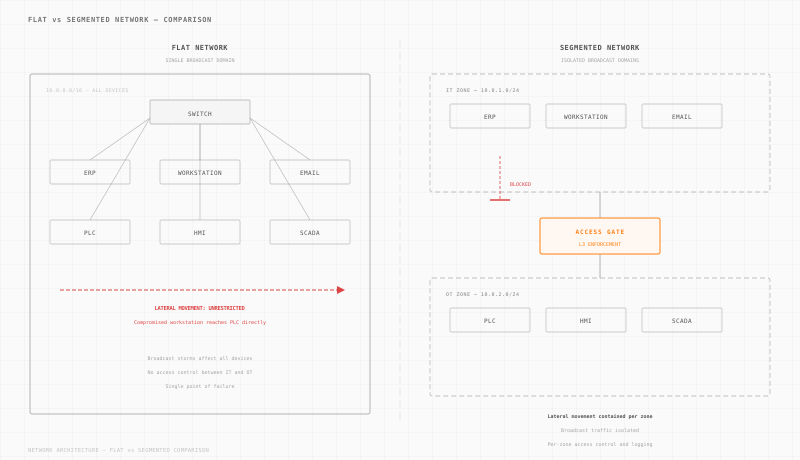
Flat Network vs Segmented Network: Side-by-Side Comparison
| Dimension | Flat Network | Segmented Network |
|---|---|---|
| Layer 2 broadcast domain | Single, shared | One per segment |
| Lateral movement after breach | Unrestricted across all devices | Blocked at zone boundaries |
| Enforcement point for access control | None | Router, firewall, or access gate at each boundary |
| Audit trail for cross-zone traffic | None, traffic does not cross a boundary | Every cross-zone connection logged |
| Compliance (CMMC L2, NERC CIP, IEC 62443) | Non-compliant | Required architecture |
| Operational complexity | Low, one subnet | Higher: subnet design, VLAN tagging, ACLs |
| Hardware needed | One switch | Layer 3 switches or routers at segment boundaries |
| Recommended for | Labs, ≤20-device deployments, commissioning | Production OT, regulated industries, multi-zone facilities |
Flat Networks
A flat network puts all devices in a single Layer 2 broadcast domain. Every device can reach every other device directly.
Where Flat Networks Work
- Small installations with fewer than 20 devices where complexity is not justified
- Lab or test environments where security is not a production concern
- Temporary setups during commissioning or migration
Where They Fail
Lateral movement. Once an attacker compromises any device on a flat network, they can reach every other device. A phishing email that compromises an office workstation gives the attacker direct access to PLCs, HMIs, and safety controllers on the same subnet.
Technical detail: On a flat Layer 2 network, ARP broadcasts reach every device. An attacker can ARP-spoof the default gateway, intercept all traffic, and pivot to any device without crossing a routing boundary. There is no enforcement point to block this.
Broadcast storms. All devices share the same broadcast domain. A misconfigured device or a network loop can generate broadcast traffic that saturates the network. In IT, this causes slow email. In OT, this causes missed PLC scan cycles and control instability.
No compliance path. CMMC and NIST 800-171 both require network segmentation. A flat network cannot satisfy these requirements regardless of what other controls are in place.
Segmented Networks
A segmented network divides devices into separate subnets or VLANs, each with its own broadcast domain. Traffic between segments passes through a router, firewall, or access gate that enforces policy.
Network Segmentation Benefits
Breach containment. A compromised device in one segment cannot reach devices in another segment without crossing an enforcement point. If the enforcement point blocks the traffic, the breach stays contained.
Per-zone access control. Each segment boundary is an opportunity to enforce who can access what. An operator on the production VLAN can reach the PLCs they manage. They cannot reach the safety system VLAN or the enterprise servers.
Audit trail. Every cross-segment connection passes through a logging point. You know who crossed which boundary, when, and using what protocol.
The Cost
Complexity. Segmented networks require more planning: subnet design, VLAN configuration, routing rules, firewall policies. Misconfiguration can block legitimate traffic and cause production issues.
Hardware. Segmentation needs routers or Layer 3 switches at segment boundaries. Depending on the architecture, this may require additional firewalls or access control appliances.
Operational overhead. Adding a new device means assigning it to the right segment. Moving a device means updating VLAN membership and firewall rules. This requires documentation and change management.
Technical detail: The most common segmentation mistake is creating VLANs without enforcing routing policy between them. If inter-VLAN routing is enabled on a Layer 3 switch without ACLs, the VLANs provide broadcast isolation but zero security benefit. Traffic still flows freely between segments. Segmentation without enforcement is cosmetic.
Industrial Network Segmentation: What Makes It Different
Industrial network segmentation is not the same problem as office IT segmentation. Three constraints change the design:
- Deterministic timing. PLC scan cycles and safety loops have sub-millisecond budgets. Enforcement that adds 5ms of latency at every hop can destabilize control. Segment boundaries must be placed between functional zones, not between every device.
- Protocol awareness. Modbus, EtherNet/IP, OPC UA, and PROFINET use protocol behaviors a generic IP firewall does not understand. Segmentation rules written at the TCP-port level either over-block (production stops) or under-block (no security gain). ICS network segmentation needs protocol-aware enforcement at the conduit.
- No agent option. Most PLCs, HMIs, and legacy controllers cannot run an endpoint agent. Segmentation must be enforced from the network, not the endpoint.
Standards that mandate OT network segmentation: IEC 62443 (zone and conduit model with defined Security Levels), NIST 800-82 Rev 3 (OT cybersecurity guide), CMMC AC.L2-3.1.3 (information-flow control), and NERC CIP-005 (Electronic Security Perimeters for bulk electric system cyber assets).
Trade-offs for Industrial Environments
Compliance Requirements
CMMC Level 2 requires control of information flow between security domains, and NERC CIP-005 requires an Electronic Security Perimeter around high and medium impact BES Cyber Systems. Defense contractors, energy operators, and manufacturers in regulated sectors do not have a choice: segmentation is required.
| Framework | Segmentation Requirement |
|---|---|
| CMMC Level 2 | AC.L2-3.1.3: Control information flow between security domains |
| NERC CIP | CIP-005: Electronic Security Perimeter with controlled access points |
| NIST 800-171 | SC-7: Boundary protection with controlled interfaces |
| IEC 62443 | Zone and conduit model with defined security levels |
Operational Impact
Segmentation adds latency at each boundary (typically under 1ms for a firewall or access gate). For most OT applications, this is negligible. For hard real-time control loops with sub-millisecond requirements, place all devices in the same segment and enforce security at the segment boundary rather than between individual devices.
How to Implement Network Segmentation in OT
Network segmentation best practices for OT environments follow a phased pattern: map first, enforce last. The five steps below move you from flat to segmented without a forklift replacement and without taking production down.
- Map your network. Document every device, its IP, its function, and what it communicates with. Passive discovery (mirroring traffic to a listener) avoids active scans that can crash older PLCs.
- Define zones. Group devices by function and security requirement. Production PLCs in one zone, HMIs in another, enterprise IT in a third. IEC 62443 zone and conduit terminology gives you a vocabulary auditors recognize.
- Deploy enforcement. Place a firewall, access gate, or Layer 3 switch with ACLs at each zone boundary. For environments where switches cannot be touched, overlay segmentation runs adjacent to the existing network instead of replacing it.
- Start permissive, then tighten. Begin with logging-only mode to capture actual traffic patterns. Use the logs to build allowlists. Then switch to enforcement mode.
- Monitor continuously. Baseline normal cross-zone traffic and alert on deviations. Cross-zone connection logs are also the audit trail CMMC and IEC 62443 require, the backbone of OT microsegmentation with SIEM integration.
Flat Networks and the Purdue Model
The Purdue Reference Model (ISA-95) defines the layered architecture of an industrial network: Level 0 is the physical process, Level 1 is sensors and actuators, Level 2 is supervisory control, Level 3 is site operations and MES, and Level 4 is the enterprise. Each level is supposed to be insulated from the ones above and below it, with controlled crossings.
A flat OT network collapses these levels. It creates a direct path from the enterprise zone (Level 4) straight into the control network (Level 2) and below. An attacker who compromises a single Level 4 workstation can reach PLCs and RTUs directly. No boundary, no enforcement point, no log. The IT/OT boundary at Level 3 is where most industrial breaches propagate, because it is the junction between the corporate network everyone can phish and the control systems that run the plant.
For a large industrial group with dozens of production sites, the stakes multiply. A single flat network at one site becomes an entry point for lateral movement across the entire estate. One weak plant exposes the rest.
IEC 62443 Zone Architecture: What Segmentation Actually Requires
IEC 62443 formalises Purdue-style segmentation into zones and conduits. A zone is a grouping of assets that share a common security level. A conduit is the controlled communication path between zones. It sets, and enforces, exactly which traffic may cross a boundary and under what conditions. The standard defines four Security Levels (SL1 through SL4), from protection against casual violation up to protection against a well-resourced state actor.
The catch is implementation. Putting IEC 62443 zones onto a legacy flat network traditionally requires a VLAN redesign: re-addressing equipment, reconfiguring switches, and taking production down for the cutover. For a multi-site industrial group, multiplying that downtime risk across 20 or 50 sites turns a traditional network-redesign programme into a multi-year project that the business will not fund.
Deploying Zone Architecture Without Network Redesign
There is a way to get IEC 62443 zone architecture without the redesign project: a two-phase overlay model.
Phase 1, adjacent deployment. Access Gate deploys alongside the existing network at each site. It creates a Zero Trust overlay across the Purdue zones without touching VLANs or installing agents on OT equipment. Visibility and access control are immediate. Each site deploys on its own, with no cross-site interdependency and no big-bang cutover.
Phase 2, consolidation. The overlay becomes the new Zero Trust fabric at about 10 systems per hour per site via the Access Gate proxy. IT admins and OT operators manage policy through role-based access in a shared UI, and central policy management across sites is available from day one of Phase 2. The result is IEC 62443 zone architecture across the full industrial estate, with no network-redesign project.
How Access Gate implements IEC 62443 zone architecture on existing OT networks
Conclusion
Flat networks trade security for simplicity. That trade-off is acceptable in a lab. It is not acceptable in a production OT environment where a compromised device can reach safety controllers, where compliance mandates segmentation, and where broadcast storms can halt production.
Segment your network. Enforce policy at every boundary. Start with the highest-risk zones and expand from there.