
Secure and encrypt Modbus TCP. Your PLCs stay as they are.
Modbus has no authentication and no encryption. This guide shows how to add both, in order of impact. Nothing changes on the PLC.
Last updated:
Modbus TCP is everywhere in operational technology: PLCs, RTUs, SCADA gateways, building management systems. Published by Modicon in 1979 for serial links, it assumes a trusted, physically constrained network where everyone with access is authorized. That assumption stopped being true two decades ago, yet most plants still run Modbus wide open, with no authentication, no encryption, and no access control. This guide walks through why, and what to do about it, in order of impact.
Why Modbus TCP is hard to secure.
Modbus TCP takes the original serial protocol and wraps it in TCP/IP on port 502. The Application Data Unit (ADU) becomes a 7-byte MBAP header (transaction ID, protocol ID, length, unit ID) followed by the function code and data. That's it. There's no TLS, no authentication header and no concept of user identity. The serial checksum was dropped because TCP handles integrity at the transport layer. TCP checks integrity. Nothing checks authenticity.
A Protocol That Outlived Its Threat Model
Modbus was designed in 1979 for serial communication between a single master and isolated slaves. It never needed authentication, encryption, or integrity checks, the physical separation was the security. That assumption no longer holds.
No Authentication. No Encryption. No Integrity Check.
Any device on the network can issue a Modbus command to any PLC. There is no handshake, no session, no verification of the sender. A legitimate engineering workstation and a compromised one look identical to the controller.
TCP/IP Connectivity Without Security
Modbus/TCP simply wrapped the original serial protocol in Ethernet frames. Connectivity expanded dramatically. The security model did not change. The result is a protocol designed for isolation now operating in connected, often internet-adjacent environments.
Attackers Use Legitimate Commands
The most dangerous Modbus attacks do not require exploits. They require access. An attacker with network visibility can issue perfectly valid protocol commands, Read Holding Registers, Write Single Register, to cause physical process changes without triggering alarms.
Attackers use valid Modbus commands.
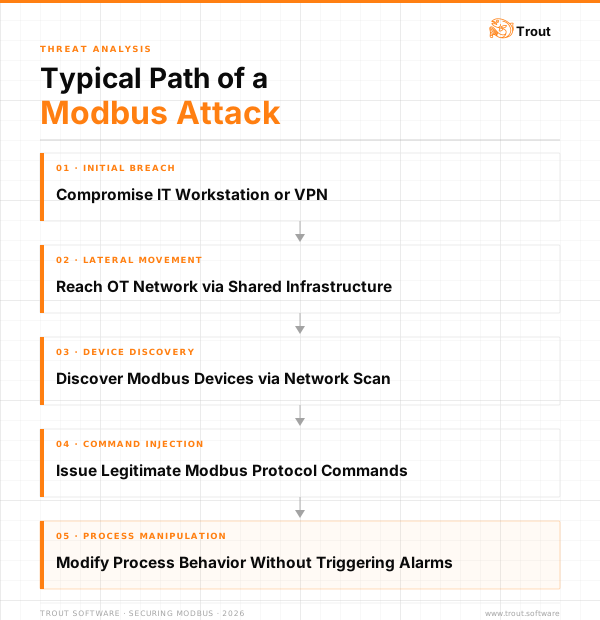
Modern Modbus threats exploit the protocol's native trust model. Once attackers reach the OT network, they can send commands that look like normal operations. The way in is often a compromised workstation, a VPN credential, or lateral movement from IT.
No exploit required
Modbus has no authentication layer to bypass. An attacker with network access can issue control commands using standard, publicly documented function codes. No vulnerability research needed.
Looks like legitimate traffic
Process manipulation via Modbus looks exactly like normal engineering activity. Traditional intrusion detection based on signatures or anomaly thresholds will not catch an attacker issuing valid commands within normal ranges.
No audit trail by default
Modbus devices record nothing. There is no native logging of who sent a command, when, or what register was written. Forensic reconstruction after an incident is impossible without an external enforcement layer.
Physical consequences
Unlike IT attacks that target data, Modbus attacks target physical processes. A write to the wrong register at the wrong time can halt a production line, cause equipment damage, or trigger unsafe operating conditions.
Start with network segmentation.
If you do nothing else, segment Modbus traffic away from the rest of the network. This single step eliminates the largest class of attacks: someone on the corporate LAN, or a compromised IT workstation, reaching directly into the control network.
VLANs are the minimum
Put Modbus devices on their own VLAN and lock down inter-VLAN routing so only specific hosts can cross the boundary. A VLAN tag is an organizational label, not a security control, until an enforcement point sits on the boundary.
Firewalls between zones
A VLAN without a firewall is organizational decoration. Put stateful inspection at the boundary with default-deny inbound, then permit only the source and destination pairs you actually expect.
Map it to IEC 62443 zones and conduits
Draw a clear line between Level 2 (control) and Level 3 (site operations) in the Purdue model, with a defined conduit for anything that must cross. CISA's defense-in-depth guidance treats segmentation and a control-to-enterprise DMZ as the foundation everything else builds on.
Encrypt Modbus traffic.
Modbus TCP has zero native encryption, so you have to wrap it in something else, roughly in order of how future-proof each option is:
Modbus/TCP Security (the standards-based answer)
The Modbus Organization's Modbus/TCP Security specification defines TLS encapsulation on port 802 (distinct from the legacy 502), using X.509 certificates for both encryption and authentication. The certificate's role-OID extension can even carry authorization, so the protocol finally gains a notion of identity. Adoption in the installed base is still thin, so treat it as the target state for new builds and gateways, not something every legacy PLC already speaks.
VPN tunnels (the common retrofit)
IPsec or WireGuard between sites, or between an engineering workstation and the control network. The key is terminating the tunnel as close to the Modbus device as possible, not at the edge of a flat network where traffic travels unencrypted for the last hop.
TLS wrappers (the more ad-hoc solution)
When the device itself can't speak TLS, a TLS wrapper encrypts Modbus TCP between two endpoints. It works well for point-to-point links, like an HMI talking to a specific PLC. More overhead to manage at scale, but it gives you per-connection encryption today, on hardware that will never see a firmware update.
Protocol-aware enforcement (the modern & scalable path)
A proxy that understands Modbus function codes can block write commands from hosts that should only read. It can also restrict which register ranges a source can access, without any change to the PLC or the HMI. In practice this is most often the right path, because you can't modernize every PLC and controller in one go. Instead of touching the equipment, you route its traffic through a modern, resilient proxy. It adds identity, authorization and audit to a protocol that has none, with no impact on the running process.
How the encryption approaches compare.
| Approach | Pros | Cons | Where to implement |
|---|---|---|---|
| Modbus/TCP Security (Modbus Organization spec) | Standards-based, no external components. | Almost no installed hardware supports it, and it depends on PLC firmware that vendors have not shipped. | New builds and greenfield gateways. |
| TLS wrapper (stunnel, IPsec) | Per-connection encryption today, open-source. | Point-to-point only, heavy to manage at scale. Adding 3rd party technology. | Fixed point-to-point links, such as an HMI talking to one PLC. |
| Modern proxy (Trout Access Gate) | Adds encryption, identity, function-code control and full audit without touching the PLC. | Adding 3rd party technology. | Live OT networks and legacy PLCs, at brownfield scale. New builds and greenfield. |
Check every command before it reaches the PLC.
A proxy checks each command.
Modbus traffic is routed through a modern proxy, between the SCADA/HMI client and the PLC. Every command passes through it. It parses the protocol, validates the request against policy, and forwards only authorized operations.
The PLC sees no change. The SCADA system sees no change. The network topology is unaltered. Security is added at the network layer, and the control logic stays untouched.
Because these systems live and die by uptime, the proxy itself has to be resilient. Run it as a high-availability pair so a single fault never stops the process. Fail-open versus fail-closed is a per-asset, logged decision. A historian's continuous collection path can fail-open so data keeps flowing, while a vendor's write path fails-closed. Keep a break-glass route so operators can always reach the PLC in an emergency, even if enforcement is degraded. Keep historian and polling continuity on their own path, so a security fault never blinds the plant.
Identity-bound access
Integrates with Active Directory or a security console. Only authorized identities can access specific PLCs. The Enforcement Layer knows which user is sending the command.
Function code allowlisting
Instead of blocking known-bad commands, the layer only allows a pre-approved list of function codes. Any other code, including rarely-used diagnostic functions, is dropped.
Register restriction
Policy can be granular: "User A can only write to Holding Register 40001." All other registers are read-only for that user. This significantly limits blast radius.
Full audit reconstruction
Every command and response is logged with timestamp and identity. Complete forensic reconstruction is possible after an incident. Compliance evidence is generated automatically.
Security has to fit plant constraints.
Industrial control systems operate under constraints fundamentally different from enterprise IT. Security mechanisms must coexist with millisecond polling cycles, certified systems, continuous uptime requirements, and equipment that cannot be modified.
| Constraint | Security impact |
|---|---|
| Millisecond polling cycles | Inspection must occur at wire speed with bounded latency |
| Validated and certified systems | No host agents or software modifications permitted |
| Continuous uptime requirements | Inline controls must not introduce single points of failure |
| Multi-decade asset lifecycles | Security solutions must remain stable across OS generations |
| Deterministic control behavior | Variable processing delays cannot be tolerated |
In IT networks, security tools can be updated, restarted or reconfigured with little consequence. Industrial environments treat change itself as risk. A modern proxy processes and forwards traffic within the process's timing budget. The PLC keeps its established, predictable behavior, and the plant does not shut down for the security upgrade. One boundary to hold: keep enforcement out of the safety-instrumented-system (SIS) path. Those loops are governed by functional-safety standards such as IEC 61511, not network policy, and should never depend on a security appliance to function. One more topology rule sits next to the SIS boundary: continuous, cyclic controller-to-I/O polling stays local on the underlay and does not traverse enforcement. Only cross-zone, supervisory and engineering access is mediated. The deterministic control loop keeps its timing, and the routable access path is the part that gets identity and audit.
Add access control, monitoring and patching.
Segmentation and encryption close the biggest gaps. These three controls close the rest.
01Enforce access control
Modbus has no concept of a user. Allowlist source IPs at the firewall, and put a protocol-aware gateway in front of PLCs to map identities to permissions: read-only function codes (1 to 4) for operators, write codes for named engineers only. Require MFA for any remote access.
How Trout deploys identity in OT02Monitor the plaintext
Modbus is plaintext and deterministic, so every transaction can be logged: who issued which function code, to which register, and when. Log it all at the gateway and forward those events to your SIEM, so an incident is a lookup, not a forensic exercise.
Forward Modbus logs to your SIEM03Patch what you can, wrap what you cannot
OT patching is slow and risky. Keep a device and firmware inventory against CISA ICS advisories, test patches in staging, and schedule realistic windows. When a device cannot be patched, tighten its segmentation and put a protocol-aware proxy in front of it.
Protect legacy assets with Enclaves
These controls align with IEC 62443 (zones, conduits, security levels), NIST SP 800-82r3 (OT security), and the compensating-control expectations of CMMC.
Download the full Modbus security guide.
The complete guide covers why Modbus was never secure, how modern attacks work, and the Enforcement Layer architecture. It also shows how to support IEC 62443 and CMMC audits without modifying PLCs.
What you'll learn
Why Modbus has no native security and why that matters now. How a 5-step attack path leads from IT breach to physical process manipulation, using only legitimate protocol commands. How the Enforcement Layer introduces mediated trust without modifying PLCs or network topology.
Apply it with Access Gate
Access Gate implements the Enforcement Layer as a single appliance beside the network. Function code allowlisting, register-level access control, identity-bound sessions, and full audit logging, no changes to PLCs, no network redesign, no downtime.
Common questions about securing Modbus.
enforcement capabilities, identity binding, function code allowlisting, register restriction, command validation, and full audit, applied without modifying a single PLC.
Yes. The modern-proxy approach needs no change to the PLC: no firmware update, no software agent, no change to the control logic. The proxy connects to the existing network, and Modbus traffic to the PLC is routed through it. It validates every Modbus command and forwards only authorized operations. The PLC operates exactly as it always has.
Modbus defines dozens of function codes, such as Read Holding Registers (03), Write Single Register (06) and Write Multiple Coils (15). Many more exist, including diagnostic codes rarely used in production. Blacklisting tries to block known-malicious codes. Allowlisting only permits the specific function codes your process actually needs. Any other command, including legitimate-looking diagnostic requests from an attacker, is dropped before it reaches the PLC.
Modbus carries no user identity on the wire, so identity is established out of band. Users authenticate to the proxy (via Active Directory, LDAP, or a local console). The proxy then re-originates only the authorized Modbus operations downstream. Access is bound to authenticated identity as well as network location. Even a compromised engineering account stays limited to the function codes and registers it is authorized for. Continuous machine-to-machine polling is pinned by source and unit, not per human. With full audit logging, anomalous usage is immediately visible.
The proxy parses and forwards traffic within the deterministic timing budget of the process. Security for industrial control must respect that budget. The budget is process-specific: a 10 ms poll loop tolerates far less added delay than a one-second one. So measure the added latency and jitter against your actual loop during a pilot rather than assume it. The PLC's own communication behavior is unchanged.
A Modbus proxy provides evidence toward specific controls. It does not make you compliant on its own, and no auditor accepts a single appliance as 'satisfying' a framework. It maps cleanly to IEC 62443 identification and authentication (FR1) and use control (FR2). It also fits the zone-and-conduit model, where a mediated conduit can stand in for physical separation toward a defined target security level (SL-T). For CMMC, it supports the NIST SP 800-171 access-control (3.1) and audit-and-accountability (3.3) families, where your OT actually handles CUI or FCI. Treat it as one documented, mapped control in a broader program.


