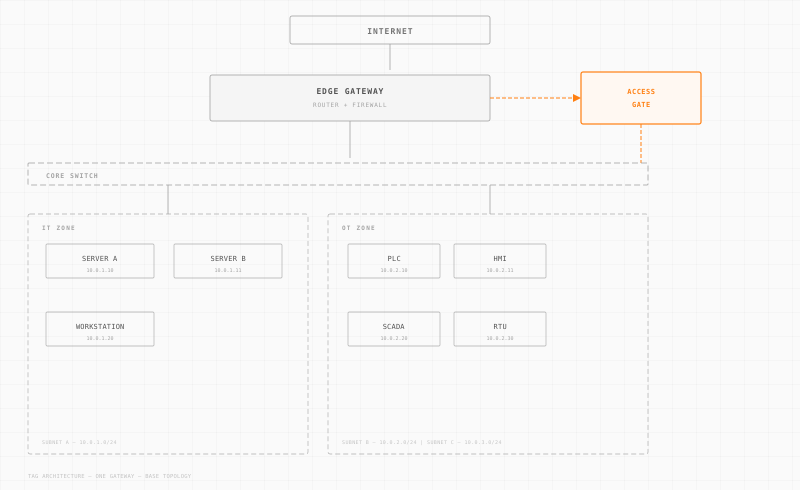
The Importance of Segmentation in Control and Safety Systems
When a ransomware infection on an HMI can reach a Safety Instrumented System (SIS), you have a segmentation problem -- and a life-safety problem. Control systems and safety systems must be isolated from each other so that a compromise in one cannot cascade into the other. This guide covers how to design and enforce that separation in OT architecture.
Why Segment Control and Safety Systems?
Segmentation involves dividing a network into smaller, isolated sections, each with its own security controls. This approach offers several benefits, particularly in ICS and OT environments:
- Enhanced Security: By isolating critical systems, segmentation minimizes the attack surface, preventing lateral movement by potential attackers.
- Improved Compliance: Segmentation helps meet regulatory requirements, such as those mandated by NIST 800-171 and CMMC.
- Operational Resilience: Isolating systems ensures that failures or attacks do not cascade through the entire network, thus maintaining operational integrity.
Understanding Control and Safety Systems in OT
Control systems refer to various components used to manage, command, direct, or regulate the behavior of other devices or systems. Safety systems, on the other hand, are designed to prevent accidents and mitigate the consequences of incidents. Both systems are integral to industrial operations, and their segmentation is vital for the following reasons:
- Risk Mitigation: Separating safety systems from control systems reduces the risk of a malfunction or cyberattack impacting safety-critical operations.
- Performance Optimization: Segmentation can help manage network load, ensuring that safety systems operate without interference from control systems.
Standards and Compliance: A Deep Dive
NIST 800-171
The NIST 800-171 framework provides guidelines to protect Controlled Unclassified Information (CUI) in non-federal systems. Segmentation aligns with several NIST 800-171 controls, particularly those related to access control and system communications protection.
CMMC
The Cybersecurity Maturity Model Certification (CMMC) is designed to enhance the cybersecurity posture of companies within the defense industrial base. Segmentation supports CMMC requirements by enabling the implementation of controlled access and the separation of CUI from other types of data.
NIS2
The NIS2 Directive emphasizes the security of network and information systems across the EU. Segmentation is crucial for compliance, as it facilitates the isolation of critical assets and supports the monitoring and management of network traffic.
Practical Steps for Segmentation
Step 1: Assess and Identify
Begin by assessing your current network architecture to identify control and safety systems. Understanding how these systems interact is crucial for effective segmentation.
- Inventory Assets: Document all devices and systems within your network.
- Map Interactions: Understand data flows and dependencies between systems.
Step 2: Define Segmentation Policies
Develop clear policies that dictate how segments are defined and managed. Policies should cover:
- Access Controls: Determine who can access each segment and under what conditions.
- Data Flows: Define how data can move between segments.
Step 3: Implement Technical Controls
Utilize technical solutions to enforce segmentation policies. This can include:
- Firewalls and VLANs: Use these tools to create physical and logical barriers between segments.
- Access Control Lists (ACLs): Implement ACLs to restrict traffic between segments.
Step 4: Monitor and Maintain
Continuous monitoring is essential to ensure that segmentation remains effective. Regular audits and performance reviews will help identify any lapses or areas for improvement.
- Network Monitoring Tools: Deploy tools to track traffic and detect anomalies.
- Regular Audits: Conduct periodic reviews to ensure compliance with segmentation policies.
Challenges in Segmentation
While segmentation offers numerous benefits, it is not without challenges:
- Complexity: Implementing and maintaining segmentation can be complex, especially in large networks with legacy systems.
- Resource Intensive: Segmentation requires investment in tools and personnel to manage and monitor segments effectively.
Conclusion: The Way Forward
Segmentation between control and safety systems is not optional -- it is a fundamental safety requirement. Start by inventorying all assets and mapping their interactions, define clear policies for what traffic can cross segment boundaries, enforce those policies with firewalls and ACLs, and monitor continuously for violations. The result is a network where a compromised control system cannot reach a safety system, and compliance evidence is generated as a byproduct of the architecture itself.