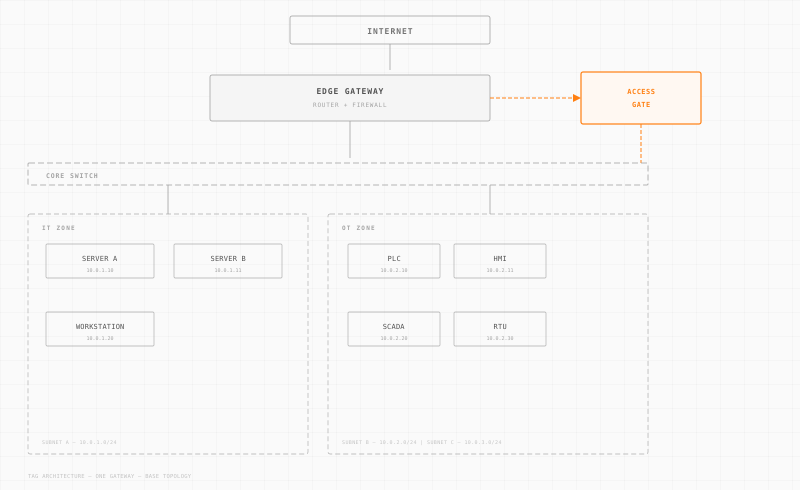
Understanding Overlay Networks in Industrial Security
Traditional methods of securing operational technology (OT) networks are often inadequate for industrial security. The rise of overlay networks offers a nuanced approach to enhancing security by enabling more flexible and granular control over network traffic. This deep dive explores how overlay networks can be leveraged to bolster industrial security, align with Zero Trust principles, and meet compliance standards like CMMC and NIS2.
What are Overlay Networks?
Overlay networks are virtual network layers that sit on top of existing physical networks. They encapsulate data packets, allowing for the creation of virtual connections that are independent of the underlying hardware. This abstraction layer provides enhanced flexibility, enabling the deployment of sophisticated security measures and network management strategies without altering the physical infrastructure.
Key Characteristics of Overlay Networks
- Scalability: Easily expand or contract the network without physical modifications.
- Flexibility: Quickly adapt to changing security policies and network demands.
- Isolation: Provide logical separation of traffic for different departments or functions.
- Security: Enable encryption and authentication independently of the physical network.
The Role of Overlay Networks in Industrial Security
Overlay networks address several challenges inherent in traditional industrial network architectures, particularly the problem of adding segmentation without re-cabling the plant floor. By providing a virtualized layer, they allow for secure communication, improved traffic management, and better compliance with security standards.
Enhancing OT Networking with Zero Trust
Implementing Zero Trust in OT networking involves ensuring that all network traffic is continuously authenticated and authorized. Overlay networks facilitate this by offering:
- Dynamic Segmentation: Segregating network traffic based on user identity, device type, or application, aligning with Zero Trust principles.
- End-to-End Encryption: Securing data in transit across the overlay network, reducing the risk of interception.
- Access Control: Implementing fine-grained access policies that are enforced at the virtual layer.
Compliance with CMMC and NIS2
Overlay networks also support compliance with standards such as CMMC and NIS2 by offering features that align with these frameworks' requirements:
- Data Protection: Ensure data integrity and confidentiality through encrypted communication channels.
- Auditability: Maintain detailed logs of all network activities, aiding in compliance audits and incident investigations.
- Risk Mitigation: Implement risk-based access controls and continuous monitoring to identify and respond to threats proactively.
Practical Implementation Steps
To successfully implement overlay networks in an industrial setting, organizations should consider the following steps:
1. Assess Current Infrastructure
Begin by evaluating the existing network infrastructure to determine compatibility with overlay network technologies. This involves:
- Mapping current network topologies.
- Identifying critical assets and data flows.
- Reviewing security policies and compliance requirements.
2. Choose the Right Overlay Technology
Select an overlay network technology that aligns with your specific security needs and operational constraints. Popular options include:
- Virtual Extensible LAN (VXLAN): Offers scalability and supports large-scale environments.
- Generic Network Virtualization Encapsulation (GENEVE): Provides flexibility and vendor-neutrality.
- Software-Defined Networking (SDN): Enables centralized control over network traffic and policy enforcement.
3. Integrate with Existing Security Frameworks
Ensure that the overlay network integrates seamlessly with existing security measures and frameworks, such as:
- Firewalls: Implement virtual firewalls within the overlay to control traffic flow.
- Intrusion Detection Systems (IDS): Deploy IDS solutions to monitor overlay traffic for anomalies.
- Identity and Access Management (IAM): Use IAM to enforce user-level access controls across the overlay.
4. Continuous Monitoring and Optimization
Overlay networks require ongoing monitoring and optimization to maintain security and performance:
- Use network analytics tools to gain insights into traffic patterns and potential bottlenecks.
- Regularly update security policies and overlay configurations to adapt to evolving threats.
- Conduct periodic security audits to ensure compliance with industry standards.
Conclusion
Overlay networks let you add segmentation, encryption, and access control to an existing physical network without changing a single cable or IP address. That is their primary value in OT: security improvements without physical disruption. Start by mapping your current traffic flows, identify the assets that need isolation, and deploy an overlay on a single segment as a proof of concept. Measure the latency impact against your process requirements before expanding to production-critical zones.
Full NIS2 on-premise compliance guide → /solutions/nis2-compliance