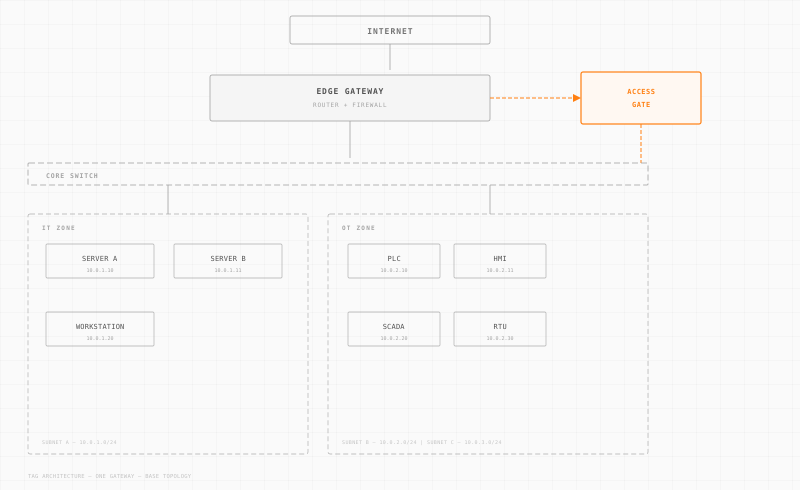
Modbus TCP has no authentication, no encryption, and no session management. A firewall rule that blocks port 502 from the internet is step one, not a security strategy. Anyone who can reach a listening device on port 502 can read any register and write any coil, because the protocol assumes every peer is trusted. This post covers what comes after basic firewall rules: encryption tunnels, segmentation that follows the process rather than the subnet, deep packet awareness, function-code control, and the monitoring that ties them together.
Understanding Modbus TCP Vulnerabilities
Modbus is a request-response protocol that carries a unit identifier, a function code, and a data payload. The TCP variant wraps this in a short Modbus Application Protocol (MBAP) header and ships it over port 502. It was published in 1979 for serial links, and the TCP mapping inherited a trust model that made sense on a point-to-point wire but breaks down on a routed network. The Modbus Organization's own MODBUS/TCP Security specification is explicit that the base protocol provides no security services and that confidentiality, integrity, and authentication must be layered on top. The result is a handful of structural weaknesses:
- Lack of Authentication: Modbus TCP does not include authentication mechanisms. Any host that can open a TCP session to port 502 can issue function code 6 (write single register) or 16 (write multiple registers) and change a setpoint, with no credential ever requested.
- No Encryption: Data transmitted via Modbus TCP is unencrypted. Register values, coil states, and the commands that change them all travel in clear text, so anyone with a tap or a SPAN port can read process state and reconstruct commands.
- No Integrity Protection: There is no message signing. A man-in-the-middle can alter a value in flight, and the receiver has no way to detect the tampering.
- Replay Attacks: Without session management or nonces, a captured write request can be resent verbatim. An attacker who records a legitimate "open valve" command can replay it later without understanding the payload.
The US guidance treats these as inherent: NIST SP 800-82 Rev. 3, Guide to Operational Technology Security, notes that many OT protocols were designed for reliability and determinism rather than security, and recommends compensating controls at the network and host level rather than expecting the protocol to defend itself.
Advanced Security Measures for Modbus TCP
Network Segmentation That Follows the Process
Segmentation is the highest-leverage control for Modbus, but only when zones map to the process rather than to convenience. The Purdue model and the zone-and-conduit approach in IEC 62443 give you the vocabulary: group devices that must talk to each other into a zone, and force all cross-zone traffic through a controlled conduit where policy can be enforced.
- Creating Secure Zones: Separate the control zone (PLCs, RTUs, the devices that actually move the process) from the supervisory zone (HMIs, historians, engineering workstations). A compromised HMI should not be able to reach a PLC except through a path you can see and govern.
- Default-Deny Conduits: A conduit between zones should start from default-deny and permit only the specific source, destination, and port that a documented data flow requires. CISA's recommended practices for improving industrial control system cybersecurity defense-in-depth describe layering segmentation, access control, and monitoring so that no single failure exposes the process.
- Identity-Scoped Access: Beyond IP and port, scope who may reach a device. An engineer performing maintenance needs a time-bounded path to one PLC, not standing access to the whole control zone.
Deep Packet Awareness and Function-Code Control
Because Modbus has no authentication of its own, the most useful enforcement point understands the protocol itself. A gateway or proxy that parses the MBAP header and function code can apply policy at the level that matters: not just "may host A talk to host B on port 502," but "may host A issue a write to register range X on device B."
- Function-Code Allow-Listing: A historian only ever needs read function codes (1 through 4). There is no legitimate reason for it to issue a write. Permitting reads and denying writes at the conduit blocks an entire class of attacks even if the historian is compromised.
- Register and Coil Scoping: Tie permissions to address ranges so a device authorized to adjust one setpoint cannot reach safety-critical registers it has no business touching.
- Rate and Shape Limits: Modbus traffic in a steady-state process is highly regular. Caps on request rate and rejection of malformed MBAP headers catch scanning, fuzzing, and floods early.
TLS-Wrapping and Encryption Tunnels
Modbus carries no encryption of its own, so confidentiality and integrity have to be added by the transport beneath it. The Modbus Organization's MODBUS/TCP Security specification defines exactly this: Modbus framing carried inside a TLS session on port 802, with X.509 certificates authenticating both ends. Where native Modbus/TLS is not available on legacy devices, wrap the traffic externally.
- Native Modbus/TLS: Where devices support it, TLS gives you mutual authentication via certificates plus encryption and integrity in one step, closing the no-authentication and no-encryption gaps together.
- TLS or VPN Gateways: For devices that only speak plain Modbus, terminate a TLS or VPN tunnel at a gateway in front of the device so traffic crossing untrusted segments is encrypted, similar to how HTTPS protects web traffic.
- Certificate Hygiene: Encryption is only as strong as key management. Rotate certificates, scope them per device, and revoke promptly when a device is decommissioned.
Monitoring and Protocol-Aware Detection
Encryption and segmentation reduce exposure; monitoring tells you when something slips through. An intrusion detection system that understands Modbus turns raw packets into process-meaningful alerts.
- Protocol Anomaly Detection: Configure detection to recognize unusual function codes, writes from devices that should only read, and commands targeting registers outside their normal range.
- Traffic Baselines: Steady-state OT traffic is predictable. Baseline the normal set of source-destination-function-code tuples, then alert on anything new, which is often the first sign of reconnaissance or lateral movement.
- Passive Collection: Use SPAN or tap-based capture so monitoring never adds load or latency to the control network itself.
Compliance and Standards Alignment
The controls above are not arbitrary. Each maps to a standard a regulator or auditor will recognize, which makes them easier to justify and budget for.
- IEC 62443: The zone-and-conduit model and security levels give a structured way to justify where segmentation and which controls belong.
- NIST SP 800-82 Rev. 3: Provides the OT-specific control guidance that maps directly to the measures above.
- CMMC and NIST SP 800-171: For defense contractors, these frameworks govern protection of Controlled Unclassified Information (CUI) in non-federal systems, applicable to Modbus TCP environments.
- NIS2 Directive: EU operators of essential and important entities fall under NIS2, which raises the bar on network and information system security and on incident reporting.
Practical Steps to Enhance Modbus TCP Security
- Inventory Every Modbus Talker: You cannot segment or monitor what you have not mapped. Build a list of every device that speaks Modbus and the flows between them.
- Segment Around the Process: Place PLCs and supervisory systems in separate zones with default-deny conduits between them.
- Enforce Function-Code Policy: Allow-list the function codes and register ranges each data flow actually needs, and deny the rest.
- Add Encryption Where Traffic Crosses Trust Boundaries: Use native Modbus/TLS where available, otherwise TLS or VPN gateways.
- Deploy Protocol-Aware Monitoring: Baseline normal traffic and alert on anomalous function codes and writes.
- Align with Standards: Map each control to IEC 62443, NIST SP 800-82, CMMC, NIST SP 800-171, and NIS2 requirements.
Conclusion
Securing Modbus TCP networks goes beyond basic firewall rules. Segment around the process so a compromised HMI cannot reach a PLC. Enforce function codes and register ranges at the conduit, because a protocol with no authentication needs an enforcement point that understands it. Wrap traffic in TLS or VPN tunnels to add the encryption Modbus lacks. Baseline normal traffic and watch for anomalous writes. Map each measure to IEC 62443, NIST SP 800-82, CMMC, NIST 800-171, and NIS2. Start by inventorying every device that speaks Modbus on your network, and the results will tell you where to focus first.