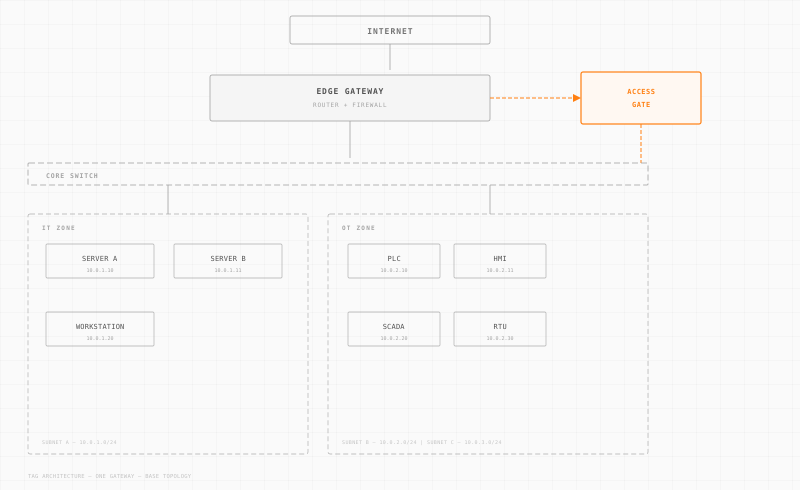
You cannot monitor what your network topology hides from you. If your topology design places monitoring tools behind a single aggregation switch, you lose visibility into half your traffic the moment that switch is oversubscribed. Designing for OT visibility means building monitoring access points into the topology from the start, not bolting them on afterward. This article will explore strategic approaches to designing network topologies that enhance monitoring and visibility, crucial for safeguarding critical infrastructure.
Understanding Network Topology in Industrial Networks
Network topology refers to the arrangement of different network elements, including nodes and connecting lines, in a structured format. In industrial settings, the topology design is pivotal for ensuring effective monitoring and visibility across OT environments.
Key Topology Types
- Star Topology: Centralized, simple to manage, but can be a single point of failure.
- Ring Topology: Ensures redundancy but can be complex to troubleshoot.
- Mesh Topology: Provides high reliability and redundancy but requires significant resources.
Selecting the appropriate topology depends on the specific needs of the industrial network, focusing on factors like scale, redundancy, and fault tolerance.
Enhancing Monitoring Capabilities
Effective monitoring is indispensable for maintaining network security and operational continuity. Monitoring capabilities should be integrated into the topology design from the outset.
Implementing Network Monitoring Tools
- Deep Packet Inspection (DPI): Offers detailed traffic analysis, essential for identifying anomalies.
- Network Traffic Analysis (NTA): Provides insights into traffic patterns and potential threats.
- Industrial Intrusion Detection Systems (IDS): Specifically tailored for OT environments to detect unauthorized activities.
Incorporating these tools into the network topology ensures comprehensive surveillance and quick response to potential threats.
Achieving Comprehensive OT Visibility
Visibility is crucial for understanding the state of your network and identifying potential vulnerabilities. A well-designed topology should facilitate complete OT visibility.
Strategies for Enhanced Visibility
- Segmentation: Dividing the network into manageable sections or zones helps in isolating potential threats and maintaining control over the network.
- Use of Network Access Control (NAC): Ensures that only authorized devices are connected to the network, enhancing security and visibility.
- Implementation of SCADA-Specific Tools: Tailored tools for SCADA systems help in monitoring and managing OT traffic effectively.
These strategies, when integrated into the network topology, enhance the ability to monitor and control the network environment comprehensively.
Compliance Considerations
Compliance with standards such as NIST 800-171, CMMC, and NIS2 is not just about meeting regulatory requirements but also about adopting best practices in network security.
Aligning Topology Design with Compliance Standards
- NIST 800-171: Emphasizes protection of Controlled Unclassified Information (CUI) in non-federal systems. Network segmentation and access controls are critical components.
- CMMC: Focuses on cybersecurity maturity and requires structured monitoring and incident response capabilities.
- NIS2: Mandates security measures and incident reporting, making network visibility and monitoring essential components.
Designing network topologies with these standards in mind helps ensure compliance and enhances the overall security posture.
Practical Steps for Designing Effective Topologies
- Conduct a Network Assessment: Understand the current state of your network, identify critical assets, and assess vulnerabilities.
- Define Security Requirements: Collaborate with stakeholders to determine the necessary security measures based on risk assessments.
- Select the Appropriate Topology: Choose a topology that balances performance, security, and redundancy.
- Integrate Monitoring Solutions: Ensure that the chosen topology supports the integration of advanced monitoring tools.
- Review and Update Regularly: Network topologies should be dynamic, adapting to evolving threats and organizational changes.
Conclusion
Design your network topology with monitoring as a first-class requirement, not an afterthought. Place network taps and mirror ports at every trust boundary and aggregation point. Choose topologies that give you redundancy (mesh or ring for critical paths) while keeping management simple (star for access layers). Validate that your DPI, NTA, and IDS tools can see the traffic they need to analyze. A topology that looks good on a diagram but blinds your monitoring tools is worse than useless -- it gives you confidence without coverage.