Two Products, Two Different Jobs
Claroty xDome is a CPS (Cyber-Physical Systems) protection platform. It was named a Leader in Gartner's 2026 Magic Quadrant for CPS Protection Platforms, and for good reason — it delivers deep asset discovery, vulnerability prioritization, and threat detection across OT, IoT, and IoMT environments.
Access Gate is a zero-trust enforcement appliance for OT networks. It segments traffic, controls access, and enforces policy — all from a single on-premise device with no cloud dependency.
These products solve different problems. Understanding the boundary between monitoring and enforcement is the key to choosing the right tool — or the right combination.
What Claroty Does Well
Claroty's strength is visibility. Its platform discovers assets passively and actively, maps communication flows, and correlates vulnerabilities against known CVEs. Specific strengths include:
- Deep Protocol Inspection (DPI) across 450+ OT/IoT protocols
- Risk scoring that prioritizes vulnerabilities by asset criticality and exposure
- Threat detection using behavioral baselines and signature matching
- Integration ecosystem — pre-built connectors for firewalls, NAC, SIEM, and SOAR platforms
- Secure Remote Access (SRA) module for third-party vendor sessions
Claroty's cloud analytics platform (xDome) aggregates telemetry from distributed sensors, giving centralized visibility across multiple sites.
What Access Gate Does Well
Access Gate's strength is enforcement. It sits inline on the network and controls what traffic is allowed to flow between zones, devices, and users. Specific strengths include:
- Network micro-segmentation without switch reconfiguration or VLAN changes
- Zero-trust access control — identity-based policies enforced at Layer 3
- On-premise deployment — single appliance or VM, no cloud round-trip
- Agentless operation — works with PLCs, HMIs, RTUs, and any IP-connected device
- Overlay networking — segments brownfield environments without touching the physical network
- Built-in remote access with session recording and granular permissions
The Architectural Difference
This is where the comparison matters most. Claroty and Access Gate are built on fundamentally different architectures:
Claroty deploys passive sensors (Claroty Edge) across the network to collect traffic data. That telemetry is sent to xDome's cloud analytics engine (or an on-premise console in some deployments) for processing. When Claroty detects a threat or identifies a segmentation gap, it generates an alert or pushes a policy recommendation — but enforcement requires a third-party device (firewall, NAC switch, or SOAR playbook) to act on it.
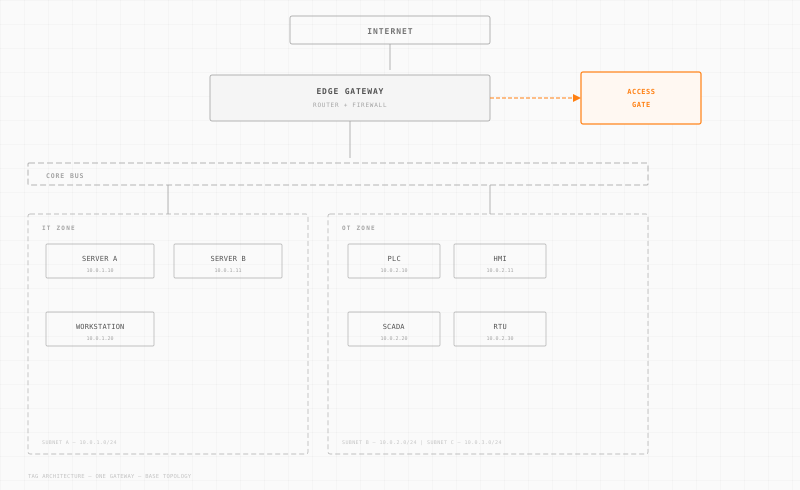
Access Gate deploys as a single on-premise appliance at each site. It creates an encrypted overlay network on top of the existing infrastructure. Segmentation policies are enforced directly by the appliance — no external firewall or NAC integration needed. Detection and enforcement happen in the same device.
The practical difference: Claroty tells you what's happening. Access Gate controls what's allowed to happen.
Feature Comparison
| Capability | Claroty xDome | Access Gate |
|---|---|---|
| Asset discovery | Deep passive + active discovery, 450+ protocols | Network-level device visibility via traffic analysis |
| Vulnerability management | Risk-scored CVE correlation | Not a primary function |
| Threat detection | Behavioral + signature-based | Anomaly detection on enforced traffic |
| Network segmentation | Recommends policies; requires firewall/NAC to enforce | Enforces segmentation directly via overlay network |
| Access control | Via SRA module for remote sessions | Inline zero-trust policy enforcement for all traffic |
| Remote access | Claroty SRA (separate module) | Built-in with session recording |
| Deployment model | Distributed sensors + cloud/on-prem console | Single on-premise appliance or VM per site |
| Cloud dependency | xDome SaaS requires cloud connectivity | None. Fully air-gap compatible |
| Enforcement | Indirect — via integrations | Direct — inline on the network |
When to Choose Claroty
Claroty is the right choice when:
- Visibility is the primary gap. You need a complete asset inventory and vulnerability assessment across a large, complex OT environment.
- You already have enforcement infrastructure. Your existing firewalls and NAC switches can act on Claroty's policy recommendations.
- Multi-site centralized monitoring is a priority and cloud connectivity is acceptable.
- Regulatory frameworks require continuous threat monitoring — Claroty's detection capabilities map well to NIS2 and IEC 62443 monitoring requirements.
When to Choose Access Gate
Access Gate is the right choice when:
- Enforcement is the primary gap. You know what's on your network but can't control lateral movement or segment traffic without downtime.
- You can't touch the physical network. Brownfield environments where switch reconfiguration and re-cabling aren't feasible.
- Air-gap or data sovereignty requirements prohibit routing telemetry to cloud platforms.
- You need segmentation and access control fast — Access Gate deploys in hours, not weeks.
Where Access Gate Falls Short
No comparison is honest without acknowledging limitations:
- Asset discovery depth. Claroty supports deep protocol inspection across 450+ OT/IoT protocols with OS fingerprinting and firmware identification. Access Gate provides network-level device visibility through traffic analysis, but it does not match the granularity of Claroty's asset intelligence.
- Threat intelligence maturity. Claroty has invested over a decade in OT-specific threat research. Its detection signatures and behavioral models reflect that depth. Access Gate's anomaly detection operates on enforced traffic patterns — useful, but not a substitute for a dedicated threat intelligence pipeline.
- Passive monitoring use cases. If your primary need is comprehensive visibility without any inline enforcement — a read-only view of your OT environment — Claroty is the better standalone choice. Access Gate is designed to sit on the traffic path. That is its strength, but it means it is not a drop-in replacement for a passive monitoring platform.
- Reference architecture breadth. Claroty's install base spans thousands of sites across healthcare, manufacturing, energy, and public infrastructure. Access Gate's deployment footprint is growing but smaller, which means fewer published reference architectures for niche verticals.
When to Use Both Together
The strongest architecture combines Claroty's monitoring depth with Access Gate's enforcement capability:
- Claroty discovers assets and identifies vulnerabilities
- Access Gate enforces segmentation and access control
- Claroty detects threats; Access Gate blocks lateral movement
- Claroty provides centralized visibility across sites; Access Gate provides per-site enforcement
This is not a theoretical pairing. Monitoring without enforcement is a dashboard. Enforcement without monitoring is blind policy. The combination closes both gaps.
If you need to start with one, ask a simple question: do you know what's on your network? If no, start with Claroty. If yes but you can't control what talks to what, start with Access Gate. For a similar comparison with another leading monitoring platform, see our analysis of Nozomi vs Access Gate. And for a deeper look at why enforcement belongs on-premise rather than in the cloud, read why on-premise OT security beats cloud-routed solutions.