The GCC High Default
Ask any CMMC consultant how to handle Controlled Unclassified Information (CUI), and the first answer is almost always Microsoft GCC High. Move your email, files, and collaboration tools into GCC High. Pay the per-user premium. Done.
For IT-centric organizations — defense consultancies, software firms, engineering services — this can work. But for manufacturers with OT environments, GCC High solves the wrong problem. It secures cloud collaboration. It does nothing for the CNC machine processing CUI-laden technical data packages, the engineering workstation running ITAR-controlled CAD files, or the SCADA network monitoring production of defense components.
A CUI enclave is the alternative. It is not a product. It is an architectural pattern: a defined logical boundary around the systems that handle CUI, enforced with access controls, segmentation, encryption, and monitoring. And it can be deployed entirely on-premise. With the CMMC October 2026 deadline requiring third-party certification, the time to build this architecture is now.
What a CUI Enclave Actually Is
A CUI enclave is a scoped security boundary within your existing network. Everything inside the boundary handles CUI and is subject to the full 110 NIST SP 800-171 controls. Everything outside the boundary does not handle CUI and is out of scope for CMMC assessment.
The enclave approach works because CMMC does not require you to apply 800-171 controls to your entire enterprise. It requires you to apply them to the systems that process, store, or transmit CUI. Define that boundary tightly, enforce it rigorously, and your assessment scope shrinks dramatically.
An enclave typically includes:
- Engineering workstations that open CUI documents (technical data packages, ITAR drawings, specifications)
- File storage where CUI resides at rest
- Network segments connecting these systems
- Access control enforcement points at every entry to the enclave
- Monitoring and logging infrastructure capturing all enclave activity
It does not need to include your ERP system, your corporate email, your guest Wi-Fi, or your general-purpose IT network — unless those systems also touch CUI.
GCC High vs On-Premise CUI Enclave
The two approaches solve different problems and carry different trade-offs.
| Dimension | GCC High | On-Premise CUI Enclave |
|---|---|---|
| What it protects | Cloud collaboration tools (email, SharePoint, Teams) | Any system handling CUI — including OT, engineering workstations, and file servers |
| Deployment model | Microsoft-managed cloud (Azure Government) | Your infrastructure — physical appliance or VM on your network |
| Cost structure | Per-user/month ($35+ per user for GCC High licensing) | Fixed cost per site — does not scale with user count |
| OT coverage | None — GCC High does not extend to the factory floor | Full — the enclave boundary wraps around OT systems handling CUI |
| Air-gap compatibility | Requires internet connectivity | Fully functional in air-gapped or limited-connectivity environments |
| Deployment timeline | 3-6 months (tenant migration, licensing, reconfiguration) | 1-4 weeks (appliance/VM deployment, policy configuration) |
| Data residency | Data resides in Microsoft Azure Government data centers | Data stays on your premises, under your physical control |
| FIPS 140-2 encryption | Microsoft manages encryption (you trust their implementation) | You control encryption configuration and key management |
| Legacy system support | Legacy systems cannot migrate to GCC High | Legacy systems are enclosed within the enclave boundary as-is |
| Assessment scope | GCC High is a shared responsibility — you still own endpoint and access controls | Entire enclave is under your control and fully auditable |
| Ongoing maintenance | Microsoft manages infrastructure; you manage configuration | You manage everything, or your MSSP does |
For a 50-person manufacturer, GCC High licensing alone runs $21,000+/year before migration costs. An on-premise enclave is a one-time deployment with predictable annual maintenance.
Architectural Components of an On-Premise Enclave
Building a CUI enclave requires five technical components. None of them are exotic. All of them map directly to NIST 800-171 control families.
1. Network Segmentation (NIST 800-171: SC 3.13.1, 3.13.6)
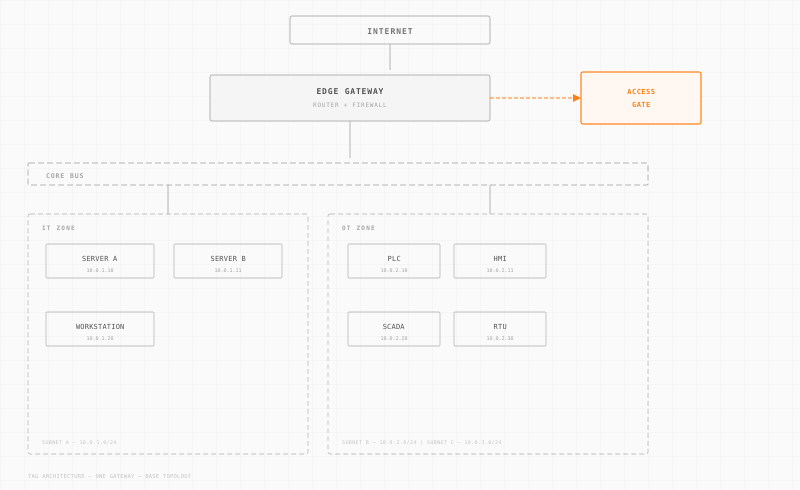
The enclave must be a distinct network segment — isolated from the general enterprise network at Layer 3. Traffic entering or leaving the enclave passes through a controlled boundary.
This is where an Access Gate appliance or VM sits. It acts as the enforcement point between the enclave and everything else. No direct routing between enclave systems and non-enclave systems. All cross-boundary traffic is inspected, logged, and policy-controlled.
2. Access Control and Authentication (NIST 800-171: AC 3.1.1–3.1.22, IA 3.5.1–3.5.11)
Every user and device entering the enclave must be:
- Identified — unique accounts, no shared credentials
- Authenticated — multi-factor authentication at the enclave boundary
- Authorized — least-privilege access based on role and need-to-know
This applies to remote maintenance sessions, local engineering workstations, and any automated process that touches CUI. The Access Gate enforces per-session authentication and records every access decision.
3. Encryption (NIST 800-171: SC 3.13.8, 3.13.11)
CUI must be encrypted in transit and at rest using FIPS 140-2 validated cryptographic modules.
- In transit: TLS 1.2+ or IPsec for all traffic crossing the enclave boundary
- At rest: Full-disk encryption or file-level encryption on storage within the enclave
FIPS validation is non-negotiable for CMMC. Self-implemented AES is not sufficient. The cryptographic module must appear on the NIST CMVP validated modules list.
4. Monitoring and Audit Logging (NIST 800-171: AU 3.3.1–3.3.9, SI 3.14.1–3.14.7)
Every event within the enclave must be logged:
- User login/logout events
- File access and modification
- Network connections (source, destination, protocol, timestamp)
- Policy changes and administrative actions
- Failed authentication attempts
Logs must be stored in a tamper-evident manner, retained for a defined period (typically 1 year minimum for CMMC), and reviewed regularly. On-premise log storage means your audit trail never leaves your facility.
5. Endpoint Hardening (NIST 800-171: CM 3.4.1–3.4.9, SI 3.14.2–3.14.3)
Systems inside the enclave must be configured to a secure baseline:
- Unnecessary services disabled
- Default accounts removed or disabled
- Patching on a defined schedule (with compensating controls for systems that cannot be patched)
- Application whitelisting where feasible
- Anti-malware with current signatures
For legacy OT systems that cannot be patched or hardened — 20-year-old PLCs, proprietary HMI software — the enclave boundary itself becomes the compensating control. The system cannot be hardened, but it can be isolated and monitored.
Deployment Timeline Comparison
| Phase | GCC High Migration | On-Premise Enclave |
|---|---|---|
| Planning and scoping | 2-4 weeks | 1-2 weeks |
| Licensing and procurement | 2-4 weeks (Microsoft tenant provisioning) | 1-2 weeks (appliance/VM delivery) |
| Configuration and migration | 6-12 weeks (email migration, SharePoint rebuild, Teams reconfiguration) | 1-2 weeks (network segmentation, policy deployment) |
| Testing and validation | 2-4 weeks | 1 week |
| User training | 2-4 weeks (new interface, new workflows) | Minimal (existing workflows unchanged) |
| Total | 14-28 weeks | 4-7 weeks |
The enclave approach is faster because it does not require migrating data or changing user workflows. Existing systems stay where they are. The enclave wraps around them.
When GCC High Makes Sense
GCC High is the right choice when:
- Your CUI handling is entirely IT-based — email, documents, collaboration
- You have no OT systems processing CUI
- You are already a Microsoft shop and the migration is incremental
- Your team size makes per-user licensing economical (under ~20 users in scope)
- You need GCC High specifically for FedRAMP High reciprocity requirements
When an On-Premise Enclave Makes Sense
An on-premise enclave is the right choice when:
- You have OT systems that process, store, or transmit CUI
- You operate in air-gapped or limited-connectivity environments
- You want predictable, fixed costs that do not scale with headcount
- You need CUI protection for legacy systems that cannot migrate to the cloud
- Your deployment timeline is measured in weeks, not months
- Data residency requirements mandate that CUI stays on your physical premises
For most manufacturers in the defense supply chain — especially those with machine shops, production lines, or test environments handling technical data packages — the on-premise enclave is the practical path. GCC High addresses one piece of the puzzle. The enclave addresses all of it. Deploy the enclave first, add GCC High later if your IT collaboration tools also need coverage. Organizations operating in both the US and EU can use this same enclave as the foundation for a unified CMMC and NIS2 compliance architecture.