
Introduction
Getting live data off a Programmable Logic Controller (PLC) sounds simple until you have to do it without slowing the controller down or opening a hole in the network. Two protocols dominate that decision: OPC-UA and Modbus. This post walks through the integration patterns for streaming real-time PLC data over both, the role of MQTT and Sparkplug as a bridge layer, the case for edge integration, and the security you inherit with each choice. It is written for IT security professionals, compliance officers, and defense contractors who have to make these calls and then defend them in an audit.
Key Takeaways
- The real constraint is the controller. The goal is to stream PLC data at the cadence you need, with the security you need, without stealing cycles from the deterministic control loop.
- OPC-UA is the secure, modern default. It has authentication, authorization, and encryption built into the specification, and subscriptions that push changes. Pick it for new builds.
- Modbus is everywhere but unsecured. Its base form has no authentication, authorization, or encryption, and no native publish, so "streaming" means polling. Wrap it in network controls.
- MQTT and Sparkplug bridge the gap. A broker fans data out from one gateway to many consumers, and Sparkplug adds the structure that turns raw MQTT into a coherent OT data layer.
Understanding PLCs in Industrial Automation
Before diving into integration patterns, it helps to be precise about what a PLC actually exposes. A PLC holds process state in a register or address space: coils, discrete inputs, holding registers, and input registers in the Modbus model, or a richly typed address space of nodes in the OPC-UA model. Streaming PLC data in real time is the act of moving the values in that address space off the controller and into a system that can store, analyze, or act on them, without disrupting the deterministic control loop that the PLC is actually there to run.
That last clause is the whole problem. PLCs are the workhorses of automation across manufacturing, energy, water, and defense supply chains, and they were designed for deterministic control, not for serving a high-volume telemetry feed. Pull too hard on a controller and you steal cycles from the control task. So the question is never simply "how do I get the data out," it is "how do I get the data out at the cadence I need, with the security I need, without degrading control."
The Importance of Real-Time Data
Real-time data streaming from PLCs lets organizations monitor processes as they happen, improve decision-making, and run predictive maintenance against live signals rather than after-the-fact reports. Accurate, timely data measurably affects production efficiency, quality control, and equipment lifespan. But "real-time" is not one thing. A vibration signal for bearing analysis may need sampling in the tens of milliseconds, while a daily energy total can be polled once a minute and nobody notices. Matching the streaming pattern to the actual latency requirement is what separates a sustainable architecture from one that quietly overloads the controller.
OPC-UA: A Secure and Scalable Solution
OPC-UA (Open Platform Communications Unified Architecture) is a platform-independent, service-oriented architecture for reliable and secure data exchange across heterogeneous industrial systems. It is standardized as the multi-part IEC 62541 series and maintained by the OPC Foundation, whose published specifications define both the information model and the communication mechanics. Its robustness and flexibility make it the modern default for real-time PLC data streaming.
Two Ways OPC-UA Moves Data
OPC-UA gives you two fundamentally different transport patterns, and confusing them is a common architectural mistake.
- Client/server with subscriptions. A client establishes a session with the server, creates a subscription, and registers monitored items. The server then pushes data change notifications only when a monitored value changes beyond a configured deadband, at a sampling interval you control. This is request/response at setup time but event-driven at runtime, which is far more efficient than naive polling because quiet tags generate no traffic.
- OPC-UA Pub/Sub. Defined in OPC UA Part 14: PubSub, this decouples publishers from subscribers entirely. A publisher emits dataset messages onto a transport, either a broker-based transport such as MQTT or AMQP, or a brokerless UDP multicast transport for low-latency, many-to-many distribution on the local network. No session, no per-subscriber connection state on the controller. Pub/Sub is what makes OPC-UA viable at fleet scale and is the natural fit when you want to fan the same data out to historians, analytics, and an MQTT broker at once.
The practical rule: use client/server subscriptions when you have a small number of consumers that need a managed session and acknowledged delivery, and reach for Pub/Sub when you need to scale fan-out, cross a broker, or hit hard latency targets on the wire.
Key Features of OPC-UA
- Platform independence. OPC-UA runs across hardware platforms and operating systems, which keeps it from locking you to a single vendor stack.
- Security as a first-class concern. The security model lives in OPC UA Part 2: Security Model and covers authentication, authorization, signing, and encryption at the message and channel level. You can run a secured channel (Sign, or SignAndEncrypt) with certificate-based mutual authentication, which is exactly the posture NIST SP 800-171 expects for protecting Controlled Unclassified Information.
- Rich, typed information model. Beyond raw values, OPC-UA carries data types, relationships, and metadata, so a consumer can discover what a tag means rather than relying on an out-of-band spreadsheet.
Implementing OPC-UA for PLCs
- Assess compatibility. Confirm your PLCs expose an OPC-UA server, or front them with one. Many modern PLCs ship with a built-in OPC-UA server, but older lines often need a gateway.
- Secure the channel by default. Turn off anonymous access, require certificate-based authentication, and run SignAndEncrypt. An OPC-UA server reachable on the network with security disabled is one of the most common and most serious findings in OT assessments.
- Design for the consumer pattern. Decide subscriptions versus Pub/Sub up front, because retrofitting from one to the other touches your entire downstream pipeline.
- Plan the address space. A clean, well-named node hierarchy pays off every time someone new has to consume the feed.
Modbus: Simplicity Meets Ubiquity
Modbus is one of the oldest and most widely deployed communication protocols in industrial automation. Published and maintained as an open specification by the Modbus Organization, its simplicity has made it a near-universal lingua franca for connecting devices, including PLCs.
How Modbus Streaming Actually Works
Modbus has no native publish mechanism. There is no "subscribe to a register and get a callback." Streaming Modbus data means polling: a client repeatedly issues read requests (read holding registers, read input registers) against a server, on an interval you set. Everything about Modbus real-time behavior follows from that fact.
- Polling cadence is your tuning knob. Poll faster for fresher data, but every poll costs a transaction on the wire and a response from the controller. On Modbus RTU serial links the round-trip time and bus contention put a hard ceiling on how fast you can go.
- Batch your reads. Reading a contiguous block of registers in one request is dramatically more efficient than many single-register reads. Laying out related values in adjacent registers is a real performance lever.
- Watch for stale and torn reads. Multi-register values that update between polls can be read mid-change. Where it matters, use the controller's mechanisms to present consistent snapshots.
Advantages of Modbus
- Simplicity. Minimal configuration, easy to implement, well understood by every integrator.
- Interoperability. Works across an enormous range of devices and vendors.
- Cost. Open and royalty-free, which keeps implementation cost down.
Integrating Modbus for Real-Time Data
- Protocol selection. Choose Modbus RTU for serial links and Modbus TCP for Ethernet networks based on your infrastructure.
- Network design. Minimize latency and maximize reliability, both of which directly bound how "real-time" your stream can be.
- Security enhancements. Modbus has no authentication, no authorization, and no encryption in its base form. The Modbus Organization's own security specification adds a TLS-protected variant, but most installed devices predate it. Treat plain Modbus as fundamentally untrusted on the wire and compensate with network controls, which is the same conclusion NIST reaches for legacy field protocols.
MQTT and Sparkplug: The Bridge Layer
Neither OPC-UA subscriptions nor Modbus polling solves the problem of getting data from many controllers to many consumers across a plant or a WAN without an explosion of point-to-point connections. This is where a lightweight publish/subscribe broker earns its place.
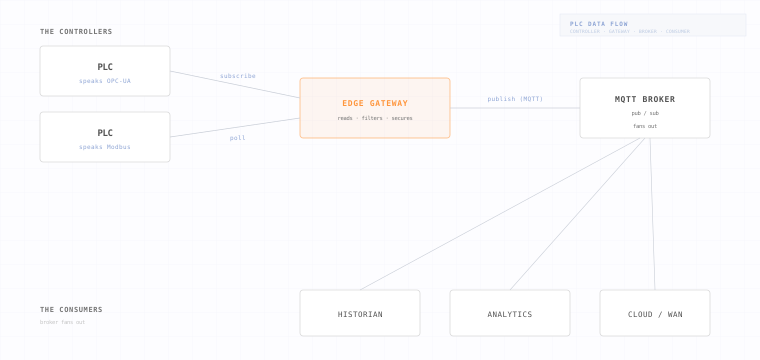
MQTT is a publish/subscribe messaging protocol designed for constrained networks and unreliable links. A gateway reads from the PLC (over OPC-UA or by polling Modbus), then publishes the values to an MQTT broker. Any number of consumers subscribe to the topics they care about. This report-by-exception, broker-mediated pattern fits OT networks well: the controller talks to one local gateway, the gateway holds one outbound connection to the broker, and the broker handles fan-out. That broker is also the exposure: a default MQTT broker ships with no authentication, encryption, or topic access control, so securing it matters as much as standing it up, see Configure MQTT flows for locking it down with identity and TLS.
Sparkplug is an open specification, governed by the Eclipse Foundation, that puts structure on top of raw MQTT. Plain MQTT says nothing about payload format or device lifecycle, so every integration reinvents both. Sparkplug standardizes the topic namespace, defines a typed payload, and adds birth and death certificates so consumers always know whether a device is online and what its current state is. For industrial telemetry, Sparkplug turns MQTT from a generic message bus into a coherent OT data layer. Pairing OPC-UA at the controller edge with an MQTT/Sparkplug bridge for transport is one of the most durable patterns in the field today.
Edge Integration
Pushing integration logic to the edge, onto a gateway or industrial PC sitting next to the controllers, changes the economics of streaming.
- Local first. The edge node polls Modbus or subscribes over OPC-UA on the local segment, where latency is low and the link is trusted, then forwards a curated stream upstream.
- Filter and aggregate before transport. Deadbanding, downsampling, and aggregation at the edge cut WAN bandwidth and cloud ingest cost, and they reduce the blast radius of a misconfigured consumer hammering a controller.
- Survive the link. A good edge gateway buffers locally and forwards on reconnect, so a WAN outage does not punch a hole in your historical record.
- Enforce the boundary. The edge is the natural place to terminate plant-side protocols and re-emit a secured, authenticated stream, which keeps insecure field protocols off the wider network entirely.
Modern Integration Patterns
Hybrid Protocol Strategy
Combining OPC-UA and Modbus lets you use each where it fits: OPC-UA for secure, typed, complex exchanges, and Modbus polling for simple, high-rate values from devices that speak nothing else. A gateway that normalizes both into a single MQTT/Sparkplug feed gives downstream systems one consistent interface regardless of what the field device actually speaks.
Cloud Integration
Streaming PLC data to cloud platforms unlocks advanced analytics and scalable storage. The boundary crossing is the sensitive part. Terminate plant protocols at the edge, push only over authenticated, encrypted channels, and make sure cloud integrations stay aligned with CMMC obligations when Controlled Unclassified Information is in scope.
Security Implications
The streaming pattern you pick is a security decision, not just an architecture decision.
- Protocol-inherited risk. OPC-UA can authenticate and encrypt; Modbus, in its base form, can do neither. Anything you stream over plain Modbus is readable and forgeable by anyone on the segment.
- Defense in depth, not protocol retrofit. NIST SP 800-82, Guide to Operational Technology Security, is explicit that OT environments should rely on layered controls, network segmentation, and strict access boundaries rather than assuming the field protocol will protect itself. That guidance maps directly onto streaming: segment the OT network, gate every flow that leaves it, and monitor at the boundary.
- Least-privilege data flows. A streaming consumer rarely needs write access. Read-only paths, enforced at the gateway, remove an entire class of attack where a compromised analytics consumer issues control writes back to a PLC.
- Visibility. Protocol-aware monitoring at the gateway turns the streaming boundary into a sensor, surfacing unexpected reads, malformed frames, or connection attempts that should never happen.
Challenges and Considerations
Legacy Systems
Many environments still run controllers that speak only legacy protocols. Protocol gateways bridge these into modern architectures and, done right, double as the security boundary that keeps the old protocol off the wider network.
Compliance and Security
Alignment with NIST 800-171, NIST SP 800-82, and CMMC is not optional in regulated environments. Regular audits and security assessments keep you compliant and surface vulnerabilities before an assessor does.
Interoperability
Seamless interoperability across devices and vendors still demands real testing. Validate the full path, controller to gateway to broker to consumer, during integration rather than discovering the gaps in production.
Conclusion
When streaming PLC data in real time, your protocol choice determines your security posture. OPC-UA gives you encryption, authentication, and a choice between managed subscriptions and scalable Pub/Sub; Modbus gives you neither security nor a native streaming model, only polling. The strongest pattern in the field today reads from the controller over a secured protocol, normalizes through an edge gateway, and transports over MQTT with Sparkplug for structure, with the OT boundary segmented and gated per NIST SP 800-82. For new integrations, default to OPC-UA with security enabled. For existing Modbus deployments, add security at the network layer rather than attempting to retrofit a protocol that was never built to defend itself.
For securing the OPC UA endpoint itself, rather than the pipeline that carries its data, see the dedicated guide.