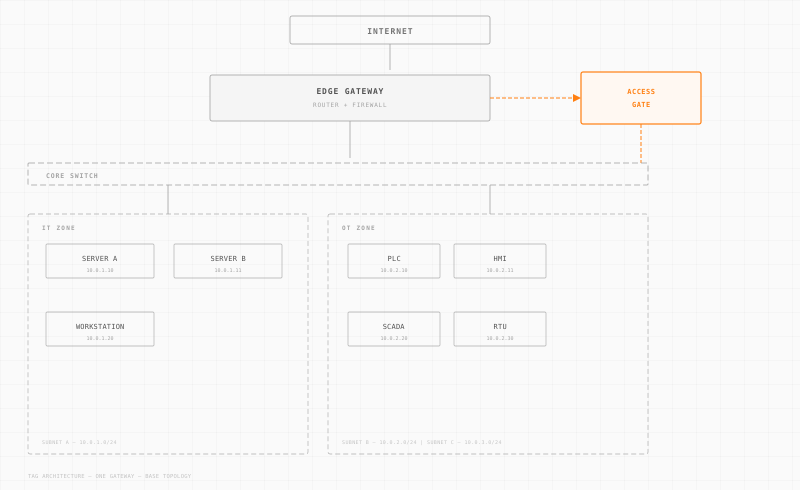
A compensating control is a security mechanism that delivers equivalent protection when the targeted NIST SP 800-171 Rev 2 requirement cannot be implemented on the asset itself. Under CMMC Level 2, every Enduring Exception must be paired with a compensating control that is technically implemented, not just described on paper.
When are compensating controls required?
CMMC maps Level 2 to the 110 controls in NIST SP 800-171 Rev 2. A defense contractor can invoke an Enduring Exception for an asset, typically a PLC, CNC, HMI, or other specialized OT equipment, that cannot natively satisfy a given control. The exception documents the asset's incapacity. It does not remove the control obligation. A compensating control closes the gap.
The Affirming Official who signs the assessment is certifying that each compensating control produces verifiable evidence equivalent to the original requirement. A C3PAO will ask for that evidence during the assessment. Control language on paper without a working technical implementation is not sufficient.
What must the compensating control do?
Four tests for an acceptable compensating control:
- Equivalent risk reduction. The control must mitigate the specific risk that the unimplemented requirement addresses, not a similar risk, the same one.
- Technically implemented. The mechanism is deployed, not planned. Configuration is exportable as evidence.
- Verifiable. Logs, policy exports, or network captures demonstrate the control operating.
- Documented in the SSP. The asset, the uncovered control, the compensating mechanism, and the evidence path are all written down.
How do compensating controls work for OT assets?
Most OT compensating controls shift enforcement from the asset to a network-layer proxy. A CNC controller that cannot perform MFA is protected by an identity gateway that enforces MFA at the network boundary before any session reaches the machine. A legacy controller that cannot generate audit logs is protected by session logging at the proxy. A device that speaks plaintext Modbus is protected by encrypted transport terminating at the proxy inside a micro-DMZ.
The pattern is consistent: the asset remains unchanged, the compensating control runs elsewhere, the SSP documents the architecture.
Related terms
- CMMC Enduring Exception
- Specialized Asset (CMMC)
- Affirming Official (CMMC)
- CMMC Shared Responsibility Matrix
- NIST SP 800-171
How Access Gate helps
Access Gate is commonly used to host compensating controls for OT assets that qualify for Enduring Exceptions, enforcing identity, audit, and encryption at the network boundary rather than modifying the asset. See the CMMC Shared Responsibility Matrix for per-control coverage.