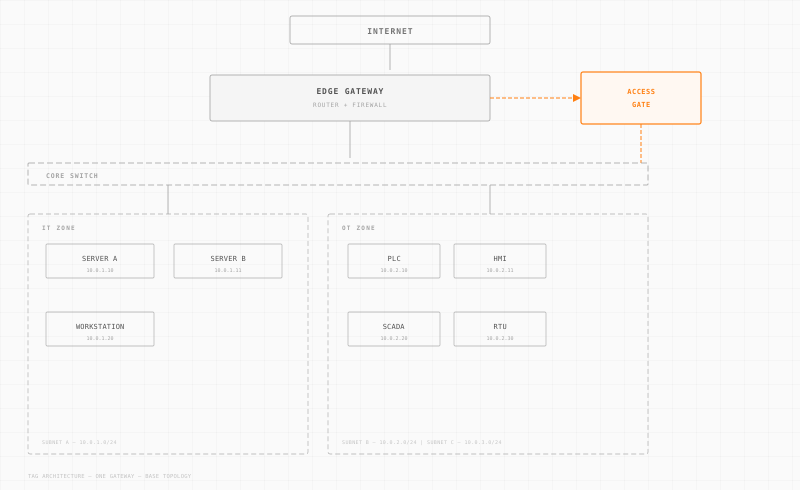
A CUI enclave is an isolated network segment that contains every system storing, processing, or transmitting Controlled Unclassified Information (CUI). It draws a hard boundary around CUI-handling assets and enforces that only authenticated, authorized identities can reach anything inside it. That boundary is also the assessment scope for CMMC Level 2 and the unit of documentation in the System Security Plan (SSP).
How does a CUI enclave work?
A CUI enclave groups every asset that touches CUI into one logical boundary: workstations where engineers open controlled technical data, file servers that store CUI documents, and any network path CUI crosses in transit. Everything inside the boundary is in scope. Everything outside it, ideally, is not.
Overlay networking lets you build that enclave without physical recabling. An overlay creates a virtual network on top of the existing LAN, using tunneling to steer traffic between enclave members. Because it operates at Layer 3 or above, it is independent of switch topology, so a contractor can stand up one enclave spanning multiple buildings, floors, or sites without new hardware or downtime for cable runs. And because all CUI traffic funnels through the overlay, a single enforcement point logs every access attempt and produces the audit evidence assessors expect.
How is a CUI enclave different from a VLAN?
The difference is the enforcement mechanism. A VLAN segments traffic at Layer 2 using switch-port assignments and 802.1Q tags. Any device plugged into the right port, or configured with the right VLAN ID, joins the segment regardless of who is using it or how the device is configured. A CUI enclave requires identity verification before granting network-layer access. Traffic from an unauthenticated or unauthorized device never reaches enclave resources, even when that device shares the same physical switch. VLANs separate traffic. Enclaves separate trust.
Why do CUI enclaves matter for OT and industrial environments?
Defense manufacturers often handle CUI on the same shop floor where PLCs, HMIs, and SCADA historians run. A CNC machine receiving controlled technical drawings is inside the CUI enclave; the adjacent environmental monitoring system is not. Without a well-drawn enclave, the whole plant network becomes the assessment boundary, and the cost and complexity of a CMMC assessment climb with it.
In brownfield OT environments, where change freezes and uptime rules block physical network edits, overlay-based enclaves are especially useful. The enclave deploys alongside production infrastructure without touching IP addressing, switch and VLAN configurations, or firewall rules on the physical network.
What CMMC and NIST controls apply to CUI enclaves?
CMMC Level 2 requires contractors to document every CUI enclave boundary in the SSP and show that access is limited to authorized users with a legitimate need. NIST SP 800-171 controls AC-3 (access enforcement), SC-7 (boundary protection), and SC-28 (protection of information at rest) map directly to enclave design. IEC 62443 zones and conduits give a complementary way to define enclave boundaries in OT.
Related terms
- Controlled Unclassified Information (CUI)
- CMMC
- Network Segmentation
- Zero Trust Architecture
- NIST SP 800-171
How Access Gate helps
Access Gate builds identity-enforced CUI enclaves with overlay networking, letting defense contractors isolate CUI-handling systems without physical network changes. See CMMC compliance.