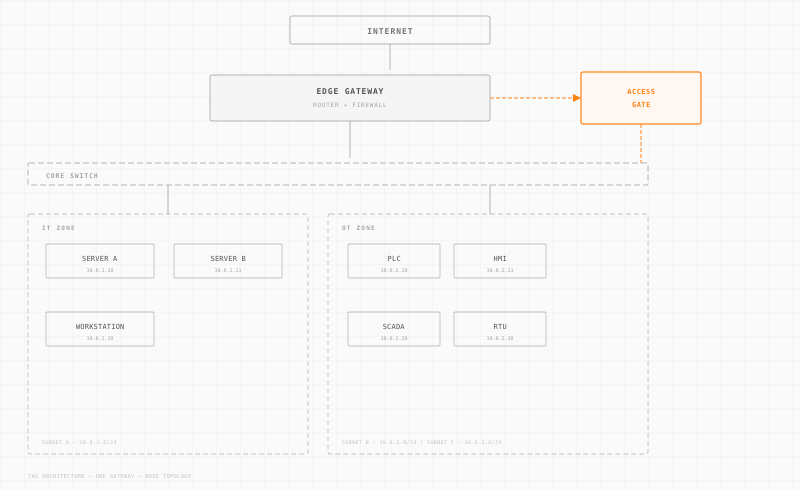
Zero Trust Architecture (ZTA) is a security model built on one rule: never trust, always verify. No user, device, or connection is trusted because of where it sits on the network. Every access request is authenticated, authorized, and checked against policy before it is granted, and the grant is scoped as narrowly as possible. NIST SP 800-207 is the reference definition, and it exists to kill the old assumption that anything inside the firewall is safe.
What is Zero Trust Architecture?
It is a shift away from perimeter security. The classic model builds a hard shell around a trusted interior, so once an attacker is inside, they move freely. ZTA removes the trusted interior. It treats the network as hostile, verifies identity on every request, enforces least privilege, and assumes a breach will happen so it limits the blast radius when it does. The building blocks are identity and access management, microsegmentation, continuous verification, and encryption in transit.
How does Zero Trust Architecture work?
A policy engine sits between a requester and a resource. When a user or device asks for access, the engine evaluates identity, device posture, and context against policy, then a policy enforcement point either brokers the connection or denies it. Access is granted per session and per resource, not once at login for the whole network. Microsegmentation carves the environment into small zones so a compromise in one does not spread, and zero-trust network access applies the same logic to remote connections, replacing the flat, all-or-nothing tunnel a VPN gives you.
Why does Zero Trust Architecture matter for OT?
Because OT is where implicit trust does the most damage and where it is hardest to remove. Plant-floor devices often cannot run agents, cannot do MFA, and speak plaintext protocols with no authentication. A flat control network means one compromised engineering laptop can reach every PLC. ZTA fixes that at the network layer: it puts identity in front of assets that cannot authenticate themselves, and it contains lateral movement so an intrusion stays local. That protects the insider-threat case, the legacy-system case, and the advanced-attacker-who-is-already-inside case at the same time. See zero trust for OT for the industrial specifics.
How does Zero Trust Architecture support compliance?
It maps cleanly onto the controls regulators ask for. NIST SP 800-171 and CMMC want strong access control and monitoring. NERC CIP wants an enforced electronic security perimeter with logged remote access. The US Department of Defense mandated a zero-trust target architecture, and DTM 25-003 extends that thinking to OT. Implementing ZTA is often the most direct way to satisfy several of these at once.
How Access Gate helps
Access Gate is an agent-free way to stand up ZTA across IT and OT without touching endpoints. It builds an identity-enforced overlay that microsegments the network, brokers every session through a policy check, proxies and logs remote and vendor access, discovers assets, and forwards east-west traffic to your SIEM. Legacy devices that cannot authenticate sit behind the overlay, so they inherit zero-trust enforcement without any change to the device. See Zero-trust access control.