Operational technology (OT) security protects the hardware and software that detect or cause changes in the physical world by monitoring and controlling industrial equipment, processes, and events. Where IT security is built to protect data, OT security is built to protect the safety and continuous operation of physical processes. When it fails, the result is not a leaked file, it is a stopped line, a damaged turbine, or an unsafe condition. For the full picture, read the guide to OT cybersecurity without downtime.
What is OT security?
It is the practice of securing industrial control systems: SCADA systems, distributed control systems (DCS), and programmable logic controllers that run factories, grids, pipelines, and water plants. These systems value availability and integrity above all, run for a decade or more without a reboot, and often speak plaintext protocols that were never designed to be authenticated. That is what makes securing them a different discipline from IT.
How is OT security different from IT security?
The priorities are inverted. IT security ranks confidentiality first, then integrity, then availability. OT flips that: availability and safety come first, because the process must keep running and must never harm anyone. Practical consequences follow. You cannot patch on IT's schedule when a reboot means stopping production. You often cannot install an agent on a controller. You cannot assume a device can do MFA or encryption. So OT defense leans on the network layer, segmentation, monitoring, and access control, rather than on endpoint agents. The convergence of IT and OT makes this harder, because connecting the two exposes fragile OT to threats that used to stop at the corporate firewall.
Why does OT security matter?
Because the consequences are physical and public. A cyberattack that reaches a power plant's control systems can cause outages. One that reaches a water treatment plant can threaten public health. Attacks like Stuxnet, the 2015 and 2016 Ukraine grid attacks, and the 2021 Oldsmar water intrusion showed that OT is a real target, not a theoretical one. For operators, downtime and safety incidents dwarf the cost of most data breaches.
Who has to comply with OT security standards?
Any operator of critical or industrial infrastructure, and the standards stack up by sector. IEC 62443 is the core international standard for industrial automation and control systems. NIST SP 800-82 gives US guidance for ICS. NERC CIP is mandatory for the North American bulk electric system. For defense contractors, CMMC and NIST SP 800-171 extend to OT that touches controlled information.
How do you actually secure an OT environment?
The workable playbook is layered: segment OT from IT and segment within OT to contain lateral movement, enforce least-privilege access so only authorized users reach control systems, monitor east-west traffic for anomalies, and control remote and vendor access tightly. Zero trust for OT ties these together by removing the implicit trust that flat control networks depend on. The OT security guide compares these approaches by the downtime each one needs, industry by industry.
How Access Gate helps
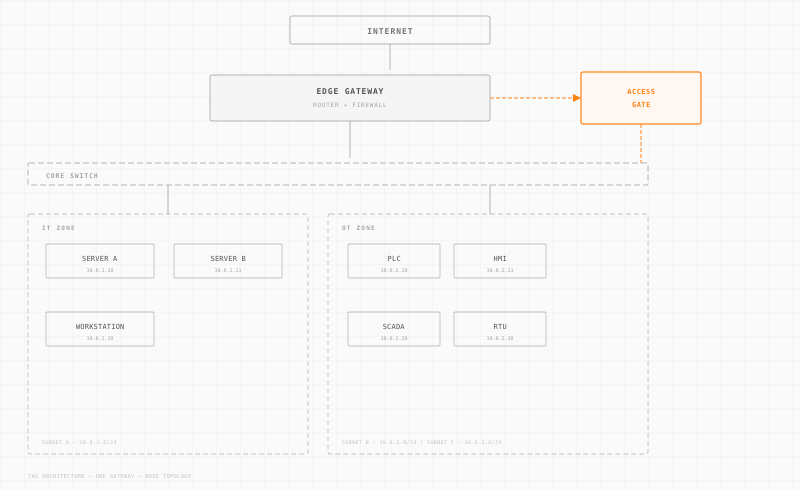
Access Gate secures OT without agents on the controllers. It builds an identity-enforced overlay that segments the network per asset or cell, proxies and logs remote and vendor sessions, discovers what is on the network passively, and forwards east-west traffic to your SIEM. Legacy devices that cannot authenticate sit behind the overlay and inherit enforcement, so you get zero-trust access control without re-cabling the plant or touching a single PLC. See Defense and government contracting.