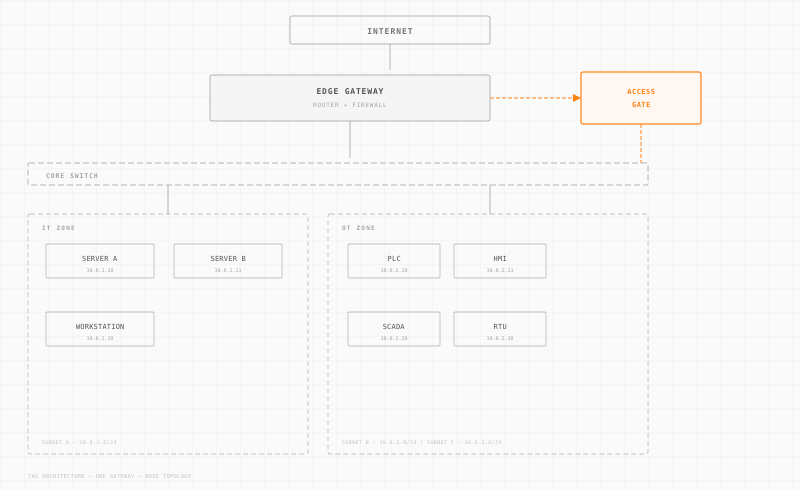
Supervisory Control and Data Acquisition (SCADA) is the control-system architecture that lets operators monitor and control industrial processes spread across many locations from one central point. It gathers real-time data from field sensors and controllers, shows it to operators through a Human-Machine Interface (HMI), and pushes commands back down to the equipment. You find it running water treatment, power grids, pipelines, and factory lines.
How does a SCADA system work?
A SCADA system is layered. Out in the field, sensors and actuators connect to Programmable Logic Controllers (PLCs) and Remote Terminal Units (RTUs) that do the direct control. Those devices report over industrial protocols like Modbus, DNP3, and EtherNet/IP to a central server, which logs everything in a historian and renders it on the HMI. An operator watches a tank level or a breaker state on screen and, when needed, issues a command that travels back down the same path to the field.
Where is SCADA used?
Anywhere a process is too large or too spread out to run by hand. Water and wastewater utilities use it to run pumps and dosing across a service area. Electric utilities use it for substation monitoring and switching. Oil and gas run it along pipelines; manufacturers run it on production lines. The common thread is a physical process that has to stay inside safe limits without an operator standing at every valve.
Why is SCADA hard to secure?
Because it was built for reliability and uptime, not for a hostile network. Much of the installed base predates modern security: flat networks, plaintext protocols with no authentication, and controllers that can fault from a single malformed packet, which is why active scanning is unsafe on production OT. Then IT and OT converged, and systems designed to sit on an isolated line got reachable from corporate networks and the internet. The 2021 Oldsmar water incident and the Colonial Pipeline shutdown both traced back to remote access into this kind of environment. Frameworks like IEC 62443 and NERC CIP exist to close that gap.
How does Access Gate help secure SCADA?
Access Gate wraps SCADA systems in an identity-enforced overlay without touching the controllers or re-addressing the network. It segments the HMI, historian, and PLC traffic so a compromised IT host cannot reach the control layer, proxies and logs every vendor and engineering session instead of dropping a flat VPN onto the plant, and watches east-west traffic between devices for anomalies. Because it needs no agent on the equipment, legacy RTUs and PLCs are covered as they are. See Zero-Trust Access Control.