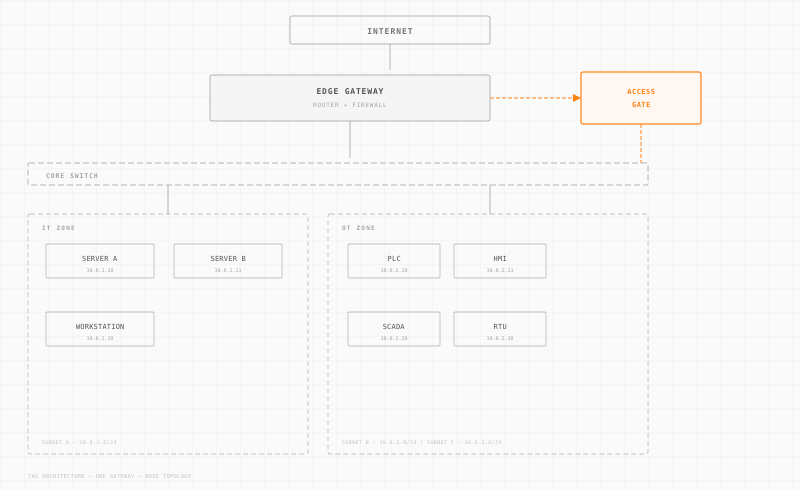
Industrial Control Systems (ICS) security is the practice of protecting the systems that run physical processes, SCADA, distributed control systems, and programmable logic controllers, from cyber threats. These are the systems that open valves, spin turbines, and move production lines. When they fail or get manipulated, the damage is physical: unsafe conditions, environmental harm, stopped production, not just leaked data.
What is ICS security?
ICS security covers the hardware, software, and networks that monitor and control industrial operations across manufacturing, energy, water, and transportation. It protects three broad kinds of system:
- SCADA: supervisory control and data acquisition, used to monitor and control field devices spread across wide geographic areas.
- Distributed Control Systems (DCS): control platforms for a localized site such as a refinery or a plant.
- Programmable Logic Controllers (PLCs): the rugged computers that automate specific machine functions. See PLC security for how to protect them.
These sit inside the wider world of operational technology, and securing them is a different job from securing an office network.
Why is ICS security different from IT security?
IT security optimizes for confidentiality first. ICS security optimizes for availability and safety, because a controller that stops or misbehaves has consequences in the physical world. The constraints that follow shape everything:
- Long lifecycles. ICS equipment runs for 15 to 20 years. Much of it predates modern security thinking and cannot be swapped on a whim.
- Patching is hard. You cannot always take a live process offline to apply an update, and vendors may not support one anyway.
- Insecure by design. Many industrial protocols, Modbus among them, have no authentication. They trust any command on the wire.
- Uptime is sacred. A reboot that is routine in IT can mean lost batches or a safety event in OT.
Why does ICS security matter?
Because ICS increasingly touches the internet and the IT network, and attackers have noticed. Stuxnet showed a PLC could be sabotaged. The 2015 and 2016 attacks on Ukraine's grid took substations offline. The 2021 Oldsmar water incident showed a remote actor reaching into a treatment plant's controls. As OT and IT converge, the isolation that once protected these systems is gone, and the standards bodies have responded: IEC 62443 for industrial automation security, NIST SP 800-82 for ICS guidance, plus NIST SP 800-171 and CMMC where CUI is involved, and NERC CIP for the bulk electric system.
How do you secure industrial control systems?
Since the devices often cannot defend themselves, the strategy leans on the network and on access:
- Network segmentation to isolate ICS from IT and stop lateral movement.
- Access control so only the right person, from the right place, through a controlled path, reaches a controller.
- Managed patching and configuration on a realistic schedule for the systems that can take it.
- Monitoring and incident response tuned to industrial protocols, plus a tested plan for when something gets through.
How does Access Gate help?
Access Gate secures ICS without touching the controllers themselves. As an agent-free overlay it discovers every asset, microsegments the flat control network into identity-defined zones, proxies remote and vendor sessions so every engineering connection is logged and terminable, and forwards east-west traffic to your SIEM. That gives legacy PLCs and SCADA the access control and segmentation that IEC 62443 asks for, without a rip-and-replace project. See Zero-trust access control.