
Pass every audit, OT and on-premise. The evidence builds itself.
Trout Access Gate is an on-premise appliance that produces compliance evidence for OT and on-premise IT systems. It turns machines and servers you cannot patch or put an agent on into documented access, identity and audit records, mapped to the frameworks your auditor checks.
Last updated:
Trusted by leading companies


Access Gate turns everyday operation into compliance evidence.
It sees the whole network, OT and on-premise IT, keeps a live inventory of machines and servers and records every session by person. So the visibility, inventory, encryption and proof of access that frameworks demand come from one system. You export them on demand.
Four kinds of evidence, one system.
Most teams stitch compliance together from separate tools. Access Gate produces the evidence for your OT and on-premise systems in one place, so it stays consistent and current.
See the whole network.
Passive visibility finds every machine, server and user on your network, OT and IT. No scanning, no production impact.
Keep a live inventory.
Every machine and server listed, with the history of what changed and when. That list is the first evidence an auditor asks for.
Prove who reached what.
Every session is tied to a person and recorded: who reached which machine or server, when, and what they did. Kept on site.
Export evidence on demand.
Generate the reports and evidence packs an assessor asks for, without assembling them by hand.
Each access is recorded once and reused.
When a person reaches a machine or a server, Access Gate records who, which system and when. The same record feeds your SIEM, the auditor's report and your framework evidence.
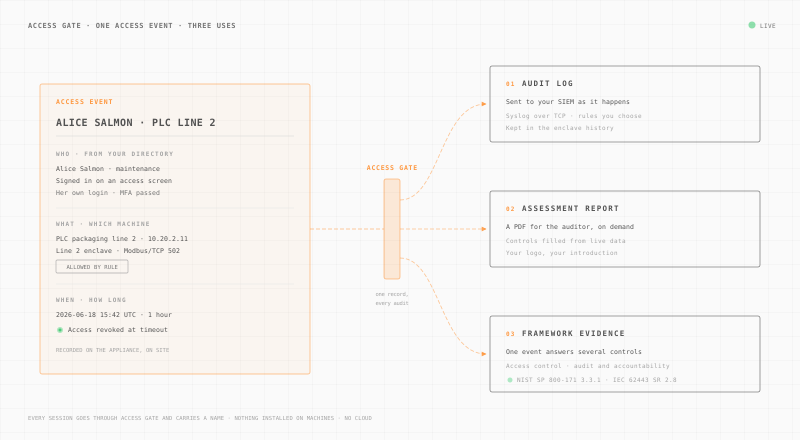
Audit log.
Each access goes to your SIEM over syslog as it happens, and stays in the enclave history.
Log forwarding guideAssessment report.
Run an assessment for a site. Controls Access Gate enforces are filled from live data, then exported as a PDF.
Assessment report guideFramework evidence.
The same record answers the access control and audit controls of CMMC, NERC CIP and IEC 62443.
CMMC complianceThe same evidence for every framework.
CMMC, NERC CIP, and IEC 62443 ask similar questions: what is on the network, who can reach it, and can you prove it. The dedicated pages show the row-by-row mapping.
CMMC
Access control, audit and accountability, and system inventory evidence for CUI enclaves.
NERC CIP
Interactive Remote Access, system inventory, and access-monitoring evidence for the bulk electric system.
IEC 62443
Zone and conduit, identification and authentication, and use-control evidence for industrial automation and control systems.
One system replaces a stack of point tools.
| Capability | Spreadsheets + point tools | Access Gate |
|---|---|---|
| Asset inventory | Manual spreadsheet, stale the day it is built | Continuous, updated from live traffic |
| Network visibility | Periodic scans with blind spots | Passive and always-on, no scanning |
| Proof of access | Shared accounts, no attribution | Identity-bound, per person, recorded |
| Audit evidence | Assembled by hand for each assessment | Exported on demand |
| Where the data lives | Scattered across tools and SaaS | One system, on-premise |
| Framework coverage | A different tool per framework | One evidence set maps to CMMC, NERC CIP, IEC 62443 |
Questions about OT and on-premise compliance.
It watches the network passively to build visibility and a live inventory, and it brokers every session so each access is identity-bound and recorded. Compliance evidence is a by-product of running the system. You export it on demand.
No. It produces the technical evidence frameworks require for your OT and on-premise systems: visibility, inventory and proof of access. Then it exports it. It feeds your GRC or audit process rather than replacing it.
The same underlying evidence maps across CMMC, NERC CIP, and IEC 62443, because they ask similar questions: what is on the network, who can reach it, and can you prove it. The dedicated pages show the row-by-row mapping.
No. Discovery is passive and agentless, and the evidence is produced and stored on-premise. There is no dependency on an external service.