Phishing is the use of deceptive messages, usually email, to trick a recipient into revealing credentials, running malware, or authorizing a transaction. In OT environments, phishing is the most common entry point for incidents that eventually touch production systems, because the humans with access to engineering workstations are phishing targets the same as anyone else.
Why OT phishing is different
General phishing campaigns are volume plays against consumer and enterprise IT. OT-relevant phishing is usually targeted and plant-specific:
- Vendor impersonation. Messages pretending to be from Siemens, Rockwell, Schneider, or a specific integrator, requesting firmware uploads, configuration changes, or credential resets for project portals.
- Operational urgency. References to a specific plant, a known scheduled maintenance window, or a production incident. The context is extracted from public filings, LinkedIn posts, or previous reconnaissance.
- Engineering-workstation targets. The goal is not to reach the PLC directly, it is to reach the engineering laptop that has PLC programming software installed, which already has authenticated access to the controllers.
- Dual-homed hosts. Many engineers' machines sit on both the corporate network and the plant network. Compromising the host gives the attacker a routable path into OT.
The common incident shape
Most disclosed OT incidents that began with phishing follow a pattern: an operator or engineer opens a document, credential theft or remote access follows, the attacker traverses to a host with OT access, then either deploys ransomware on IT systems that OT depends on (scheduling, historians, file shares) or, rarely, reaches the control layer directly. The Saudi Aramco incident (Shamoon, 2012) began with a phishing email. The Ukrainian power-grid attack (BlackEnergy / Industroyer, 2015 to 2016) began with Excel macros in phishing attachments targeting grid operators.
What changes in the mitigation model
IT phishing defense focuses on three layers: email filtering, user training, and endpoint detection. In OT, the engineering workstation sits in a harder-to-defend position, it often runs legacy software that cannot be patched or restricted because the PLC programming tools depend on specific OS versions. Two additional controls matter disproportionately:
- Network-layer containment of engineering workstations. A compromised host should not be able to reach every PLC on the segment by default. Identity-bound rules and per-session authorization limit the blast radius.
- Session-level audit on privileged OT access. If an engineer account reaches a PLC outside normal change windows, that session is detectable regardless of how the credential was obtained.
Related terms
- Spear Phishing
- Social Engineering
- Multi-Factor Authentication
- Cybersecurity Awareness Training
- Zero Trust in OT
Access Gate connection
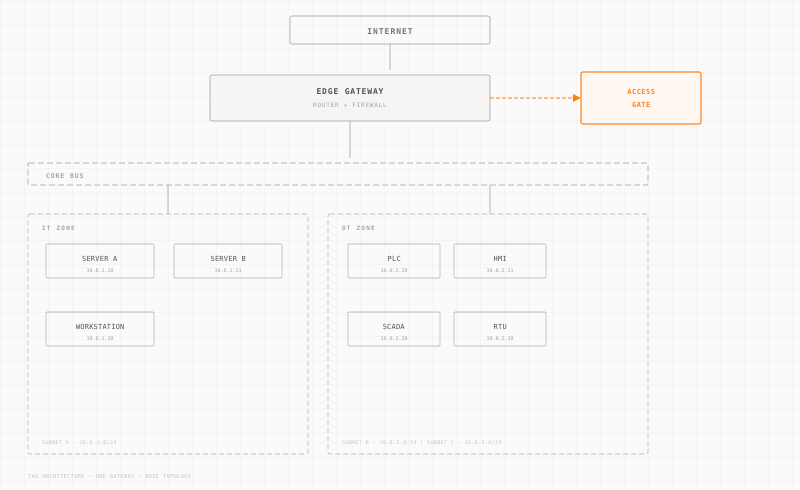
Access Gate enforces identity-bound, per-session access to OT assets, a phished credential does not grant the attacker a routable path to the control layer, because every session is re-authorized at the proxy. See OT Network Visibility.