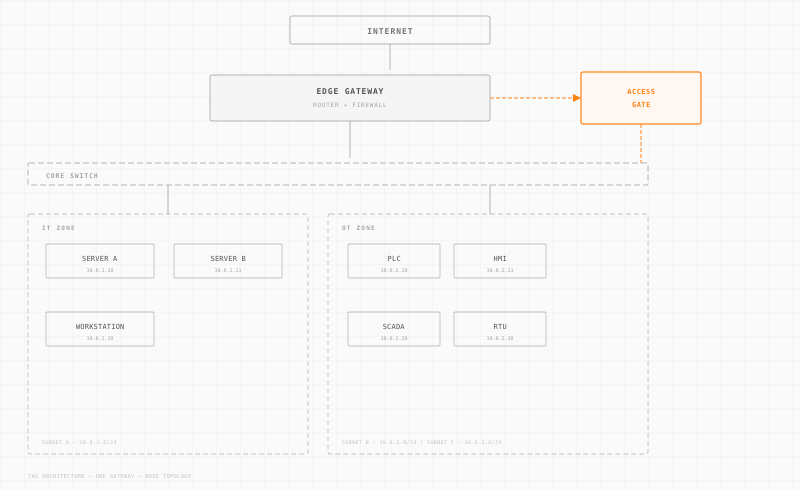
Multi-Factor Authentication (MFA) is a security process that requires users to provide two or more verification factors to gain access to a resource such as an application, online account, or VPN. This method combines something the user knows (password), something the user has (security token), and something the user is (biometric verification) to enhance security beyond passwords alone.
Understanding Multi-Factor Authentication in OT/IT Cybersecurity
In the context of Operational Technology (OT) and Information Technology (IT) cybersecurity, MFA plays a critical role in safeguarding sensitive systems and data against unauthorized access, especially in environments that are part of critical infrastructure, industrial, and manufacturing sectors. These environments are often targets for sophisticated cyber threats due to their significant impact on national security and economic stability.
The Role of MFA in Critical Environments
In industrial and critical environments, the consequences of a security breach can be severe, potentially leading to physical damage, operational downtime, or threats to human safety. MFA mitigates these risks by ensuring that even if a password is compromised, additional layers of security must be breached before unauthorized access is granted. This is particularly crucial in environments where legacy systems and industrial control systems (ICS) might not have built-in robust security features.
Standards and Compliance
Implementing MFA is not just a best practice; it is often a requirement under various cybersecurity frameworks and standards. For instance:
- NIST 800-171: This standard specifies that federal contractors must implement MFA to protect Controlled Unclassified Information (CUI) in non-federal systems.
- Cybersecurity Maturity Model Certification (CMMC): Enforces the use of MFA as a measure to ensure that contractors meet cybersecurity requirements to protect sensitive information.
- IEC 62443: Although primarily focused on industrial automation and control systems security, this standard recognizes the importance of strong authentication measures, including MFA, to protect critical systems.
Why It Matters
MFA is crucial in reducing the attack surface in industrial and critical environments. By requiring multiple forms of verification, MFA makes it significantly more difficult for attackers to gain unauthorized access. This is particularly important in OT environments, where the impact of a cyber attack might not only be data theft but could also lead to physical consequences such as damage to infrastructure or interruptions in service delivery.
For example, in a manufacturing plant, MFA can protect the control systems that regulate machinery, preventing unauthorized changes that could disrupt operations or cause accidents. Similarly, in a power grid, MFA ensures only authorized personnel can access systems that monitor and control power distribution, thereby maintaining grid stability and security.
In Practice
Implementing MFA in an OT/IT environment involves integrating it into existing security frameworks and ensuring that all users, from operators to administrators, adhere to its requirements. It is essential to balance security with usability, ensuring that the MFA process does not impede legitimate users' ability to perform their duties efficiently. This might involve using hardware tokens for operators working in environments where mobile devices are impractical or leveraging biometric authentication for ease of use and security.