Ethernet is a widely-used networking technology that facilitates communication over a local area network (LAN) through the use of specific protocols and hardware. It is the foundational technology for most wired network connections, employing various types of network cabling to link devices and enable data transmission.
Ethernet in OT/IT Cybersecurity
In the context of Operational Technology (OT) and Information Technology (IT) cybersecurity, Ethernet plays a critical role by providing the physical and data link layers of the network infrastructure. It is the backbone for connecting various devices, systems, and control networks within industrial and manufacturing environments. Industrial Ethernet refers to the adaptation of Ethernet technology to meet the demanding requirements of industrial settings, where robustness, reliability, and real-time data communication are critical.
Industrial Ethernet supports protocols such as PROFINET, EtherNet/IP, and Modbus TCP, which are designed to withstand harsh conditions often found in factories, energy plants, and critical infrastructure. These protocols ensure seamless integration and communication between IT and OT systems, enhancing the overall security posture by allowing centralized monitoring and management.
Why It Matters for Industrial, Manufacturing & Critical Environments
Ethernet's significance in industrial, manufacturing, and critical environments cannot be overstated. The technology provides the necessary infrastructure to support complex networks that drive automation, control systems, and data exchange, all of which are vital for efficient and secure operations. Ethernet's ability to facilitate high-speed communication, while maintaining network integrity and security, is crucial for ensuring the confidentiality, integrity, and availability of data.
Compliance with Standards
Ethernet networks in critical environments must align with various cybersecurity standards and guidelines to ensure robust protection against cyber threats:
-
NIST 800-171: This standard emphasizes the protection of Controlled Unclassified Information (CUI) in non-federal systems, highlighting the importance of secure network configurations, which Ethernet supports.
-
CMMC (Cybersecurity Maturity Model Certification): Industrial Ethernet networks play a role in achieving CMMC compliance by adhering to best practices for network management and security.
-
IEC 62443: This series of standards focuses on securing industrial automation and control systems, endorsing the use of Industrial Ethernet as part of a secure network architecture.
In Practice
Implementing Ethernet in an industrial setting involves selecting appropriate network cabling and hardware that can withstand environmental challenges such as temperature extremes, electromagnetic interference, and physical wear. Shielded cables, rugged connectors, and industrial-grade switches are commonly used to ensure reliable operation.
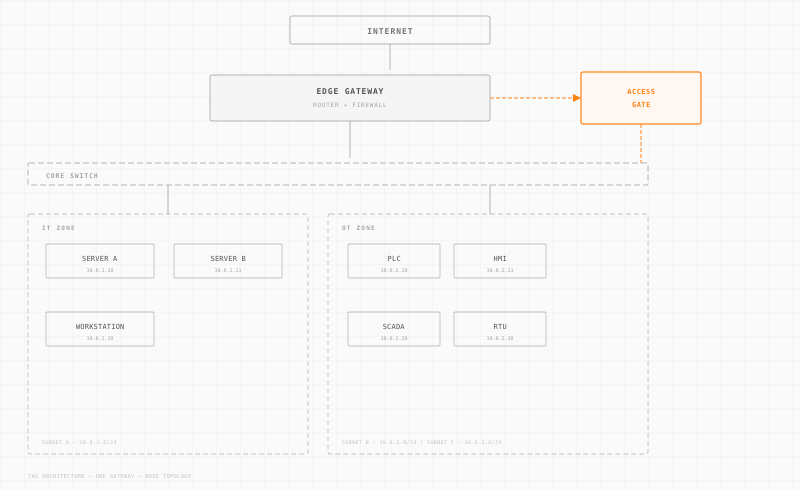
Consider a manufacturing facility that employs Ethernet-based communication to connect its programmable logic controllers (PLCs), human-machine interfaces (HMIs), and sensors. This setup allows real-time monitoring and control of production lines, enhancing efficiency and safety. Furthermore, by integrating Ethernet with cybersecurity measures, the facility can protect against unauthorized access and data breaches, ensuring compliance with industry standards and regulations.
Related Concepts
- Industrial Ethernet: Specialized Ethernet protocols and hardware for industrial environments.
- Network Cabling: The physical medium used to connect devices in a network.
- OT/IT Convergence: The integration of operational and information technologies.
- NIST 800-171: A standard for protecting controlled unclassified information.
- IEC 62443: Standards for securing industrial automation and control systems.