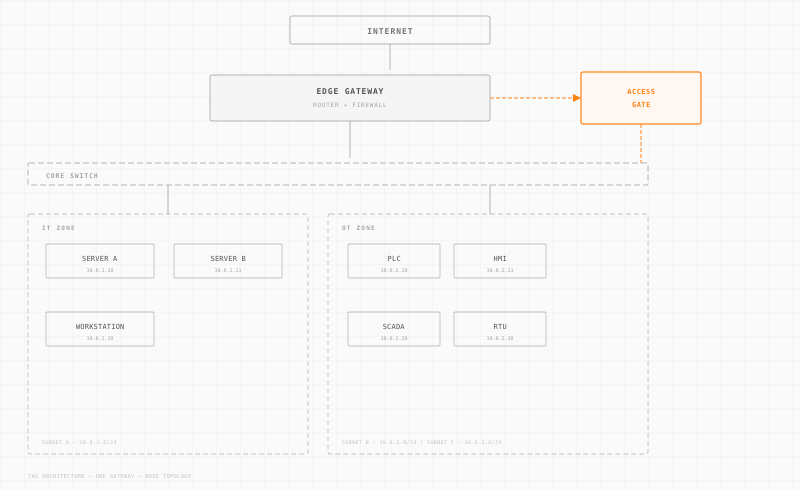
Industrial networking is the set of network systems and protocols built to connect machines, controllers, sensors, and control systems inside industrial environments. It carries the traffic that runs SCADA and industrial control systems, and it is engineered for a different job than office IT: predictable real-time delivery, near-continuous uptime, and survival on a plant floor full of heat, vibration, and electrical noise.
What is industrial networking?
It is the plumbing of operational technology. Where an office network moves emails and files and can tolerate a dropped packet or a half-second delay, an industrial network moves control commands where timing is part of correctness. A motion controller that expects a signal every few milliseconds treats a late packet as a fault. That single difference, determinism over raw throughput, shapes almost every design choice in the field.
Industrial networks are also built to physical extremes: wide temperature ranges, electromagnetic interference from nearby motors, and constant vibration that would loosen ordinary connectors. The hardware is ruggedized, and the topologies favor redundancy so a single cable failure does not stop a line.
How does industrial networking work?
Most plants run a layered design. At the bottom, fieldbus and industrial Ethernet protocols connect controllers to the devices they command. Above that, a supervisory layer links controllers to HMIs and historians. The Purdue Model is the reference architecture that names these layers and defines how they should be separated.
The protocols are the part that surprises people coming from IT. Many are decades old and were designed for isolated networks with no authentication or encryption:
- Industrial Ethernet variants such as PROFINET and EtherNet/IP adapt standard Ethernet for deterministic control traffic.
- Modbus remains everywhere despite offering no built-in security.
- Fieldbus protocols and OPC UA fill the layers between devices and supervisory systems.
Why does industrial networking matter for security?
Because the protocols trust each other by default. Modbus, PROFINET, and their peers were built for air-gapped networks where anything on the wire was assumed friendly. As plants connected OT to IT for remote monitoring and analytics, that assumption stopped holding, and a network that trusts every device became a network where one compromised laptop can command a PLC.
This is the core problem of OT/IT convergence. The fix is not to bolt IT security onto OT wholesale, which can break the timing OT depends on, but to segment the network so control traffic is contained and every crossing between zones is inspected and authorized. Standards such as NIST SP 800-82 and IEC 62443 exist precisely to guide that work, and compliance regimes like CMMC and NERC CIP increasingly require it.
How is an industrial network different from an IT network?
An IT network optimizes for bandwidth, flexibility, and confidentiality; a brief outage is an annoyance. An industrial network optimizes for determinism and availability; an outage can stop production or create a safety hazard. IT devices are patched on a monthly cycle, while an OT controller may run untouched for a decade because taking it offline means shutting down the line. Those constraints are why you cannot simply run standard IT security tools on OT and why segmentation, not agent-based endpoint software, does most of the protective work.
How Access Gate helps
Access Gate segments an industrial network without re-cabling or re-addressing it. It lays an identity-enforced overlay over the existing network, so machines, controllers, and cells sit in micro-segmented zones where only authorized, authenticated traffic crosses between them, and every crossing is logged, all without putting an agent on a single controller. See CMMC compliance with Trout Access Gates.