IoT in manufacturing is the use of connected sensors, actuators, and devices across the factory floor to monitor, control, and optimize production in real time. It is usually called Industrial IoT, or IIoT. The payoff is real: less downtime, better quality, predictive maintenance instead of run-to-failure. The catch is that every new device is another thing on the network that an attacker can reach.
What is IoT in manufacturing?
Picture a production line where vibration and temperature sensors sit on every motor, a gateway aggregates their readings, and an analytics system predicts a bearing failure days before it happens. That is IIoT. It stitches together sensors, controllers, edge gateways, and cloud or on-premise analytics into what people call a smart factory, where machines report their own state and processes adjust on the fly.
How does IIoT connect OT and IT?
IIoT is where OT and IT converge in the most literal sense. Sensor data born on the plant floor, historically an isolated operational technology world, now flows up to IT systems for analytics and down again as control decisions. That two-way path is the point of IIoT and also its problem. It punches holes through the separation that used to keep production networks safe, and it does so with devices that are often cheap, rarely patched, and shipped with weak or default credentials.
Why is IoT security in manufacturing so hard?
A few reasons that show up on almost every site:
- The attack surface grows with every device. Hundreds or thousands of sensors, each a potential entry point, many of them too small to run security agents.
- Legacy meets new. IIoT gateways often bridge modern sensors to decades-old PLCs that trust anything on the wire.
- Devices you cannot touch. You cannot install antivirus on a temperature probe or take a production controller offline to patch it mid-shift.
- Flat networks. Drop IIoT devices onto the same broadcast domain as critical control systems and a single compromised sensor can pivot straight to the machines.
Standards respond to this. NIST SP 800-171 and IEC 62443 both push access control, segmentation, and monitoring, and CMMC makes those obligations concrete for defense suppliers.
How do you secure IoT in manufacturing?
The devices themselves usually cannot defend themselves, so the network has to. That means network segmentation to keep IIoT traffic away from critical control systems, identity-based access so a device reaches only what it needs, asset discovery so you actually know what is connected, and continuous monitoring to catch a sensor that starts behaving like an attacker.
How does Access Gate help?
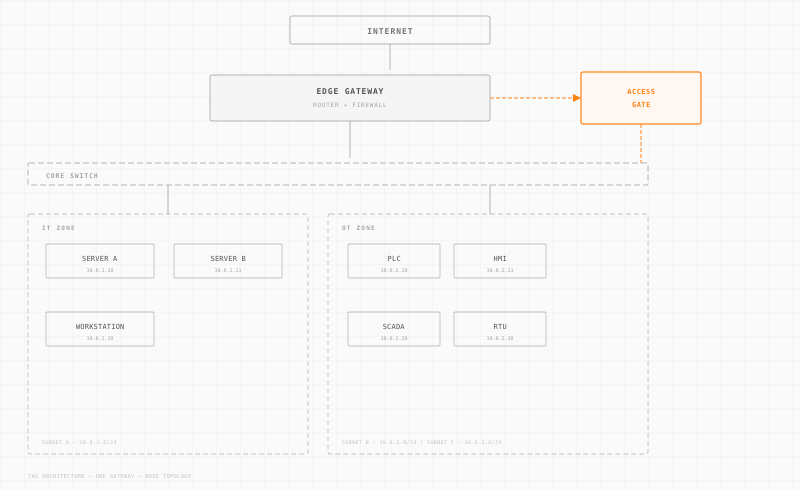
Access Gate wraps IIoT devices in an agent-free Zero Trust overlay, so nothing has to run on the sensor itself. It discovers every connected asset, microsegments the flat plant network into identity-defined zones, proxies remote and vendor access, and forwards east-west traffic to your SIEM, which is how you contain a compromised device instead of letting it roam. See Zero-trust access control.