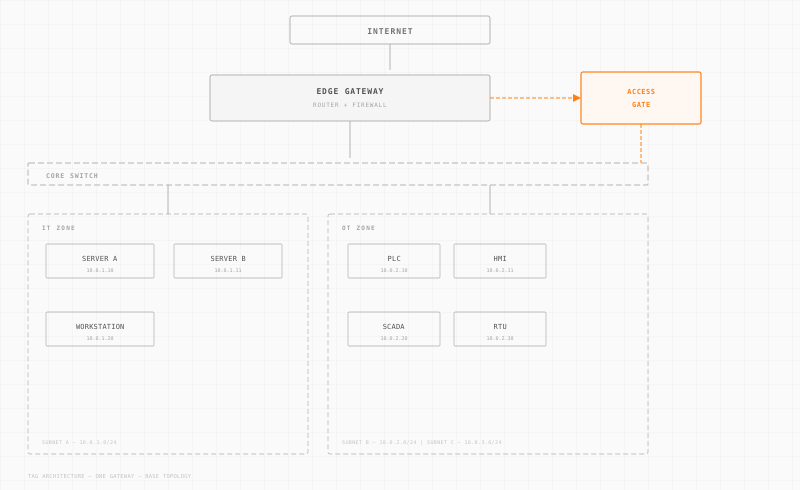
Quality Assurance (QA) refers to the systematic process of evaluating and improving the quality of products and services to ensure that they meet specified requirements and customer expectations. In the context of OT/IT cybersecurity, QA involves the assessment and enhancement of security measures to protect networks and systems from vulnerabilities and attacks.
Understanding Quality Assurance in OT/IT Cybersecurity
In industrial, manufacturing, and critical environments, Quality Assurance plays a crucial role in maintaining the integrity and reliability of both operational technology (OT) and information technology (IT) systems. These environments depend on a seamless integration of technology to function efficiently and safely, making robust QA processes essential for preventing disruptions caused by security breaches.
Quality Assurance Processes
QA processes in cybersecurity involve several key activities:
- Risk Assessment and Management: Identifying potential vulnerabilities and threats to OT/IT systems and implementing controls to mitigate these risks.
- Testing and Validation: Conducting rigorous testing of security protocols and systems to ensure they function as intended and meet security standards.
- Continuous Monitoring: Implementing ongoing monitoring solutions to detect and respond to security incidents in real-time.
Standards and Frameworks
Several standards and frameworks provide guidelines for implementing effective QA in cybersecurity:
- NIST SP 800-171: Offers guidelines for protecting controlled unclassified information in non-federal systems, emphasizing the importance of maintaining quality security measures.
- CMMC (Cybersecurity Maturity Model Certification): Requires organizations to demonstrate their cybersecurity quality through a structured assessment process.
- NIS2 Directive: Aims to enhance the overall level of cybersecurity in the EU by ensuring that organizations maintain high-quality cybersecurity measures.
- IEC 62443: Provides a comprehensive framework for ensuring the security and quality of industrial automation and control systems.
Why It Matters
For industrial, manufacturing, and critical environments, the importance of QA cannot be overstated. These sectors rely on precise and uninterrupted operations, where a single security lapse can lead to significant downtime, financial loss, or even safety hazards. Implementing a robust QA strategy helps ensure that security measures are not only present but effective, thereby safeguarding critical infrastructure against evolving threats.
In Practice
Consider a manufacturing plant that employs a range of automated systems for production. A rigorous QA program ensures that all security systems are tested for vulnerabilities before deployment, that regular audits are performed to check for compliance with industry standards, and that incident response plans are continuously refined based on the latest threat intelligence. This proactive approach minimizes the risk of cyber incidents that could otherwise disrupt production or compromise safety.
Related Concepts
- Quality Control: Focuses on identifying defects in final products rather than preventing them during the production process.
- Continuous Improvement: A key principle of QA that involves ongoing efforts to improve products, services, or processes.
- Risk Management: The process of identifying, assessing, and prioritizing risks, and implementing strategies to manage them effectively.
- Compliance Management: Ensures that an organization adheres to required laws, regulations, and standards.
- Vulnerability Assessment: The practice of identifying, quantifying, and prioritizing vulnerabilities in a system.