Status, September 2026. The Department of War suspended CMMC Phase II on 13 July 2026, pausing the mandatory third-party C3PAO certification. Phase 1 self-assessment and the underlying NIST SP 800-171 and DFARS obligations remain in force, so the controls are still required. What is paused is how compliance gets verified, not whether CUI must be protected. See what the suspension changes.
A C3PAO (CMMC Third-Party Assessor Organization) is a firm authorized by the Cyber Accreditation Body (Cyber AB) to conduct the official Cybersecurity Maturity Model Certification (CMMC) Level 2 assessment. It is the gate between a defense contractor and a CMMC certificate. Without a passing C3PAO assessment, you cannot win a contract that requires CMMC Level 2.
What does a C3PAO actually do?
A C3PAO assigns a Lead Certified CMMC Assessor (CCA) and a team to check whether the contractor meets all 110 controls in NIST SP 800-171. The assessment is on-site, or hybrid for distributed environments, and it looks at four things:
- System Security Plan (SSP): the contractor's documentation of how each control is implemented.
- Plan of Action and Milestones (POA&M): open gaps with closure deadlines.
- Technical evidence: configuration screenshots, audit logs, asset inventories, access policies, network diagrams.
- Process maturity: interviews and observation to confirm controls run consistently, not just on paper.
The outcome is binary. You are certified or you are not. There is no partial pass at Level 2.
Who needs a C3PAO?
Any contractor or subcontractor in the Defense Industrial Base that stores, processes, or transmits Controlled Unclassified Information and holds a contract with the CMMC Level 2 requirement. Level 1 self-assessments do not involve a C3PAO. Level 2 with priority CUI does. If your prime contractor flows down a CMMC Level 2 clause, a C3PAO assessment is how you satisfy it.
Why is a C3PAO assessment hard on OT and the shop floor?
Most C3PAO scrutiny lands where IT is already well documented: Active Directory, endpoint management, SIEM tooling. The tense conversations happen on the shop floor, where:
- CNC machines and PLCs cannot run agents, which breaks the "every endpoint logged" assumption.
- Specialized assets share credentials by design, like HMI consoles and engineering workstations.
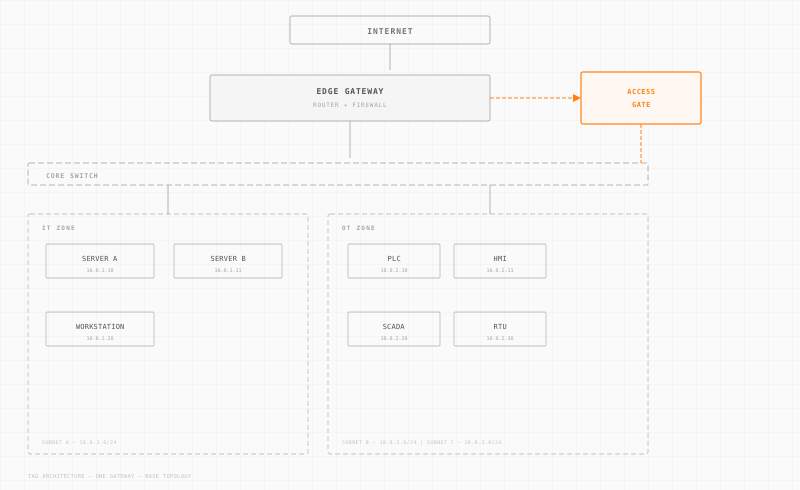
- Proving segmentation around CUI flows needs diagrams and packet evidence, not policy statements.
Assessors generally accept compensating controls for OT, as long as you can show the mechanism is enforced and audited. A network-layer gateway that terminates sessions, applies identity, and logs every command produces evidence that maps cleanly to the AC, AU, IA, and SC control families.
How do you choose a C3PAO?
The Cyber AB maintains the authorized C3PAO marketplace. Phase II is suspended as of 13 July 2026, so certification assessments are not currently being scheduled. When you evaluate a C3PAO, ask about prior experience with OT-heavy environments, whether they accept network-layer compensating controls for legacy assets, and how they handle multi-site assessments when CUI flows span locations.
Related terms
- CMMC, the broader certification framework
- CMMC Level 2, the level most DIB contractors need
- NIST SP 800-171, the underlying control set
- Controlled Unclassified Information, what CMMC protects
- CMMC Enduring Exception, the mechanism for OT assets that cannot comply natively