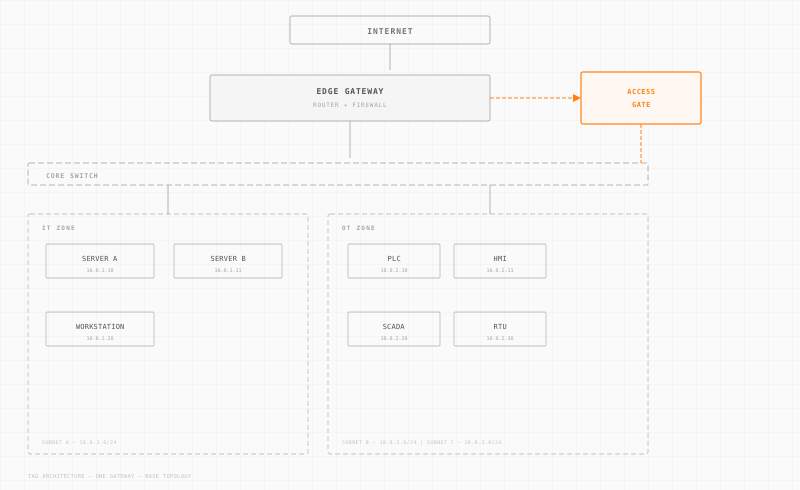
A data center is a physical facility that organizations use to house their critical applications and data. It typically includes components such as servers, storage systems, networking equipment, and power and cooling infrastructure, all essential for the operation and security of the organization's IT environment.
Data Centers in OT/IT Cybersecurity
In the context of OT/IT cybersecurity, data centers play a crucial role as they are the backbone of a company's IT infrastructure. They support the operations and security of both operational technology (OT) and information technology (IT) systems, which are pivotal in industrial, manufacturing, and critical environments. The convergence of OT and IT within data centers requires robust security measures to protect against cyber threats that could disrupt operations or compromise sensitive information.
Data centers often house the systems that manage and monitor industrial control systems (ICS) and supervisory control and data acquisition (SCADA) systems, which are vital for the safe and efficient operation of critical infrastructure. Ensuring the security and reliability of these systems is critical, as any disruption could lead to significant operational and financial impacts.
Importance for Industrial, Manufacturing, and Critical Environments
In industrial and manufacturing sectors, data centers are integral to maintaining operational continuity, efficiency, and security. They enable colocation, where multiple tenants share the same facility, optimizing resource use and cost-efficiency. This is particularly beneficial for organizations that require scalable and flexible IT resources without the need to build their own server facilities.
Data centers also support the compliance requirements of various cybersecurity standards and regulations. For instance, the NIST 800-171 framework requires organizations to protect Controlled Unclassified Information (CUI) in non-federal systems, which often involves robust data center security measures. Similarly, the Cybersecurity Maturity Model Certification (CMMC) emphasizes the protection of defense contract information, much of which is stored and processed in data centers. The IEC 62443 standards further guide the secure integration of IT and OT systems, highlighting the importance of secure data center operations.
Why It Matters
Data centers are critical to ensuring the secure and efficient operation of both IT and OT environments. In practice, they provide the necessary infrastructure for real-time data processing, storage, and analytics, which are essential for decision-making in industrial and critical sectors. A well-managed data center supports business continuity, protecting against data breaches and cyberattacks that could lead to operational disruptions.
For example, a manufacturing company could rely on a data center to host its enterprise resource planning (ERP) systems, production scheduling applications, and quality control systems. Any cyber incident affecting the data center could result in production delays, quality issues, or even safety hazards, underscoring the importance of robust cybersecurity measures.
Related Concepts
- Colocation: The practice of housing privately-owned servers and networking equipment in a third-party data center.
- Server Facility: A physical space housing computer servers and related equipment.
- Industrial Control Systems (ICS): Systems used to control industrial processes, often supported by data center infrastructure.
- Supervisory Control and Data Acquisition (SCADA): Systems used for remote monitoring and control, frequently integrated with data center operations.
- Cybersecurity Maturity Model Certification (CMMC): A framework that includes data center security as part of its compliance requirements.