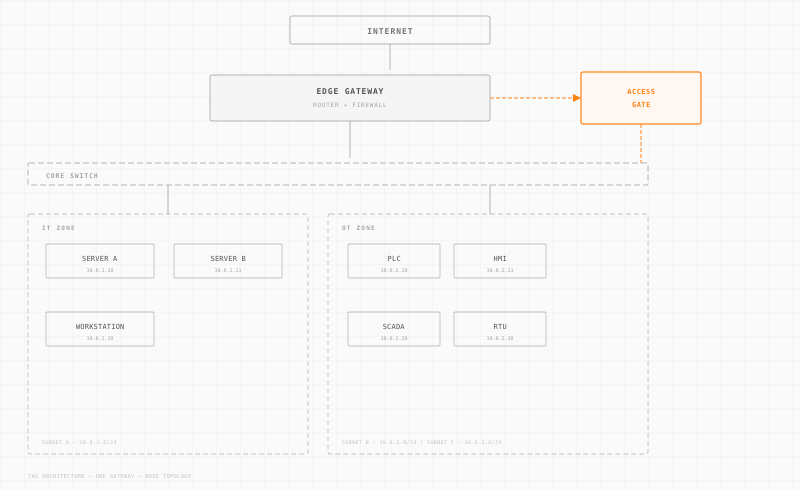
Data integrity refers to the accuracy, consistency, and reliability of data throughout its lifecycle. It ensures that data remains unaltered and accurate during storage, retrieval, and processing, which is critical in maintaining trust in data-driven decision-making processes.
Understanding Data Integrity in OT/IT Cybersecurity
In the context of Operational Technology (OT) and Information Technology (IT) cybersecurity, data integrity is paramount. Industrial environments, such as manufacturing plants and critical infrastructure like energy grids, rely on precise data to operate efficiently and safely. Any compromise in data integrity could lead to incorrect operational decisions, potentially causing equipment malfunctions, safety hazards, or significant financial losses.
Data integrity involves several components, including data accuracy, data validation, and data consistency. These components ensure that data is correct and usable, hasn't been tampered with, and remains the same across all systems and processes.
Importance in Industrial, Manufacturing & Critical Environments
In industrial settings, maintaining data integrity is crucial for several reasons:
- Operational Efficiency: Accurate data allows systems to function optimally, reducing downtime and increasing productivity.
- Safety: Many industrial processes are safety-critical. Any data discrepancy can lead to unsafe operations, endangering human lives and the environment.
- Compliance: Regulations such as NIST 800-171, CMMC, and IEC 62443 require organizations to ensure data integrity to protect national and international security interests. Compliance with these regulations often involves rigorous data handling and integrity verification processes.
Mechanisms Ensuring Data Integrity
To maintain data integrity, organizations employ various mechanisms:
- Access Controls: Implementing strict access controls prevents unauthorized data modifications.
- Data Validation: Ensures that data meets the required format and standards before being processed.
- Encryption: Secures data in transit and at rest, preventing unauthorized access and tampering.
- Checksums and Hashing: These techniques verify data integrity by comparing stored values to recalculated ones, identifying any discrepancies that may have arisen from corruption or unauthorized changes.
Why It Matters
Data integrity is critical not only for operational success but also for maintaining stakeholder trust. In environments where data drives decision-making, any compromise can have far-reaching consequences. For instance, in a manufacturing plant, if sensor data indicating machine temperatures is incorrect, it could lead to machinery overheating, causing expensive damage and safety risks.
Furthermore, as industries increasingly integrate IoT and smart technologies into their operations, the volume of data generated grows exponentially. Ensuring the integrity of this data is essential to harness its full potential and avoid the introduction of vulnerabilities.
In Practice
Consider a power plant that uses a network of sensors to monitor equipment performance. These sensors generate real-time data critical for adjusting operations and preventing failures. If data integrity is compromised, operators might receive false readings, making it impossible to make informed decisions. Ensuring data integrity in such a context means regular system audits, deploying robust cybersecurity measures, and adhering to regulatory standards like IEC 62443, which provides guidelines for industrial communication networks and systems security.
Related Concepts
- Data Validation: The process of ensuring data is accurate and meets required standards.
- Data Accuracy: A measure of how close data is to the true values or intended output.
- Data Consistency: Ensuring data remains uniform across different systems and processes.
- Encryption: The process of converting data into a secure format to prevent unauthorized access.
- Access Control: Mechanisms that restrict who can view or use resources in a computing environment.