Defense contracting is the process by which government agencies, primarily the U.S. Department of Defense (DoD), buy goods and services from private companies to meet military and national security needs. It runs through a regulated cycle: the government publishes a solicitation, companies bid, an award is made, and the contract is managed to delivery. What gets bought ranges from aircraft and munitions to software, logistics, and cybersecurity services.
How does defense contracting work?
Federal procurement follows the Federal Acquisition Regulation (FAR), and defense work adds the Defense Federal Acquisition Regulation Supplement (DFARS) on top. A typical path starts with a solicitation such as a Request for Proposal (RFP) or Request for Quote (RFQ). Companies respond, the contracting officer evaluates on price, past performance, and technical merit, and the award goes to the selected bidder. Large programs run through prime contractors who then flow requirements down to subcontractors.
Who can bid on defense contracts?
Any registered business can pursue defense work, but there are gates. A contractor needs a CAGE code and an active registration in SAM.gov. Some contracts are set aside for small businesses or other categories. And since 2020, DFARS clause 252.204-7012 has required contractors that handle Controlled Unclassified Information to meet the security controls in NIST SP 800-171, an obligation now enforced through CMMC.
Why do cybersecurity standards matter in defense contracting?
Because the supply chain is a target. Adversaries go after subcontractors to reach the programs above them, which is why the DoD ties eligibility to security posture. Contractors that touch defense information typically have to satisfy several frameworks:
- NIST SP 800-171: the control set for protecting Controlled Unclassified Information in non-federal systems.
- CMMC: the certification that verifies a contractor actually implements those controls, not just claims them.
- DFARS 252.204-7012: the clause that makes the 800-171 controls contractual and requires incident reporting.
- IEC 62443: the standard for industrial automation and control systems, relevant to contractors that build or operate OT.
How is defense contracting different from commercial procurement?
Commercial buyers optimize for price and speed. Defense procurement adds layers commercial deals rarely carry: statutory competition rules, domestic sourcing requirements, export controls, and cybersecurity certification as a condition of award. A commercial vendor can close a deal on a handshake and a purchase order. A defense contractor has to prove compliance before it can invoice, and a failed audit can cost the contract.
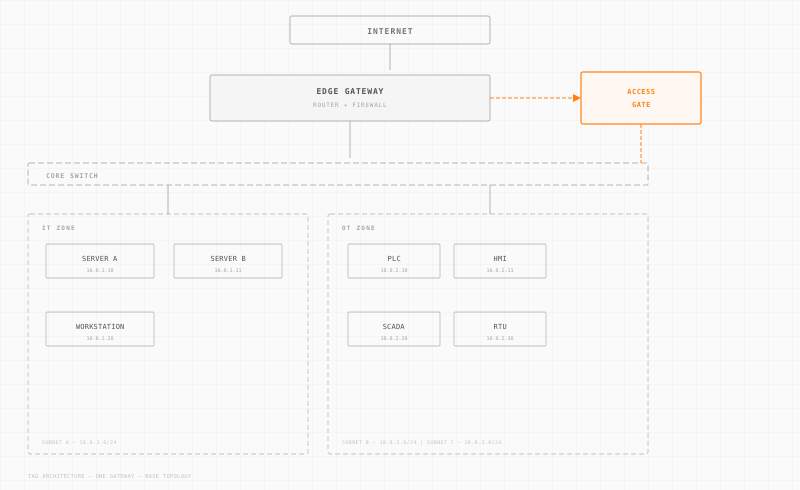
For contractors that run operational technology, meeting DoD security requirements often comes down to segmenting and monitoring OT the same way IT is already covered. That is the problem Access Gate is built for.
Related terms
- Defense Contract, the binding agreement at the center of the process
- DFARS, the DoD supplement to federal acquisition rules
- CMMC, the certification defense contractors must hold to handle CUI
- NIST SP 800-171, the control set for protecting CUI
- Defense Industrial Base, the supplier ecosystem defense contracting runs on