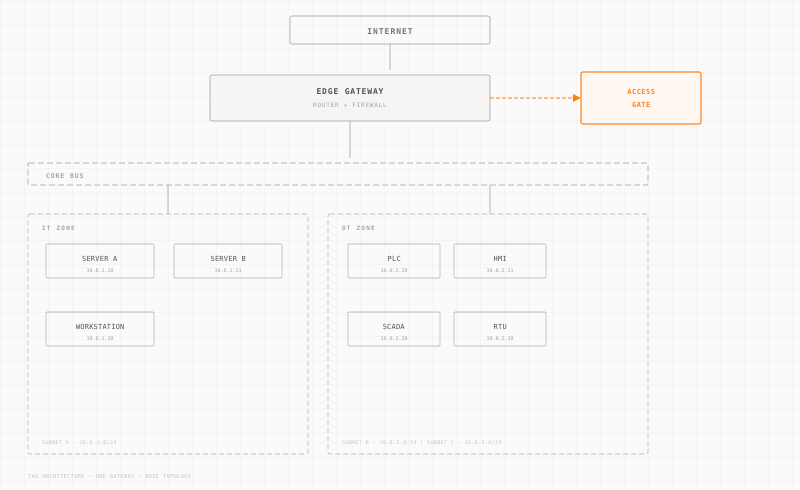
Edge computing refers to a distributed computing paradigm that brings computation and data storage closer to the location where it is needed, to improve response times and save bandwidth. It involves processing data at the "edge" of the network, near the source of data generation, rather than relying on a centralized data center.
Edge Computing in OT/IT Cybersecurity
In the realm of Operational Technology (OT) and Information Technology (IT) cybersecurity, edge computing plays a crucial role by enabling quicker decision-making processes and reducing latency. By processing data locally on edge devices, such as gateways and routers, organizations can achieve real-time data analysis and response, which is vital for maintaining Zero Trust network security principles. This approach minimizes the risk of data breaches by limiting data movement across networks and helps maintain the integrity and confidentiality of sensitive information.
Edge Devices and Fog Computing
Edge devices are critical components of edge computing; they are the hardware that performs data processing at or near the source. These devices can include industrial machines, sensors, routers, and gateways that are designed to handle computations locally. Fog computing extends this concept by creating a network of edge devices that work together to process data, thus providing a layer between the edge devices and the cloud. This hierarchical approach ensures that data is processed as efficiently as possible, reducing latency and bandwidth usage.
Why It Matters
For industrial, manufacturing, and critical environments, edge computing is a transformative technology. It enables facilities to process vast amounts of data generated by industrial equipment in real time, which is essential for maintaining operational efficiency and safety. In environments where milliseconds matter, such as automated production lines or critical infrastructure controls, the reduced latency offered by edge computing can prevent costly downtime and enhance response times to cybersecurity threats.
Compliance Considerations
Edge computing can also assist in meeting compliance standards such as NIST SP 800-171, CMMC, NIS2, and IEC 62443. By processing sensitive data locally, organizations can better control data access and movement, which is a critical aspect of these standards. For example, NIST SP 800-171 mandates the protection of Controlled Unclassified Information (CUI) in non-federal systems, emphasizing the need for secure data handling practices that edge computing can facilitate.
In Practice
Consider a manufacturing plant that utilizes edge computing to monitor and control its production line. Edge devices can analyze data from sensors in real-time to detect anomalies or potential failures, allowing for immediate corrective actions. This capability not only enhances operational efficiency but also supports proactive maintenance strategies, reducing the risk of unexpected outages. Additionally, by processing data locally, the plant can ensure compliance with industry regulations, protecting sensitive information from potential cyber threats.
Edge computing's ability to process data locally also reduces the amount of data that needs to be sent to the cloud, which can significantly decrease bandwidth costs and improve data security. This is particularly beneficial in remote or isolated environments where connectivity to central data centers might be limited or costly.
Related Concepts
- Fog Computing: A decentralized computing infrastructure that extends cloud computing to the edge of the network.
- IoT (Internet of Things): The interconnected network of physical devices that collect and exchange data.
- Zero Trust Architecture: A cybersecurity model that requires strict identity verification for every person and device attempting to access resources on a network.
- NIST SP 800-171: A set of guidelines for protecting Controlled Unclassified Information in non-federal systems.
- CMMC (Cybersecurity Maturity Model Certification): A framework for ensuring cybersecurity practices in defense supply chains.