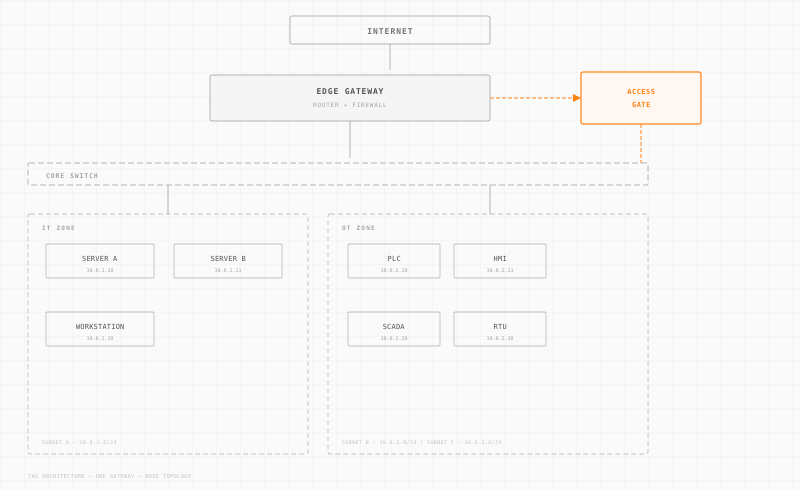
Industrial cybersecurity standards are the frameworks and best practices for protecting industrial control systems (ICS) and operational technology (OT) networks: the systems that run manufacturing plants, energy grids, and other critical infrastructure. They exist because OT is not IT, and applying office security assumptions to a plant floor tends to break either the security or the process.
This page is a short definition. To apply these standards to a running plant, read the full OT cybersecurity guide: what OT security covers, how it differs from IT, and how to secure PLCs, SCADA and HMIs without downtime.
What are industrial cybersecurity standards?
They are structured guidance for assessing risk, hardening control systems, and responding to incidents in environments where a security control cannot be allowed to disrupt a running process. Some are voluntary frameworks you adopt to raise your posture. Others are legal mandates with audits and penalties. Most real programs use a technical framework for the "how" and a regulatory one for the "must."
How do OT standards differ from IT standards?
IT security optimizes for confidentiality first and assumes you can patch, reboot, and run agents on managed endpoints. OT flips the priorities: availability and safety come first, systems run for decades, downtime is expensive or dangerous, and much of the equipment cannot host an agent or take a patch on demand. Industrial standards are written around those constraints, which is why they lean on network segmentation, the Purdue model, and access control rather than endpoint tooling.
Which industrial cybersecurity standards matter most?
- IEC 62443: the core international standard for industrial automation and control systems, built around zones, conduits, and security levels. The most widely referenced technical framework in OT.
- NIST SP 800-82: NIST's guide to OT security, the U.S. companion to 62443.
- NERC CIP: mandatory, audited controls for the North American bulk electric system.
- NIST SP 800-171 and CMMC: required across the defense industrial base for handling controlled information.
Why do these standards matter?
Industrial systems are targeted precisely because disrupting them causes physical and economic damage, not just data loss. Following a recognized standard gives operators a defensible baseline: it structures how they find vulnerabilities, segment networks, and prepare for incidents, and it demonstrates due care to regulators, insurers, and partners. In safety-critical settings like chemical or nuclear facilities, that structure is what stands between a cyber event and a physical one.
Are these standards mandatory?
It depends on who you are. IEC 62443 and NIST SP 800-82 are voluntary frameworks, though customers and contracts increasingly require them. NERC CIP and CMMC are enforceable: miss them and you face penalties, loss of contracts, or loss of authorization to operate. Many operators are subject to more than one at the same time.
How Access Gate helps
Strip the standards down and they ask for the same handful of things: segment the network, control who can reach what, restrict remote and vendor access, and monitor and log traffic. The hard part is doing that on legacy gear you cannot modify. Access Gate delivers those controls as an agent-free overlay, software security perimeters and microsegmentation without re-cabling, identity-based and proxied access for operators and vendors, and east-west monitoring forwarded to your SIEM. That lets an operator satisfy the technical intent of IEC 62443, NIST 800-82, or CMMC without replacing the plant. The OT cybersecurity guide walks through those controls step by step.