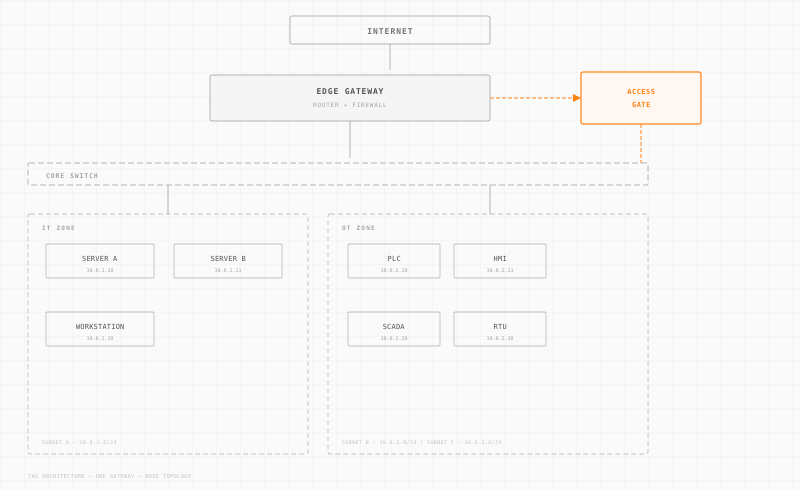
Incident Response refers to the organized approach to addressing and managing the aftermath of a security breach or cyberattack, with the goal of limiting damage and reducing recovery time and costs. In the realm of OT/IT cybersecurity, incident response is critical for safeguarding sensitive information and maintaining the integrity of industrial, manufacturing, and critical infrastructure systems.
Understanding Incident Response in OT/IT Cybersecurity
In the context of OT (Operational Technology) and IT (Information Technology) cybersecurity, incident response takes on a particularly vital role. Systems in industrial and critical environments are often part of essential services, such as power grids, water supply, and manufacturing processes. Disruptions can lead to significant consequences, including operational downtime, data breaches, and even risks to physical safety.
Incident response in these settings involves a set of procedures and actions designed to identify, contain, eradicate, and recover from cyber incidents. These procedures are usually outlined in an Incident Response Plan (IR plan), which provides a framework for responding to various types of security incidents, such as malware infections, unauthorized access, or denial-of-service attacks.
Key Components of an Incident Response Plan
An effective IR plan generally includes the following components:
- Preparation: Establishing and training an incident response team, defining roles and responsibilities, and developing policies and procedures.
- Identification: Detecting and recognizing potential security incidents through monitoring and alert systems.
- Containment: Isolating affected systems to prevent further damage or spread of the incident.
- Eradication: Removing the root cause of the incident, such as deleting malware or closing a security loophole.
- Recovery: Restoring systems and services to normal operations, often involving data recovery and system validation.
- Lessons Learned: Conducting a post-incident analysis to improve future response strategies and prevent recurrence.
Why It Matters
Incident response is essential for industrial, manufacturing, and other critical environments due to the high stakes involved. The potential impact of a cyber incident in these settings can extend beyond financial losses to include regulatory penalties, environmental damage, and threats to human safety.
Standards and frameworks like NIST SP 800-171 and CMMC (Cybersecurity Maturity Model Certification) underscore the importance of having robust incident response processes. For example, NIST SP 800-171 outlines requirements for protecting controlled unclassified information (CUI) in non-federal systems, which includes having an incident response capability.
For electric utilities, NERC CIP-008 requires a documented incident response plan and reporting of qualifying cyber security incidents, highlighting the necessity of a systematic incident response approach.
In Practice
Consider a manufacturing plant where an unexpected network anomaly is detected. The incident response team quickly swings into action, following the IR plan. They identify the anomaly as a ransomware attack, contain the affected systems to prevent spread, and work on eradicating the ransomware. After securing the systems, they recover the data from backups and resume normal operations. The incident is thoroughly documented, and the lessons learned are used to fortify defenses against future attacks.
This proactive approach not only minimizes downtime and financial loss but also supports compliance with relevant standards and regulations. It demonstrates a commitment to maintaining the security and resilience of critical infrastructure, which is crucial for sustaining public trust and safety.