Operational efficiency refers to the ability of an organization to deliver products or services to its customers in the most cost-effective manner possible while ensuring quality. It involves optimizing processes and resources to improve productivity and reduce waste, thereby enhancing the overall performance of the organization.
Understanding Operational Efficiency in OT/IT Cybersecurity
In the context of Operational Technology (OT) and Information Technology (IT) cybersecurity, operational efficiency is crucial for maintaining a secure and resilient digital infrastructure. Cybersecurity measures must be integrated into the operational processes without hindering productivity or compromising service quality. This involves seamless collaboration between OT and IT systems, ensuring that security protocols do not disrupt critical operations or lead to inefficiencies.
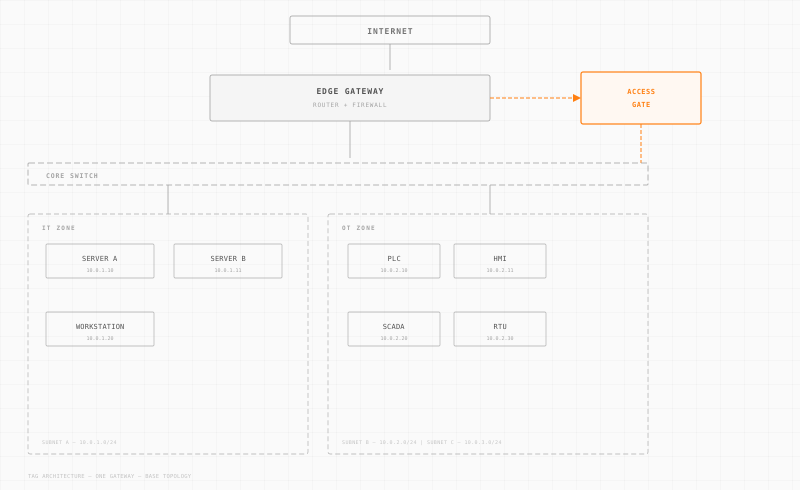
For example, in a manufacturing plant, operational efficiency can be seen in the seamless integration of cybersecurity tools that protect both the IT networks and the OT systems like industrial control systems (ICS) and supervisory control and data acquisition (SCADA) systems. The goal is to enhance process efficiency by safeguarding data and operational assets, preventing downtime, and ensuring continuous production flow.
Importance in Industrial, Manufacturing & Critical Environments
Operational efficiency is paramount in industrial, manufacturing, and critical environments because these sectors rely heavily on tightly integrated systems to maintain high productivity levels. Any disruption, whether due to a cyber attack or inefficient processes, can lead to significant financial losses, safety hazards, and compliance issues.
For instance, a cyber attack on a manufacturing system could halt production lines, leading to downtime and loss of revenue. By focusing on operational efficiency, organizations can implement robust cybersecurity measures that protect against such threats while minimizing impacts on productivity. This is particularly important in environments where safety is a concern, as compromised systems can lead to accidents or unsafe conditions.
Standards and Compliance
Adhering to relevant standards is essential for achieving operational efficiency while maintaining cybersecurity. Standards like NIST 800-171 and CMMC provide guidelines for protecting controlled unclassified information (CUI) in non-federal systems, emphasizing the need for efficient security measures that align with operational goals.
Similarly, the NIS2 Directive focuses on improving the cyber resilience of critical infrastructure across European Union member states. It mandates operational efficiency by ensuring that security measures are adaptive and do not impede the functionality of essential services.
The IEC 62443 standard is particularly relevant for industrial automation and control systems, providing a framework for securing these environments without compromising operational efficiency. It emphasizes integrating security measures into existing processes to enhance productivity while maintaining high security levels.
In Practice
In practice, achieving operational efficiency involves a combination of technology, process improvement, and workforce training. Organizations must invest in cybersecurity technologies that are not only effective but also easy to implement and manage. For example, deploying a Zero Trust architecture can help ensure that only authorized users and devices have access to critical systems, thereby improving security without complicating operational workflows.
Additionally, process improvement techniques such as Lean manufacturing and Six Sigma can be applied to streamline operations, eliminate waste, and enhance productivity. When combined with strong cybersecurity practices, these methodologies can lead to significant improvements in both operational efficiency and security posture.
Related Concepts
- Cyber Resilience: The ability to continuously deliver intended outcomes despite adverse cyber events.
- Zero Trust Architecture: A security model that requires strict identity verification for every person and device trying to access resources on a network.
- Industrial Control Systems (ICS): Systems used in industrial production for controlling and monitoring processes.
- Information Security Management System (ISMS): A systematic approach to managing sensitive company information so that it remains secure.
- Lean Manufacturing: A production practice that considers the expenditure of resources in any aspect other than the direct creation of value for the end customer to be wasteful.