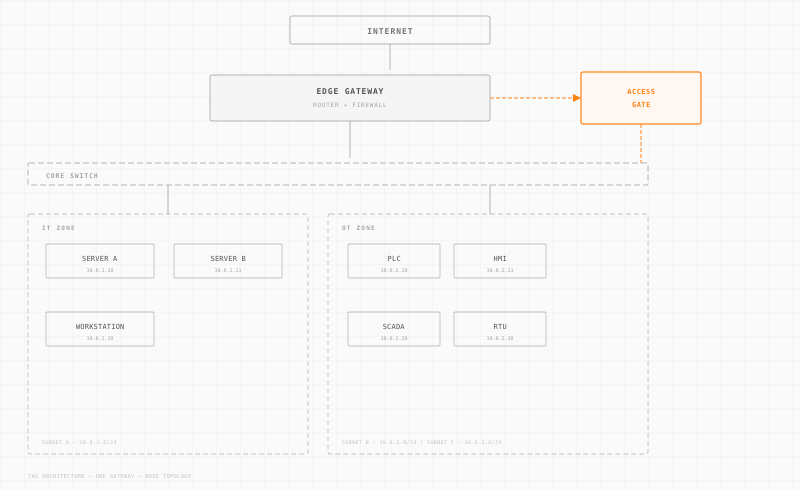
A Programmable Logic Controller (PLC) is a ruggedized industrial computer that reads inputs from sensors and switches, runs a control program, and drives outputs to motors, valves, and actuators. It was built to replace banks of hard-wired relays, and it now runs the physical processes inside almost every factory, plant, and utility. When a PLC stops or misbehaves, the process it controls stops or misbehaves with it.
What is a programmable logic controller?
A PLC is a purpose-built computer with a microprocessor, a bank of digital and analog I/O, and one or more communication interfaces. It sits on the plant floor, takes readings from field devices, evaluates a control program on a fixed scan cycle, and sets its outputs accordingly, thousands of times a second. Vendors like Siemens (S7), Rockwell Automation (Allen-Bradley), Schneider Electric (Modicon), and Mitsubishi dominate the installed base, and many of those units have been running for a decade or more.
How does a PLC work?
Every scan cycle does the same three things: read all inputs, execute the control logic, then write all outputs. The logic is usually written in the IEC 61131-3 languages, most commonly ladder logic, which was designed to look familiar to engineers who grew up with relay diagrams. PLCs talk to each other and to supervisory systems over industrial protocols like Modbus, EtherNet/IP, and PROFINET, which puts them squarely inside the SCADA and industrial control system architecture that runs a site.
Why are PLCs a cybersecurity risk in OT?
Most PLCs were designed for reliability, not for a hostile network. They frequently ship with no authentication, unencrypted protocols, and firmware that is painful to patch during a production run. Anyone who can reach a PLC on the network can often read or rewrite its logic directly. Stuxnet showed what that means in practice: it reprogrammed Siemens PLCs to wreck centrifuges while reporting normal readings upstream. Because a PLC is the seam between the network and a physical process, a compromised one is not just a data problem, it can move machinery.
Which standards govern PLC security?
No single standard is PLC-specific, but several set the expectations. IEC 62443 is the core framework for securing industrial automation and control systems, covering zones, conduits, and device-level hardening. NIST SP 800-171 and CMMC apply when the plant handles defense contract information, and NERC CIP applies to controllers in the bulk electric system. The common thread across all of them is access control and network segmentation, because you rarely get to fix the controller itself.
How is a PLC different from a SCADA system or a DCS?
A PLC controls a machine or a process cell. SCADA is the supervisory layer that monitors and coordinates many controllers across a site or a region, usually through an HMI. A Distributed Control System (DCS) blends the two for large continuous processes like refining or chemicals, with control logic distributed across the plant. In short: the PLC does the controlling, SCADA does the watching, and a DCS does both at plant scale.
How Access Gate helps
You usually cannot add authentication or patch a live PLC, so the practical move is to control what can reach it. Access Gate wraps controllers in an agent-free, identity-based overlay: engineering and vendor sessions to a PLC are proxied and logged, east-west traffic between cells is microsegmented so a foothold on one line cannot pivot to the next, and asset discovery inventories the controllers you did not know were exposed. Protocol-aware monitoring watches the Modbus and EtherNet/IP traffic and forwards it to your SIEM, all without touching the controller.