
For central IT and security teams at utilities
Protect every remote site from one console.Without disrupting operations.
Why central IT can't see its remote sites
Every site has its own network, its own operator and its own remote access boxes. Central IT sees none of it, and securing it site by site is a project your team can't staff. Access Gate Fleet gives you one inventory, one policy and one audit trail for every site, without downtime.
A Hub at the main site, a small local DMZ at every remote site.
Each Spoke is a small DMZ at the site. Every connection to the site's PLCs and SCADA goes through the Spoke, which checks who connects and to what. The Hub sits at your treatment plant or control center, and the Spokes connect to the Hub over secure tunnels.
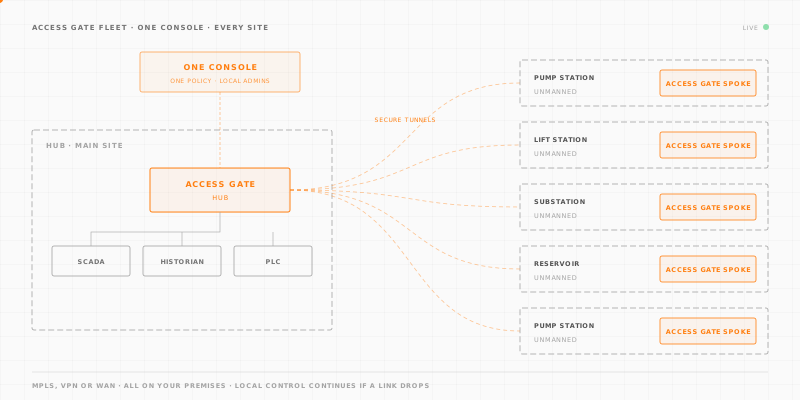
A Spoke is not a firewall or a VPN tunnel. A firewall filters addresses and a tunnel carries traffic. A Spoke decides which person reaches which machine, with MFA, and records every session.
Everything stays on your premises, and each Spoke keeps working on its own. If the link to a site drops, the site keeps running and local control continues.
Utilities already running it

55
ski lift sites on one console, with no security staff
“Deploying Zero-Trust across our site - a ski resort - was not in the cards with our resources. Now we operate a ZT architecture with a simple centralized control. Game changer.”
100%
of lateral flows covered on new sites, without downtime
Each new heating network is a remote site the operator barely knows. Access Gate Fleet connects the site to the operator’s IT through a local DMZ and enforces the NIS2 requirements on every connection.
Price Access Gate Fleet for your sites.
Every price includes the hardware, software, updates and support.

Base bundle: 1 Hub + 3 Spokes
$24,900 per year
1 Access Gate Hub and 3 Access Gate Spokes, for your first 4 sites.

Each extra Spoke
$2,280 per year
One more Access Gate Spoke for one more site, with the hardware included.
Start with the Hub, then add Spokes.
Each Access Gate connects beside the network you already run. You keep your VLANs, IP addresses and SCADA setup, and treatment and pumping keep running.
Install the Hub at the main site.
The Access Gate Hub connects beside the plant network. One route on the existing router sends traffic through the Hub.
Add a Spoke at each remote site.
Each Access Gate Spoke connects the same way and opens a secure tunnel to the Hub.
Add sites as your network grows.
A new pump station or a newly acquired site adds one Spoke to the same console and the same policy.
Questions about Access Gate Fleet.
sites are covered by the base bundle: one Hub and three Spokes. Each extra site adds one Spoke.
Access Gate Fleet protects every site of a water, wastewater or energy utility from one console. The main site gets an Access Gate Hub. Each remote site, such as a pump station, lift station or reservoir, gets an Access Gate Spoke. Each Spoke is a small DMZ at the site: every connection to the site's equipment goes through the Spoke, with MFA, and is logged. You set one policy and see every site and every session in one place.
No. Keep them. Put each box behind the site's Access Gate Spoke: it then reaches only the machines you allow, and each of its connections is logged with the rest of the site. Central IT sees every remote access path, including the vendors' own.
Yes. Remote sites often reuse the same addresses, such as 192.168.1.0/24. Access Gate gives each protected machine a twin address and translates between them with NAT, so central IT reaches every site without renumbering any network.
No. A firewall filters traffic by address and port, and a VPN or MPLS tunnel carries traffic between sites. A Spoke is a small DMZ at the site. The Spoke checks who connects, lets each person reach only the machines and protocols they need, and records every session. The Spoke works alongside your firewall and your WAN links.
The base bundle costs $24,900 per year and covers 4 sites: 1 Hub and 3 Spokes. Each extra Spoke costs $2,280 per year. A fleet of 10 sites, a Hub and 9 Spokes, costs $38,580 per year. Prices include the hardware, software, updates and support.
Yes. Each Spoke enforces the same policy as the rest of the fleet, with nobody on site. Operators and contractors log in with MFA and reach only the equipment they need. Every session is logged.
No. The console, the policy and the logs stay on your premises. The Hub and the Spokes connect directly by secure tunnels over MPLS, internet VPN or dedicated WAN lines.
The site keeps running on its own Spoke, so local control continues. Access between sites pauses and resumes on its own when the link returns.
No. Each Access Gate connects beside the existing network, and you keep your VLANs and IP addresses. One route on the existing router sends traffic through Access Gate, and treatment and pumping keep running.
Community water systems serving more than 3,300 people must cover their computer and automated systems in a risk and resilience assessment under Safe Drinking Water Act section 1433. In New York, the DOH drinking water controls apply from January 1, 2027, and the DEC wastewater controls are due by March 11, 2027. Access Gate Fleet logs every connection at every site, so you can export the evidence reviewers ask for.
Protect every site you already run, from one console.
Tell us how many sites you run. We size the fleet with you and send the quote.