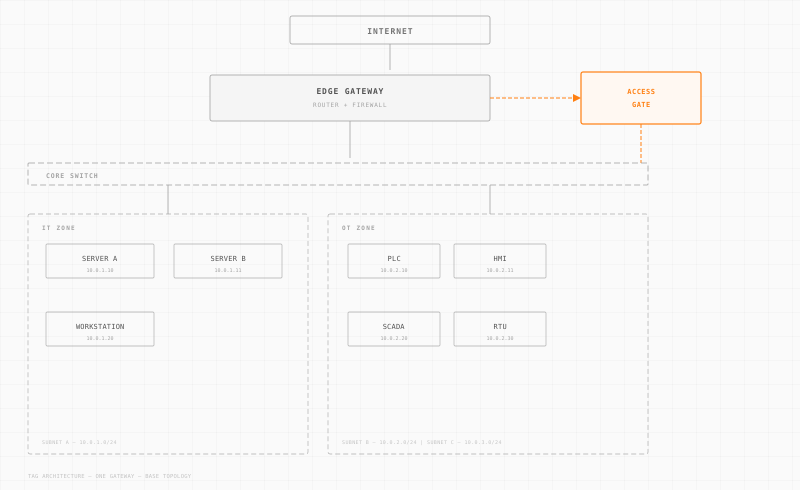
Passive asset discovery identifies the devices on an OT network by watching the traffic they already send, not by probing them. A sensor listens on a SPAN port, a mirror, or an inline tap and pulls device identity, protocol, and behavior out of the packets it sees. Nothing is ever sent to the devices themselves, which is what makes it safe on a running plant.
Why use passive discovery instead of active scanning?
Active scanning, the Nmap, Nessus, and Rapid7 approach that is standard in IT, is often forbidden in OT. A single malformed packet to a legacy PLC can fault the controller, drop the control loop, or trip a safety shutdown. Vendor documentation for Rockwell, Siemens, Schneider, and Mitsubishi controllers regularly warns against port scans, and some insurance policies and customer contracts prohibit them outright. Passive discovery sidesteps the risk entirely: the appliance never initiates a session, so there is nothing to knock over.
How does passive asset discovery work?
The discovery system reads a copy of the network traffic and reconstructs the inventory from patterns in it: source and destination IPs, protocol fingerprints, MAC addresses, plaintext firmware banners, and device-specific behavior in ICS protocols like Modbus, DNP3, EtherNet/IP, and Profinet. From those signals it infers what each device is and how it talks, without a single probe.
What does a good passive discovery system identify?
- Device type and role: PLC, HMI, historian, engineering workstation, or RTU, inferred from protocol behavior.
- Vendor and model: extracted from protocol fingerprints, banner text, or OUI lookup.
- Firmware version: when the protocol exposes it in plaintext.
- Communication graph: which devices talk to which, on which protocols, and how often.
- Anomalies: new devices, unexpected protocols, or changed communication patterns.
What are the limits of passive discovery?
It only sees what the traffic reveals. A device that speaks only on a power-on poll cycle might not appear for hours. A device behind NAT shows the gateway's identity, not its own. Silent equipment, heartbeat-only or powered-off hardware, stays invisible. That is the trade-off you accept for safety. Most mature OT programs run passive discovery always-on and layer in tightly scoped active scans only during approved maintenance windows, never during production.
How does Access Gate help?
Access Gate performs passive asset discovery on enrolled OT segments, building a live inventory of devices, protocols, and communication flows without sending a single probe to the production network. That inventory feeds the segmentation and access policy, so what you discover is what you protect. See Asset Inventory for OT.