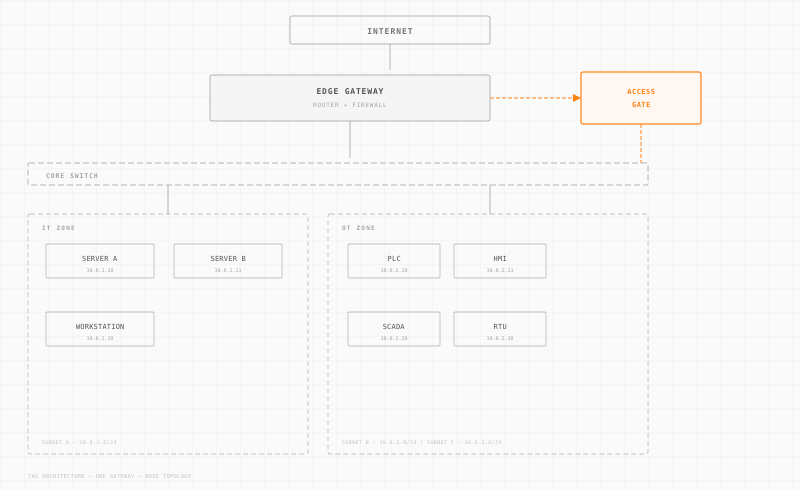
IoT security is the practice of protecting Internet of Things devices and the networks they connect to. That covers industrial sensors, smart controllers, cameras, and building systems as much as consumer gadgets. The defining problem is that most IoT devices are cheap, long-lived, and built with almost no security of their own, so protecting them is mostly about controlling the network around them rather than hardening each device.
What is IoT security?
It is the set of controls that keep connected devices from becoming an entry point or a weapon: encrypting the data they send, controlling who and what can reach them, delivering software updates safely, and watching their traffic for anything abnormal. Because IoT devices collect and act on real-world data, a compromised one can leak information, feed false readings, or serve as a beachhead into the rest of the network.
Why are IoT devices hard to secure?
Three reasons keep showing up. First, they are heterogeneous: a plant might run a dozen vendors' devices with a dozen different firmware stacks and no common management. Second, they are thin, many have no room for an endpoint agent, weak or hardcoded credentials, and firmware that ships and never gets patched. Third, they live for years, so a sensor installed in 2016 is still on the network with its original, unfixable flaws. The Mirai botnet made the point at scale by conscripting hundreds of thousands of unsecured devices. You often cannot fix the device, so you have to contain it.
Why does IoT security matter for industrial environments?
In manufacturing and utilities, IoT devices do real work: predictive maintenance, real-time monitoring, and process automation. They also sit close to physical processes and are part of critical infrastructure, which makes them attractive targets. A compromised device on an energy grid or a water system is not an inconvenience, it is a safety and continuity problem. These are cyber-physical systems, where a network event can become a physical one.
How is IoT security different from IT security?
IT security assumes you can install agents, push patches, rotate credentials, and reboot on a maintenance window. IoT breaks most of those assumptions. Devices resist agents, updates are rare or vendor-gated, and availability often outranks confidentiality because you cannot take a running process offline to patch it. So the emphasis shifts from securing the endpoint to securing the network: segmentation, access control, and passive monitoring instead of active agents.
What standards apply?
- NIST SP 800-171: access control, audit, and system protection expectations that map cleanly onto IoT.
- CMMC: required where connected devices touch defense contract information.
- IEC 62443: the industrial control systems standard that addresses device-level security directly.
How Access Gate helps
When you cannot put security on the device, you put it in the network, and that is what Access Gate does without agents. Asset discovery inventories the IoT devices already on your LAN, including the ones nobody remembers deploying. Microsegmentation isolates them so a compromised camera or sensor cannot pivot into control systems. Access is identity-based and deny-by-default, so devices only talk to what they are supposed to, and east-west traffic is monitored and forwarded to your SIEM for the anomaly detection an unpatched device can never do itself.