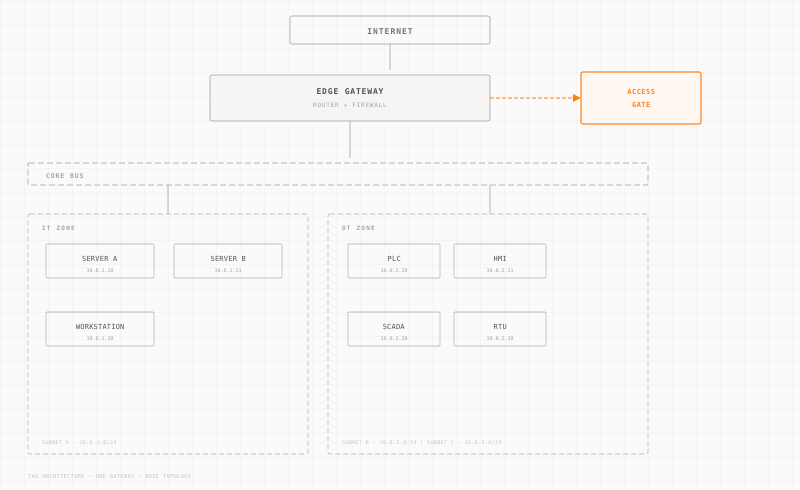
IT Infrastructure Management refers to the comprehensive oversight and administration of all components that form the backbone of IT services, including hardware, software, network resources, and data storage. It ensures the seamless operation, performance, and security of these resources to support business processes and objectives.
Understanding IT Infrastructure Management
In the context of OT/IT cybersecurity, IT infrastructure management becomes a critical pillar. As organizations increasingly integrate operational technology (OT) with traditional information technology (IT) systems, managing the infrastructure that supports these technologies becomes imperative to maintaining security and efficiency. IT infrastructure management encompasses the deployment, operation, and maintenance of data centers, servers, network devices, and software applications, all of which must be fortified against cyber threats.
Effective infrastructure management involves several key activities: monitoring and maintenance, configuration management, asset management, and incident response. By continually monitoring the infrastructure, organizations can detect anomalies or failures that could indicate security breaches or system failures. Configuration management ensures that systems are set up consistently and securely, while asset management tracks all components, ensuring they are up-to-date and compliant with relevant standards.
Importance in Industrial, Manufacturing & Critical Environments
For industrial, manufacturing, and critical environments, robust IT infrastructure management is indispensable. These sectors rely heavily on both IT and OT systems for critical operations. Any disruption can lead to significant downtime, financial losses, or even safety hazards. Moreover, these environments often require compliance with stringent cybersecurity standards such as NIST 800-171, CMMC, and IEC 62443.
For example, in a manufacturing plant, IT infrastructure management ensures that production lines equipped with Internet of Things (IoT) devices and sensors remain operational and secure from cyber threats. By maintaining a secure and efficient IT infrastructure, companies can ensure continuous production, protect sensitive data, and comply with industry regulations.
Compliance and Standards
Compliance with cybersecurity standards is a key component of IT infrastructure management. NIST 800-171 provides guidelines that help organizations protect controlled unclassified information in non-federal systems, which often involves managing IT infrastructure securely. CMMC (Cybersecurity Maturity Model Certification) builds upon these guidelines by assessing the cybersecurity maturity of defense contractors, requiring rigorous infrastructure management.
NIS2 (Network and Information Systems Directive 2) and IEC 62443 also play significant roles in ensuring that IT infrastructure in critical sectors is secure. NIS2 expands on the original NIS Directive, focusing on improving the cybersecurity of network and information systems across the EU, while IEC 62443 provides a framework for securing industrial automation and control systems.
In Practice
In practice, IT infrastructure management involves using a variety of tools and technologies to automate and streamline processes. For instance, infrastructure as code (IaC) tools enable organizations to manage and provision infrastructure through code, ensuring consistent configurations and rapid deployments. Additionally, security information and event management (SIEM) systems help in real-time monitoring and analysis of security alerts generated by network hardware and applications.
Automation and orchestration are becoming increasingly important as they allow for enhanced agility and scalability. By automating routine tasks, organizations can reduce human error and focus on strategic initiatives, thereby improving overall cybersecurity posture.
Related Concepts
- Operational Technology (OT) Security
- Network Security Management
- Cybersecurity Compliance
- Data Center Management
- DevOps and Infrastructure as Code (IaC)