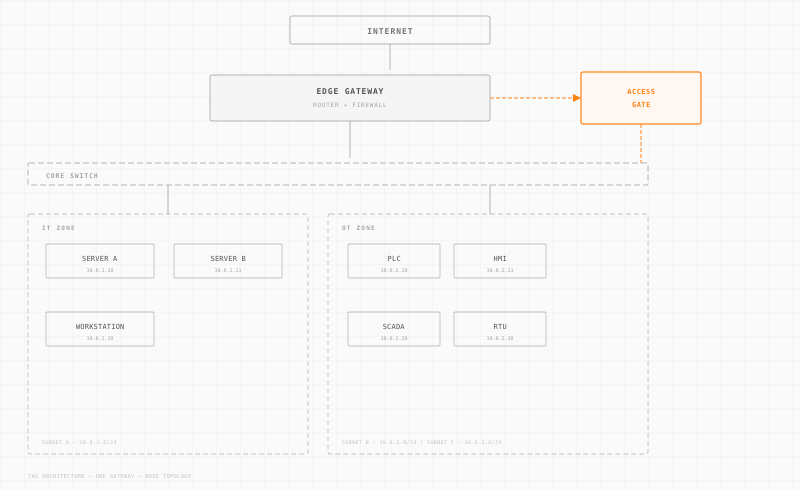
Identity and Access Management (IAM) refers to the comprehensive set of policies, technologies, and practices used to manage digital identities and regulate user access to systems and data. In the context of OT/IT cybersecurity, IAM is crucial for ensuring that only authorized individuals can access sensitive systems and information, thereby safeguarding critical infrastructure from unauthorized access and potential cyber threats.
Identity and Access Management in OT/IT Cybersecurity
In the realm of Operational Technology (OT) and Information Technology (IT) cybersecurity, IAM serves as a foundational component for implementing a Zero Trust security model. This model operates under the principle of "never trust, always verify," necessitating stringent control over who can access what resources and under what conditions. This is especially important in industrial, manufacturing, and critical environments where unauthorized access could lead to significant disruptions, safety hazards, and financial losses.
IAM in these contexts involves multiple layers:
- Identity Management: This layer focuses on creating, maintaining, and deleting user identities. It ensures that each individual accessing the network is uniquely identifiable and that their identity is authenticated before access is granted.
- Access Management: This aspect involves defining and enforcing access policies, ensuring that users have the appropriate levels of access based on their roles. It includes technologies like multi-factor authentication (MFA), single sign-on (SSO), and role-based access control (RBAC).
Importance in Industrial, Manufacturing, and Critical Environments
In environments like manufacturing plants, power grids, and other critical infrastructure, the stakes for cybersecurity are incredibly high. Unauthorized access can not only lead to data breaches but also physical damage to equipment and threats to human safety. IAM helps mitigate these risks by:
- Reducing Attack Surfaces: By ensuring that only necessary personnel have access to sensitive systems, IAM minimizes potential entry points for attackers.
- Enhancing Compliance: Regulations such as NIST SP 800-171, CMMC, and IEC 62443 mandate stringent access controls and identity verification as part of their compliance requirements. Implementing robust IAM solutions helps organizations align with these standards.
- Supporting Incident Response: Effective IAM systems provide detailed logs and audit trails that are invaluable during security incident investigations, helping identify how and when unauthorized access occurred.
Standards and Compliance
- NIST SP 800-171: Outlines requirements for protecting controlled unclassified information, emphasizing access controls as a critical component.
- CMMC: The Cybersecurity Maturity Model Certification integrates IAM as a key domain to ensure that defense contractors maintain robust cybersecurity practices.
- IEC 62443: A series of standards designed to secure industrial automation and control systems, which highlight access management as a critical factor for secure environments.
In Practice
Consider a manufacturing plant deploying an IAM system to manage access to its networked machines and equipment. By implementing role-based access control, the plant can ensure that operators have access only to the systems they need to perform their jobs, while administrative access is restricted to a smaller group of IT personnel. This not only improves security but also simplifies compliance with industry regulations.
Another example is the use of multi-factor authentication (MFA) in a utility company managing critical infrastructure. By requiring multiple forms of verification before granting access, the company significantly reduces the risk of unauthorized access, even if a user's credentials are compromised.