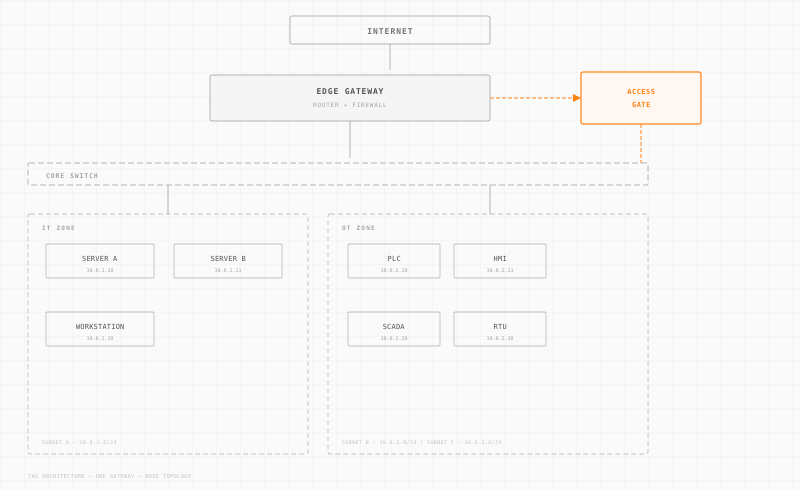
Zero Trust Security is a security model built on one rule: never trust, always verify. No user, device, or workload is trusted because of where it sits on the network. Every access request is authenticated, authorized against least-privilege policy, and re-checked continuously, whether it comes from the corporate LAN or the open internet.
What is Zero Trust Security?
The old model assumed a hard perimeter: get past the firewall and you were trusted. That assumption breaks the moment an attacker phishes a credential, a vendor laptop carries in malware, or a flat network lets a single compromised host reach everything. Zero Trust throws out implicit trust entirely. It treats the internal network as if it were already hostile and forces every connection to prove who it is and what it is allowed to reach. The term was popularized by Forrester analyst John Kindervag in 2010 and codified by NIST in Special Publication 800-207 in 2020.
How does Zero Trust work?
Four principles do the work:
- Continuous verification. Trust is never granted once and left alone. Each request is evaluated against current identity, device posture, and context.
- Least privilege. A user or device gets only the access its job requires, so a compromised account has a small blast radius. See least privilege.
- Microsegmentation. The network is split into small, identity-defined zones that stop lateral movement, which is the difference between one infected machine and a plant-wide outage. See network segmentation.
- Logging and monitoring. Every access attempt is recorded, so anomalies surface fast and audits have evidence.
Why does Zero Trust matter for OT?
Industrial and critical environments are where implicit trust hurts most. Plants run legacy PLCs and proprietary protocols that were built to trust anything on the wire and cannot authenticate a caller. They also cannot always be patched, and downtime is expensive or unsafe. Zero Trust fits that reality: instead of hardening each fragile device, you wrap it in identity-enforced access so only the right operator, from the right machine, through a controlled path, ever reaches it. That contains both external attackers and insider mistakes. It also lines up with the standards these operators answer to, NIST SP 800-171, CMMC, and IEC 62443, all of which lean on access control, segmentation, and continuous monitoring. The US Department of Defense went further with DTM 25-003, which extends its Zero Trust mandate to OT.
How is Zero Trust different from a VPN?
A VPN authenticates you once, then drops you onto the network with broad reach. Zero Trust authenticates continuously and grants access to specific resources, not the whole LAN. A VPN answers "are you allowed in?" Zero Trust answers "are you allowed to touch this exact thing, right now?" That is why teams now add Zero Trust access control on top of the VPN for remote and third-party access into sensitive environments.
How does Access Gate help?
Access Gate is an agent-free Zero Trust overlay for OT and IT. It enforces identity-based access control and microsegmentation across a flat network without ripping out switches or re-addressing devices, proxies remote and vendor sessions so they are logged and terminable, discovers assets, and forwards east-west traffic to your SIEM. It turns the principles above into something a plant can actually deploy. See Zero-trust access control.