Two-Factor Authentication (2FA) is a security mechanism that requires two distinct forms of identification to access systems or data, typically combining something the user knows (like a password) with something the user has (such as a smartphone or a hardware token). This extra layer of security helps protect sensitive information by making it more difficult for unauthorized users to gain access.
Understanding Two-Factor Authentication
In the context of OT/IT cybersecurity, two-factor authentication serves as a critical component for safeguarding networks in industrial, manufacturing, and critical infrastructure environments. Given the increasing complexity and interconnectivity of these systems, the traditional single-factor authentication (password only) is no longer sufficient to protect against sophisticated cyber threats. 2FA mitigates this risk by adding an additional verification step.
How 2FA Works
Two-factor authentication typically involves two of the following verification methods:
- Knowledge Factors: Something the user knows, such as a password or PIN.
- Possession Factors: Something the user has, such as a smartphone with an authentication app or a hardware token.
- Inherence Factors: Something the user is, typically a biometric verification such as a fingerprint or facial recognition.
In practice, a user might enter their password (knowledge factor) and then receive a one-time code on their smartphone (possession factor) to complete the login process.
Why It Matters
For Industrial and Critical Environments
In industrial and critical environments, unauthorized access to control systems can lead to severe consequences, including operational disruptions, safety risks, and financial losses. 2FA is essential in these settings because it:
- Reduces the risk of unauthorized access to sensitive systems and data.
- Protects against phishing attacks by ensuring that even if a password is compromised, the attacker cannot gain access without the second factor.
- Supports compliance with security standards such as NIST 800-171, CMMC, and IEC 62443, which often mandate or recommend multi-factor authentication as a best practice.
Regulatory Implications
Standards like CMMC (Cybersecurity Maturity Model Certification) explicitly require the implementation of multi-factor authentication for certain levels of certification. Similarly, NIST 800-171 provides guidelines for protecting controlled unclassified information in non-federal systems, emphasizing the importance of multi-factor authentication to bolster security.
In Practice
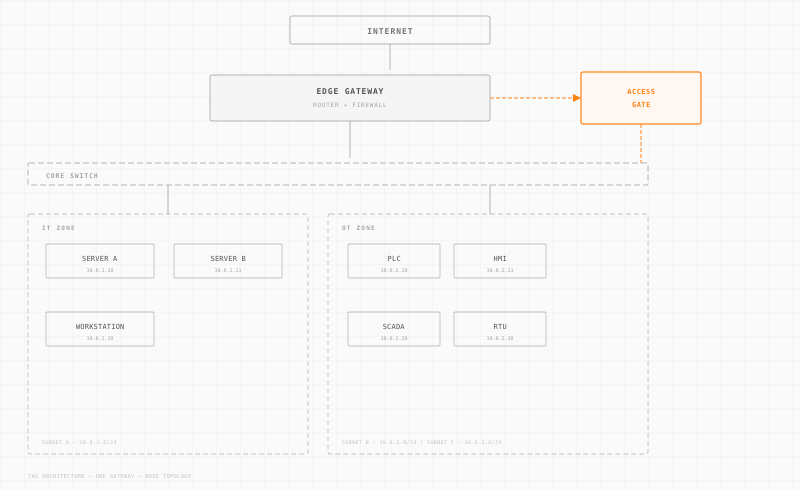
Consider a manufacturing facility with an OT network that controls the production line. If an attacker gains access to this network, they could potentially disrupt operations or cause physical harm. Implementing 2FA helps protect this network by ensuring that only authorized personnel can access critical systems, even if passwords are compromised.
For instance, an engineer might need to log into a control system to adjust settings. With 2FA, they would first enter their username and password, and then confirm their identity by entering a code sent to their mobile device. This two-step verification process significantly enhances security by ensuring that the person logging in is indeed who they claim to be.