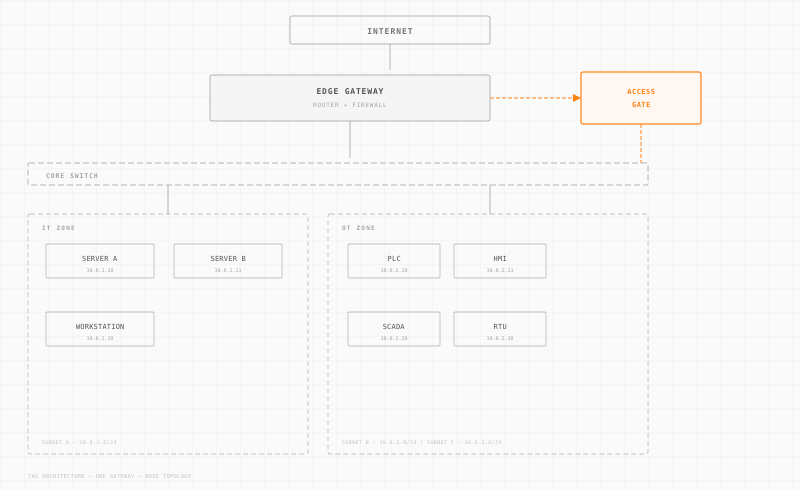
A secure access gateway is a control point that sits between users and the systems they need to reach. It authenticates every connection, checks it against policy, and brokers the session so no user ever talks to a protected asset directly. Along the way it usually adds encryption, traffic inspection, and full session logging, which makes it the enforcement and audit chokepoint for remote and cross-network access.
How does a secure access gateway work?
Instead of routing a user onto the target network, the gateway terminates their connection and opens a separate, controlled one to the resource on their behalf. That proxy pattern means the user's device never shares a broadcast domain with the protected system. Before brokering, the gateway verifies identity, often with multi-factor authentication, applies authorization rules tied to that identity, encrypts the traffic in transit, and records the session for audit. If a policy is violated mid-session, the connection can be cut.
How is it different from a VPN?
A VPN extends the network to the user: once connected, the device is on the LAN and can reach whatever routing and firewall rules allow, which is often far more than the job requires. A secure access gateway adds control behind that link. The user's connection ends at the gateway, and the gateway brokers one connection to one resource under an explicit policy. That is the difference between "trusted once you are inside" and zero trust, where every request is authenticated and least-privilege by default.
Why does it matter for OT and industrial environments?
Because OT is exactly where flat, trust-everything access does the most damage. Engineers, integrators, and vendors all need to reach SCADA systems and PLCs, and the usual answer, a shared VPN into a flat plant network, gives a compromised laptop a path straight to the control layer. Remote access has been the entry point in a string of OT incidents. A gateway forces those sessions through a single monitored, logged, revocable door, which is what an industrial DMZ and standards like IEC 62443 and NERC CIP are built around.
How does Access Gate help?
Access Gate is an agent-free secure access gateway for IT and OT. It proxies remote and vendor sessions so no one lands on the plant network, ties every connection to a verified identity with network-layer MFA, and logs each session with the ability to terminate it. It stands up software enclaves and an industrial DMZ around existing assets without replacing equipment or re-cabling, and forwards its audit trail to your SIEM. See Industrial DMZ Architecture.