Security configuration refers to the process of setting up system and network settings to align with security best practices, ensuring that vulnerabilities are minimized and systems are protected against unauthorized access. This involves a systematic approach to configuring software, hardware, and network settings to bolster defenses against potential cyber threats.
Understanding Security Configuration
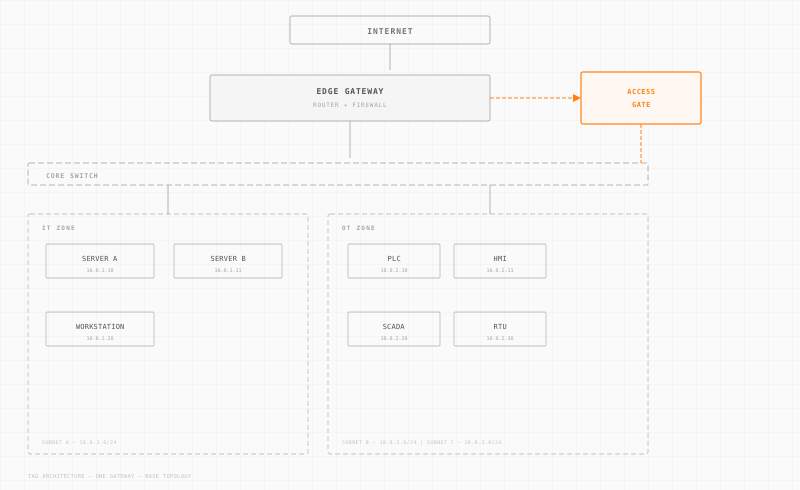
In the context of OT/IT cybersecurity, security configuration is a foundational practice that ensures all components within a network are configured to prevent exploitation by malicious actors. This includes adjusting settings on firewalls, routers, servers, and application software to close off unnecessary ports, disable unused services, and enforce strong authentication mechanisms.
Security configuration is not a one-time event but a continual process, as systems and threats evolve. This is especially critical in environments where both Operational Technology (OT) and Information Technology (IT) intersect, such as in industrial control systems, manufacturing processes, and critical infrastructure. The convergence of OT and IT increases the attack surface, making robust security configurations essential.
Importance in Industrial, Manufacturing & Critical Environments
Industrial and manufacturing environments, which often rely on legacy systems and proprietary protocols, face unique challenges in security configuration. These systems tend to prioritize availability and efficiency over security, making them attractive targets for cyber threats. Implementing a strong security configuration helps in safeguarding these environments against cyber incidents that could lead to operational disruptions, safety risks, or data breaches.
In critical infrastructure sectors, such as energy, water, and transportation, the repercussions of a security breach can be severe, affecting public safety and national security. Security configuration in these contexts involves adhering to stringent standards and guidelines, such as those outlined in NIST 800-171, CMMC, and IEC 62443. These standards provide a framework for securing sensitive information and ensuring systems are resilient against attacks.
Standards and Guidelines
- NIST 800-171: Provides guidelines for protecting controlled unclassified information in non-federal systems, emphasizing the need for a robust security configuration.
- CMMC (Cybersecurity Maturity Model Certification): Mandates security practices, including configuration management, for defense contractors to protect sensitive data.
- IEC 62443: A series of standards focusing on cybersecurity for industrial automation and control systems, highlighting the importance of secure configuration.
Why It Matters
A well-executed security configuration forms the backbone of a robust cybersecurity strategy. It helps prevent unauthorized access, data breaches, and other cyber incidents by ensuring that systems are not left with default or weak settings that can be easily exploited. For example, changing default passwords, disabling unnecessary services, and applying security patches are critical steps in the security configuration process.
In practice, this means that organizations must regularly review and update their security configurations to adapt to new vulnerabilities and technological changes. Automated tools and configuration management systems can assist in maintaining consistent and secure configurations across complex environments.
Related Concepts
- Hardening: The process of securing a system by reducing its surface of vulnerability.
- Patch Management: The practice of managing updates for software applications and technologies.
- Network Segmentation: Dividing a network into smaller parts to improve security and performance.
- Access Control: Methods to ensure that only authorized personnel can access certain systems or data.
- Intrusion Detection Systems (IDS): Tools used to detect unauthorized access or anomalies in network or system activities.