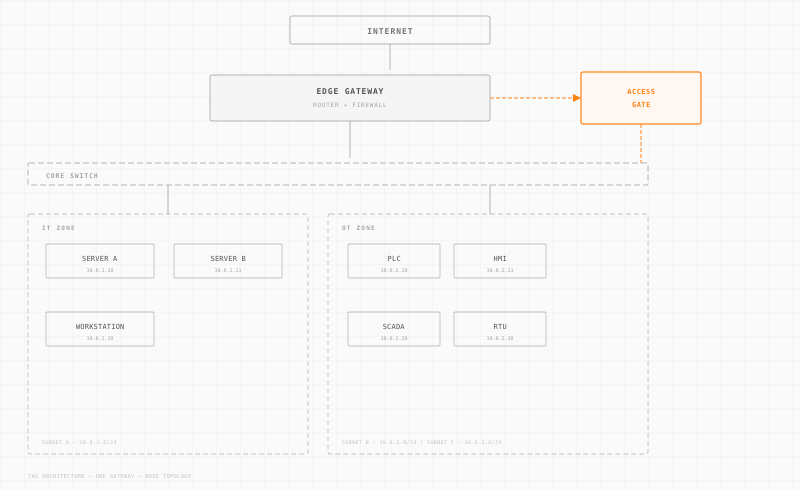
Zero Trust Network Access (ZTNA) grants access to individual applications or resources, per session, based on verified identity and device posture, rather than granting access to a network. It assumes no implicit trust inside or outside the perimeter and verifies every request. Built on a software-defined perimeter, ZTNA keeps protected resources invisible until a user or device proves it should reach them.
What is Zero Trust Network Access?
ZTNA is the access-control expression of zero trust, the model NIST codified in SP 800-207 and Gartner popularized under the ZTNA name. The operating principle is "never trust, always verify": every access request is treated as if it came from a hostile network, and authorization is decided from identity, device state, and context at the moment of the request.
The idea traces back to the collapse of the perimeter. Google's BeyondCorp work and the Cloud Security Alliance's software-defined perimeter both rejected the assumption that being inside the network means being trusted. ZTNA carries that into a product pattern: connect the right user to the right resource, and nothing else.
How does ZTNA work?
A ZTNA system sits between users and resources as a policy enforcement point. When a user or device requests access, the system authenticates the identity, usually with multi-factor authentication, checks device posture such as patch level and configuration, evaluates the request against policy, and then brokers a connection to just that one resource. The resource itself stays dark to everyone who has not been authorized, so it cannot be scanned or attacked by parties who never get that far.
Crucially, access is per session and continuously evaluated. A granted session does not become a standing tunnel into the network. If posture or context changes, authorization can be pulled. That is the sharp break from the model ZTNA is built to replace.
How is ZTNA different from a VPN?
A VPN authenticates a user once and then drops them onto a network segment with broad reach. Anything on that segment is potentially reachable, which is why a single stolen VPN credential has seeded so many breaches through lateral movement. ZTNA inverts it: no network-level access, only application-level access, scoped to what the user's role requires and re-checked continuously.
The practical wins in OT and industrial settings are concrete:
- Smaller attack surface. Users reach only the specific resources they are authorized for, not the whole subnet.
- Contained lateral movement. A compromised session cannot pivot across a flat network the way a VPN foothold can.
- Continuous verification. Identity and device posture are re-evaluated during the session, not trusted after login.
Who needs ZTNA?
Any organization where the old perimeter no longer holds, which by now is most of them: remote and third-party engineers, cloud and hybrid environments, and industrial sites where OT and IT increasingly touch. In manufacturing and critical infrastructure the stakes are physical, a compromised control system can halt production or endanger people, so restricting who can reach a controller, and how, is a safety control as much as a security one. ZTNA also aligns with the access-control and continuous-monitoring expectations in NIST SP 800-171 and CMMC.
Why does ZTNA matter for OT?
Legacy OT was never built to defend itself. Controllers speak unauthenticated protocols, cannot run agents, and cannot be patched on demand. Putting a ZTNA enforcement point in front of those assets means the network verifies identity and authorization before any traffic reaches the controller, so a reachable device is not an open one. Access to a remote engineering session becomes a scoped, logged, revocable event instead of a standing tunnel into the plant.
How Access Gate helps
Access Gate delivers ZTNA for OT and IT as an agent-free overlay: identity-based access to individual resources, microsegmentation across the LAN, and proxied, logged remote sessions over your existing VPN or 4G link, with no agents on legacy gear. See Zero-trust access control.