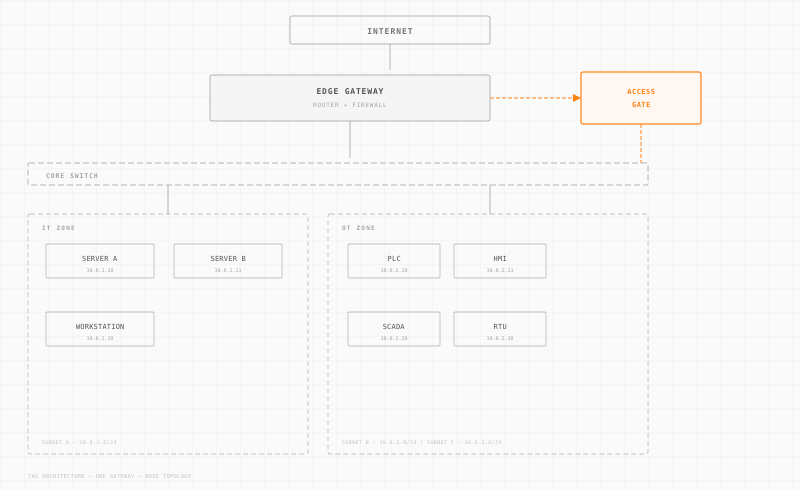
Critical Infrastructure Protection (CIP) is the practice of securing the essential systems and assets a society runs on, so that an attack, disaster, or failure in one of them does not cascade into a broader crisis. In the U.S., the government recognizes 16 critical infrastructure sectors, including energy, water, transportation, healthcare, and communications, under CISA, the Cybersecurity and Infrastructure Security Agency. When these systems go down, the impact is measured in blackouts and boil-water notices, not lost files.
What is critical infrastructure protection?
CIP is the mix of strategy, policy, and technical controls used to keep those systems available and safe. Most of the risk lives in operational technology: the control systems that run pumps, breakers, and turbines. Because those systems bridge the digital and physical worlds, protecting them is as much about preventing physical consequences as about defending data. The framing traces to Presidential Policy Directive 21, which set the sector model CISA works from today.
Why is critical infrastructure hard to secure?
Much of it was built before cybersecurity was a design consideration. Control systems installed decades ago run protocols with no authentication, on hardware that cannot be patched without a costly shutdown. Then IT and OT converged, connecting those fragile systems to corporate networks and the internet for efficiency, which widened the attack surface enormously. You end up defending 1990s equipment against 2020s threats, on networks that were never meant to touch each other. The IT/OT convergence that made operations smarter also made them reachable.
Why does CIP matter for OT and industrial environments?
The consequences are physical and public. Colonial Pipeline's 2021 ransomware shutdown disrupted fuel supply across the U.S. East Coast, even though the attack hit IT systems and the operator took OT offline as a precaution. The 2015 and 2016 attacks on Ukraine's grid cut power to hundreds of thousands of people. A compromise at a water treatment plant can threaten public health directly. In these sectors, a cyber event is a safety event, which is why CIP is treated as a national security matter, not an IT line item.
What standards and agencies govern CIP?
- CISA: coordinates U.S. critical infrastructure defense across all 16 sectors.
- NERC CIP: mandatory, audited standards for the North American bulk electric system.
- NIST SP 800-171 and CMMC: protect controlled information across the defense industrial base.
- IEC 62443: the international standard for securing industrial automation and control systems.
How is CIP different from NERC CIP?
They share three letters and cause endless confusion. Critical Infrastructure Protection is the broad discipline of securing all essential sectors. NERC CIP is a specific, enforceable set of standards that applies only to the North American power grid, with audits and per-day penalties. Every NERC CIP requirement is CIP, but most CIP work happens in sectors NERC does not touch.
How Access Gate helps
The recurring obstacle in CIP is that you cannot rip out and replace legacy control systems, so you have to protect them where they sit. Access Gate does that as an agent-free overlay: it builds software security perimeters around vulnerable OT without re-cabling or re-addressing the plant, microsegments the network so an intrusion cannot spread across sites, proxies and logs remote and vendor access, and forwards east-west traffic to your SIEM. That gives operators the segmentation, access control, and monitoring that CIP demands, on equipment that was never built to provide it.