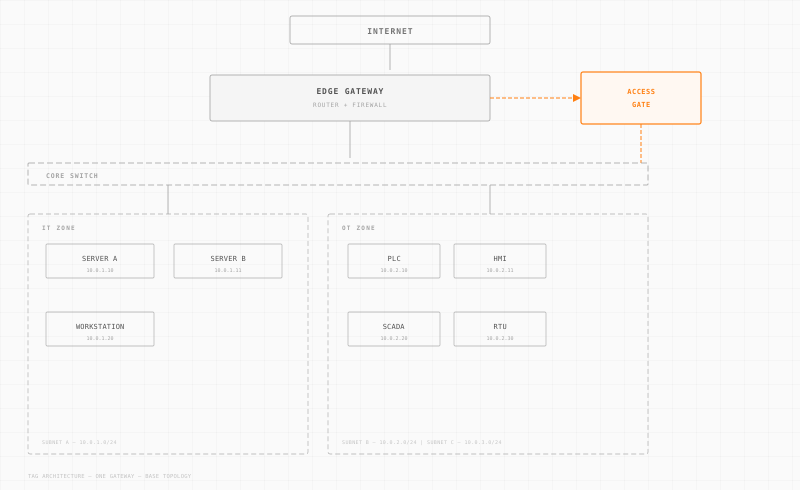
NERC CIP (North American Electric Reliability Corporation Critical Infrastructure Protection) is the set of mandatory cybersecurity standards that operators of the North American bulk electric system have to meet. It is not a framework you adopt by choice. NERC enforces it through audits, and violations carry financial penalties assessed per day, per violation.
The standards tell a utility what to protect, how to wall it off, and what evidence to keep. That last part is where most audits are won or lost.
What does NERC CIP cover?
Each standard owns one domain. These are the ones a utility gets measured on most often:
- CIP-002 (asset categorization): identify every BES Cyber System and rate it high, medium, or low impact. Everything downstream depends on getting this list right.
- CIP-005 (electronic security perimeter): define a boundary around those systems and force all Interactive Remote Access through an Intermediate System, a monitored access point that terminates the session before it reaches the asset, and be able to disable an active vendor session (R2.4/R2.5).
- CIP-007 (systems security): ports and services, patching, malware prevention, authentication, and security event logging.
- CIP-010 (configuration and change management): hold a known baseline, detect deviations, and run periodic vulnerability assessments.
- CIP-013 (supply chain): manage the cyber risk that vendors and their software bring in.
Two newer obligations reshaped the 2026 audit cycle: CIP-003-9 extended vendor remote access controls to low-impact systems (effective April 1, 2026), and CIP-015 now requires internal network security monitoring inside the perimeter for high- and medium-impact systems.
Who has to comply?
Any entity registered with NERC that operates BES Cyber Systems: generation owners and operators, transmission owners, and the municipal utilities and cooperatives that used to sit outside the strictest requirements. CIP-003-9 pulled a lot of the smaller low-impact utilities into scope for the first time, and many did not expect it.
How is NERC CIP different from CMMC or NIS2?
They protect different things. NERC CIP protects grid reliability for electric utilities. CMMC protects Controlled Unclassified Information across the defense supply chain. NIS2 is the European directive for essential and important entities. The controls rhyme (access control, segmentation, logging, supply chain), but NERC CIP is a continuous compliance obligation with recurring audits and per-day penalties, not a one-time certification.
Why NERC CIP is hard on real grids
The requirements are clear on paper. The pain is scale. A transmission operator runs protective relays across hundreds of substations, and classic CIP-005 wants an electronic security perimeter at each one, built from firewalls and access lists that every change has to document under CIP-010. A generation facility has to wrap its distributed control system in a perimeter and route every vendor and engineering session through a logged access point. Doing that with traditional inline gear, site by site, is where budgets and change windows disappear.
How Access Gate helps
Access Gate is the CIP-005 Intermediate System that Interactive Remote Access must route through, defined in software as an identity-enforced overlay around BES Cyber Systems, so you don't re-cable or re-address the substation to stand one up. Every vendor and remote session is proxied, recorded, and terminable on demand, which is what CIP-003-9, CIP-013, and the R2.4/R2.5 vendor-session requirements ask for. It runs on-premise with no cloud dependency, so no BES traffic or audit data leaves your environment, and the same overlay sees east-west traffic inside the perimeter for CIP-015. See Power grid security for the full picture.