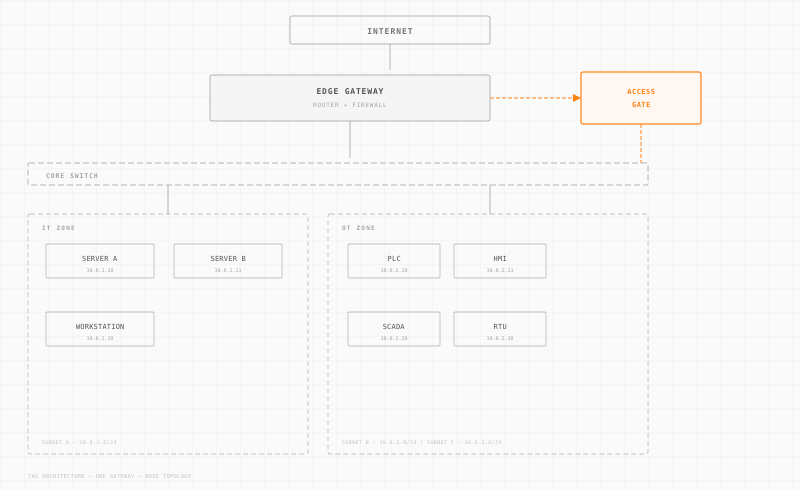
Intrusion Prevention System (IPS) is a network security technology designed to monitor network traffic for suspicious activities and policy violations, actively taking steps to block or mitigate threats. It serves as an active defense mechanism, reacting in real-time to prevent potential intrusions into a network or system.
Understanding Intrusion Prevention Systems
An Intrusion Prevention System (IPS) is a critical component in the cybersecurity toolkit, particularly within the OT/IT environments of industrial and manufacturing sectors. Unlike an Intrusion Detection System (IDS), which only alerts administrators of potential threats, an IPS takes proactive measures to block or quarantine malicious traffic. This capability is crucial in environments where uninterrupted operations are essential, and the risk of cyber threats can have significant consequences.
IPS devices are typically deployed inline with network traffic, inspecting packets as they flow through the system. They use a variety of techniques such as signature-based detection, anomaly-based detection, and stateful protocol analysis to identify malicious behavior. Once a threat is identified, the IPS can drop malicious packets, block offending IP addresses, or reset connections to prevent the threat from propagating further.
Importance in Industrial and Critical Environments
For industrial, manufacturing, and critical infrastructure environments, maintaining network integrity and security is of utmost importance. These sectors rely heavily on both Operational Technology (OT) and Information Technology (IT) systems, which often have different security requirements yet are increasingly interconnected. An IPS can bridge the gap between these systems by providing a unified security posture that identifies and mitigates threats across the entire network spectrum.
Compliance and Standards
IPS solutions are often aligned with industry standards and compliance requirements such as NIST 800-171, CMMC, and IEC 62443. For example, NIST 800-171 requires organizations to protect controlled unclassified information (CUI) by implementing security requirements such as monitoring and controlling communications at external boundaries. An IPS can fulfill these requirements by providing automated, real-time threat prevention capabilities.
Similarly, the Cybersecurity Maturity Model Certification (CMMC) mandates certain levels of cybersecurity practices for defense contractors, where an IPS can be integral to achieving compliance by ensuring threats are actively blocked.
Practical Examples
Consider a manufacturing plant where the IT network is connected to OT systems that control machinery and production lines. An IPS deployed in such an environment can prevent cyber threats from disrupting operations by immediately blocking malware or unauthorized access attempts. For instance, if a known ransomware signature is detected, the IPS can stop it before it reaches critical OT systems, thereby averting potential downtime and financial losses.
In another example, within a power plant, an IPS can protect against threats targeting SCADA systems, ensuring that any anomalies or attacks are swiftly mitigated before they can impact energy production.
Why It Matters
The proactive nature of an Intrusion Prevention System makes it an indispensable tool in the cybersecurity frameworks of industrial and critical sectors. By actively blocking threats, IPSs not only protect sensitive data and maintain operational continuity but also support compliance with stringent regulatory requirements. As cyber threats become more sophisticated, the need for robust, automated defenses like IPSs becomes increasingly vital.
Related Concepts
- Intrusion Detection System (IDS): A passive system that monitors network traffic for suspicious activities and sends alerts to administrators.
- Firewall: A network security device that monitors and controls incoming and outgoing network traffic based on predetermined security rules.
- Network Segmentation: The practice of dividing a network into smaller, isolated sections for improved security and performance.
- Zero Trust Architecture: A security model that requires strict verification for every user and device attempting to access network resources.
- SCADA Security: Protecting Supervisory Control and Data Acquisition systems, which are critical for industrial control processes, from cyber threats.