The least privilege principle says every user, device, service, and process should have exactly the access it needs to do its job, and no more. Strip away standing permissions nobody uses, and a stolen credential or a compromised machine can only reach a fraction of your environment instead of all of it. It is one of the oldest ideas in security and still one of the most violated.
What is the principle of least privilege?
At its core it is a default of "no" that you selectively open. Instead of granting broad access and hoping nobody abuses it, you grant narrow access tied to a specific role or task, and you take it back when the task ends. The principle applies to people (an operator who only touches the control system they run), to machines (a historian that can read a PLC but never write to it), and to software (a service account scoped to one database). Least privilege is also a founding assumption of zero trust architecture, which treats every request as untrusted until it is verified.
How does least privilege work in practice?
Three mechanisms do most of the work:
- Role-Based Access Control (RBAC): users inherit permissions from a role, so access maps to job function instead of being handed out one person at a time. See role-based access control.
- Access Control Lists (ACLs): granular rules that say which users or systems can reach a specific resource.
- Identity and Access Management (IAM): the system that ties identities to entitlements and enforces them across the estate. See identity and access management.
The hard part is not turning access on. It is finding and removing the standing access that accumulated over years of "just give them admin so the ticket closes."
Why does least privilege matter for OT?
In a plant, over-broad access is dangerous in a physical way. A flat network where an operator laptop can reach every PLC means one phishing hit can move machinery, not just leak files. OT also runs on shared logins, vendor accounts with permanent access, and jump boxes that see everything, all of which are the opposite of least privilege. Enforcing it here directly limits how far a supply chain compromise or an insider can travel before it hits something that matters.
How is least privilege different from zero trust?
Least privilege is a principle: grant the minimum. Zero trust is an architecture that operationalizes it: verify identity on every request, assume the network is hostile, and never grant implicit trust based on location. You can state least privilege on a whiteboard. Zero trust is how you actually enforce it at scale, with continuous verification instead of a one-time gate at the perimeter.
How Access Gate helps
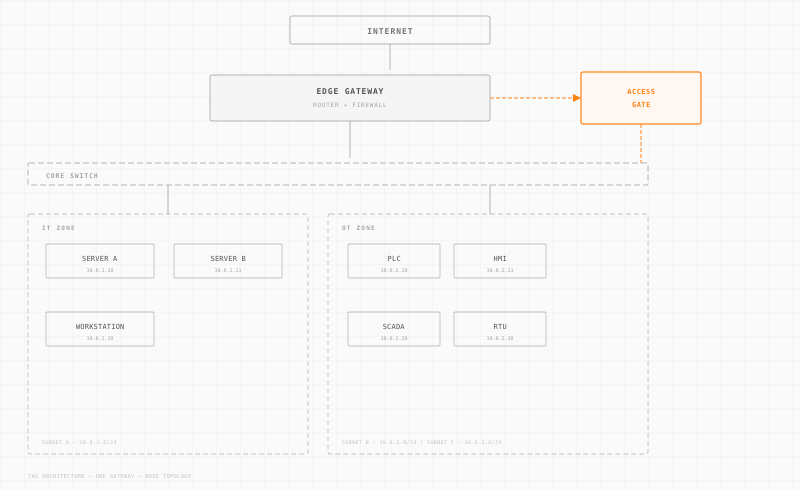
Access Gate enforces least privilege at the network layer without agents on the OT devices. Access is identity-based and deny-by-default: a user or vendor is granted a path to the specific asset they need for the task, and nothing else on the LAN is reachable. Microsegmentation turns a flat network into isolated zones, remote sessions are proxied and time-boxed instead of standing open, and every grant is logged and forwarded to your SIEM. The result is least privilege that holds even on legacy gear that has no access controls of its own. Standards that require it, including NIST SP 800-171, CMMC, and IEC 62443, all map to the same enforcement.