Role-Based Access Control (RBAC) is a method of restricting system access by assigning permissions to roles and then assigning users to those roles. A user gets access because of the job they do, not because someone granted them a permission by hand. It was formalized by NIST in the 1990s and is now the default access model in most enterprise and industrial systems.
How does RBAC work?
RBAC has three moving parts: roles, permissions, and assignments. You define roles that match real job functions (operator, maintenance technician, controls engineer), attach a set of permissions to each role, then assign people to roles. When someone changes jobs, you move them to a different role instead of editing dozens of individual grants. When an auditor asks who can reach a system, you answer with a role definition instead of a spreadsheet of exceptions. It pairs naturally with the least privilege principle: each role carries only the access its function requires, and nothing more.
Why does RBAC matter in OT and industrial environments?
On a plant floor the roles map to real safety and uptime boundaries. In a manufacturing facility, controls engineers need to change PLC logic, operators need to run the line but not reprogram it, and maintenance staff need diagnostic access to specific machines. Collapsing those into a single shared login, which is still common in OT, means any compromised credential reaches everything. RBAC draws the lines so a phished operator account cannot push new ladder logic to a controller, and a compromised vendor account cannot wander outside the cell it was scoped to.
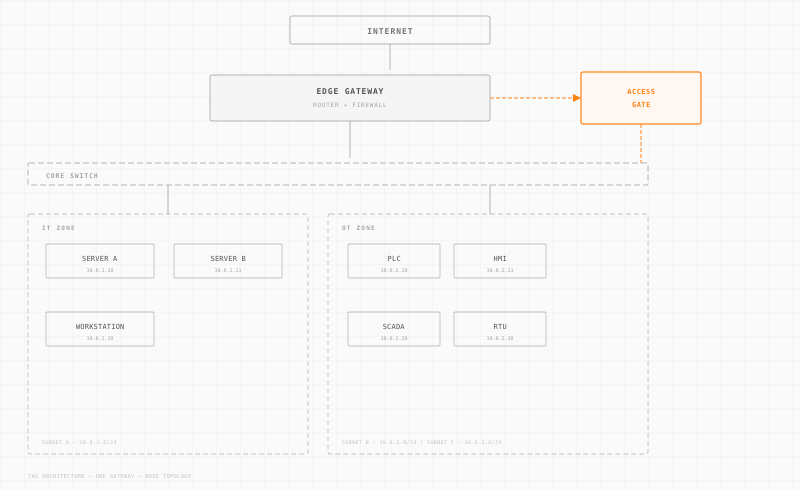
The hard part in OT is that many devices have no native concept of a user. A legacy PLC authenticates a connection, not a person. That is why RBAC in industrial networks is increasingly enforced at the network layer, where a gateway maps an identity to a role and only then permits the flow to the device.
How is RBAC different from ABAC and ACLs?
An access control list binds permissions directly to a resource: this user or this IP can reach this device. It works but does not scale, because every change touches the resource. RBAC adds the role as a layer of indirection, so policy lives in one place. Attribute-based access control (ABAC) goes further and decides access from attributes evaluated at request time (device posture, time of day, location), which is more expressive but harder to reason about. Most real deployments use RBAC as the backbone and add a few attribute conditions on top.
Which standards require RBAC?
RBAC shows up across the frameworks that govern industrial and defense environments. NIST SP 800-171 Access Control family expects permissions tied to authorized functions. CMMC Level 2 inherits those controls. IEC 62443 calls for role-based authorization within zones. None name a single product, but all point at the same model: access decided by role, granted least-privilege, and auditable.
How Access Gate helps
Access Gate enforces role-based policy at the network layer, so even OT assets that have no user model of their own inherit RBAC. It maps an authenticated identity to a role, permits only the flows that role allows, and logs every session, which is how a flat industrial LAN gets least-privilege access without touching the endpoints. See Zero-Trust Access Control.