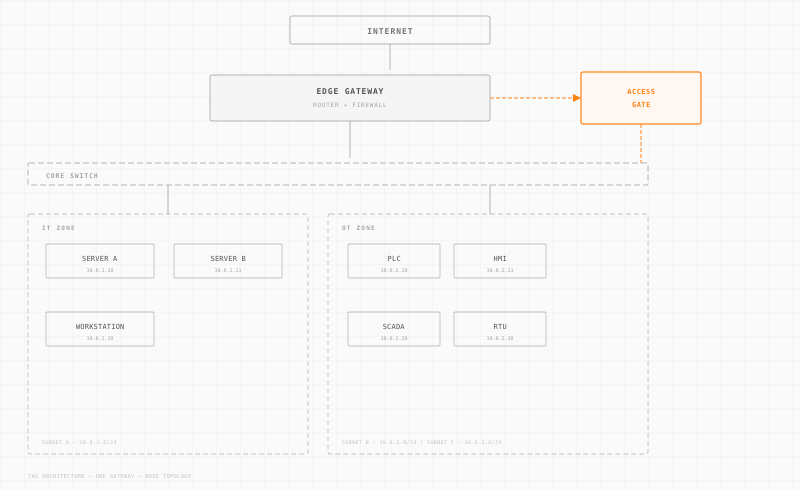
Remote Desktop Protocol (RDP) is a proprietary protocol developed by Microsoft that allows users to connect and control a remote computer or server over a network. It facilitates remote access to a desktop environment, enabling users to interact with remote systems as if they were physically present at the machine.
Understanding RDP in the Context of OT/IT Cybersecurity
In operational technology (OT) and information technology (IT) environments, RDP is an essential tool for remote administration and support. It enables system administrators and technicians to manage devices across a network without needing to be physically present, which is particularly valuable in industrial, manufacturing, and critical infrastructure settings. These environments often span large geographical areas or involve highly secure facilities where physical access is restricted.
RDP functions by transmitting the graphical interface of a remote machine to the user’s local device while sending input commands back to the remote system. This interaction is facilitated through the Transmission Control Protocol (TCP) and sometimes the User Datagram Protocol (UDP) to improve performance.
Security Considerations
While RDP provides significant convenience, its use poses several security risks, especially in OT/IT environments. Unsecured RDP connections are a common target for cyberattacks, including brute-force attacks, man-in-the-middle attacks, and ransomware. To mitigate these risks, it is imperative to implement robust security measures such as:
- Network Level Authentication (NLA): Requires users to authenticate before establishing a session, adding an extra layer of security.
- Strong Password Policies: Enforcing complex passwords and regular updates to reduce the risk of unauthorized access.
- Multi-Factor Authentication (MFA): Adding an additional verification step beyond just a password.
- Encryption: Utilizing Transport Layer Security (TLS) to encrypt data transmitted via RDP.
- Limiting Access: Restricting RDP access to specific IP addresses and using virtual private networks (VPNs) for secure connections.
Why It Matters
For industrial, manufacturing, and critical environments, the secure use of RDP is crucial due to the sensitive nature of the infrastructure and operations involved. Unauthorized access could lead to operational disruptions, data breaches, or even physical damage to machinery and equipment.
Compliance with relevant standards such as NIST 800-171 and CMMC requires organizations to secure remote access methods, including RDP. These standards emphasize the importance of protecting Controlled Unclassified Information (CUI), ensuring network security, and maintaining the integrity of critical infrastructure systems.
In Practice
For example, a manufacturing plant may use RDP to allow IT technicians to troubleshoot and maintain OT systems remotely, minimizing downtime and increasing operational efficiency. Implementing security measures like those mentioned ensures that this remote access does not compromise the plant’s cybersecurity posture.
In another scenario, a utility company might use RDP for remote monitoring and control of critical infrastructure, such as power grids or water treatment facilities. Here, securing RDP connections is paramount to prevent potential disruptions or malicious activities.
Related Concepts
- Virtual Private Network (VPN)
- Network Level Authentication (NLA)
- Multi-Factor Authentication (MFA)
- Transport Layer Security (TLS)
- Brute-Force Attack